A Detailed Guide to Making and Caring for Five-Needle Pine Bonsai
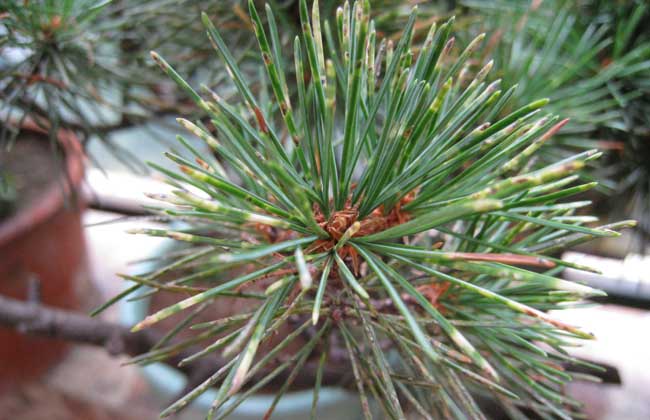
The five-needle pine gets its name from its needles growing in clusters of five. It is an evergreen coniferous tree of the genus Pinus in the family Pinaceae, native to Japan. It has a long history of introduction and cultivation in China and is widely grown in various regions, mainly distributed in the middle and lower reaches of the Yangtze River, the eastern and southern parts of the southern warm-temperate deciduous broad-leaved forest region, and the northern subtropical deciduous and evergreen broad-leaved mixed forest region. Let us take a look at how to make and care for five-needle pine bonsai!
How to Make Five-Needle Pine Bonsai
1. Choosing a pot: Making five-needle pine bonsai starts with choosing a good pot. The five-needle pine has an elegant, antique appearance with lush green needles in all four seasons, so it is best to use a purple clay (zisha) pot with a simple, antique shape and a deep, subdued color. For large five-needle pine bonsai, pots carved from white alum stone or marble may also be used, but care must be taken to drill holes in the bottom of the pot and fill them with sand to allow drainage.
2. Choosing soil: The potting soil for five-needle pine should be loose, fertile, slightly acidic sandy loam, preferably mountain soil or leaf mold, mixed with 40% sand and a small amount of bone meal. With ample nutrients and good drainage and aeration, it favors the growth and development of the root system.
3. Potting: Planting five-needle pine is most suitable from February to March before bud break, which favors the sprouting of new roots. Planting after autumn is also acceptable. When transplanting, it is best to keep the original soil ball around the roots to help it survive.
Note: When potting a five-needle pine, care should be taken to prune damaged and rotten roots and to properly shorten thick roots that interfere with potting, and to coat the cut surfaces with wax or paint to prevent pine resin from leaking out. The bottom of the pot must be cushioned with several pieces of broken tile or charcoal to leave space, and tall cylindrical pots and deep pots especially must be cushioned so as to leave gaps for aeration and drainage.
Five-Needle Pine Bonsai Care Techniques
1. Placement: The five-needle pine is a neutral plant and can grow in both sunny and fairly shady spots, but it should be cared for in a place with ample sunlight and good air circulation.
2. Bud pinching: Five-needle pine bonsai should have its buds pinched in time. When the winter buds begin to swell and granular needle primordia appear on them, 1/2 to 2/3 of the bud length can be pinched off to encourage the new shoots to become shorter and denser.
3. Watering: Watering five-needle pine bonsai must be done in moderation. As the gardening saying goes, “pines dry, cypresses wet”, which shows that the five-needle pine prefers dry conditions. In summer, when temperatures are high and the potting soil dries easily, water once in the morning and once in the evening; the morning watering must be thorough, while the evening watering should depend on how dry or moist the potting soil is. During showers, cover it promptly to keep off the rain, so that nutrients in the soil are not washed away.
4. Fertilizing: Fertilizing is the key to growing good five-needle pine bonsai and can be combined with watering. In July and August, when the weather is hot, apply a 10% dilute fertilizer solution once every half month. In addition, note that after fertilizing, the five-needle pine should be shaded and must not be exposed to the scorching sun.
5. Pruning: For five-needle pine bonsai that have already been styled, shaping and pruning must be carried out every year to maintain their established form. However, pruning of the five-needle pine should be done during its winter dormant period and must never be done in the height of summer, otherwise the wounds will exude large amounts of pine resin and affect the growth of the five-needle pine.
Precautions for Caring for Five-Needle Pine Bonsai
1. Never water five-needle pine bonsai too frequently. In June, when there is more rain, the potting soil is often too wet, and combined with poor drainage and water accumulating in the pot, this causes a lack of oxygen in the soil, resulting in root rot and yellowing needles.
2. In the hot summer, water evaporates quickly, and if watering is insufficient, the needles will scorch and wither; if the plant continues to lack water, it will eventually die.
3. If the five-needle pine is kept indoors for a long time with insufficient light and air, going against its habit of receiving light outdoors, or if it is suddenly moved outdoors and exposed to the blazing sun, the same problems described above can also occur.
Summary: The five-needle pine is a tree species with high ornamental value and a well-proportioned form. It is suitable both for accent planting in gardens and as an important tree species for potted plants or bonsai. When making bonsai, its tree form must be maintained and the growth of branches and needles controlled to achieve a shape with short, small, dense and vigorous branches and needles.