How to grow Isuzu jade seeds? Detailed sowing method
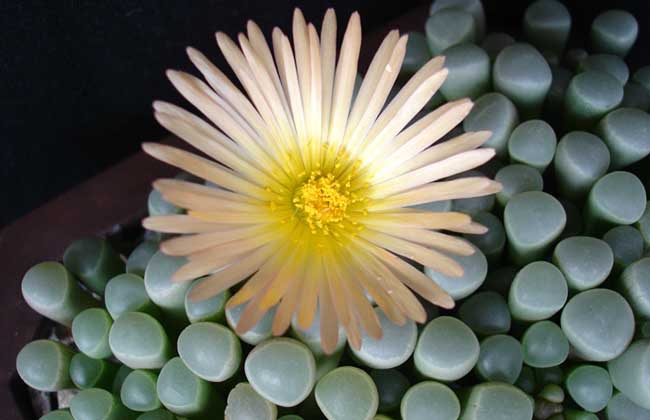
Isuzu jade is a succulent plant of the genus Fenestraria in the family Aizoaceae, with the scientific name Orange-yellow Fenestraria. It is native to South Africa and Namibia, and can now be cultivated in many places around the world. Its plant shape is peculiar and its flowers are beautiful, making it an excellent small indoor potted plant. Its propagation methods mainly include sowing and division. Now let us take a look at how to grow Isuzu jade seeds!
Sowing time
Because artificial temperature control is now very easy, there are no special requirements for timing. Generally speaking, around April in spring, or before October in autumn, depending on the temperature control for sowing, with 10-25°C being optimal.
Sowing medium ⟧7⟧For sowing Isuzu jade, a loose, breathable soil with good water retention should be used. The simplest soil mix is 1 part akadama, 1 part vermiculite, and 1 part coarse sand. Under normal circumstances, pure sand or soilless growing media should not be used, because after the seedlings sprout the plants are very small, and without nutrients their growth will be poor.
For sowing Fenestraria rhopalophylla (indow plant), use loose, airy soil with good water retention. The simplest soil mix is 1 part akadama, 1 part vermiculite, and 1 part coarse sand. Generally, pure sand or soilless growing media should not be used, because after the seedlings sprout the plants are very small, and without nutrients they will grow poorly.
Soil disinfection
Before sowing, the soil must be disinfected in advance. The most primitive high-temperature boiling method for disinfection is the simplest and most economical disinfection method for ordinary sowing enthusiasts, and its disinfection and sterilization effect is also very ideal. The boiling time can be controlled at 30 minutes. After high-temperature disinfection, harmful pathogens and insect eggs are basically killed.
Sowing method
Fold the prepared white paper in half from the middle, pour the seeds onto the white paper. Most succulent seeds are very small, so this step is very important. Be sure to spread the seeds out into a long line. Then fold the white paper slightly, and gently flick the back of the white paper with your hand so that the seeds are scattered onto the soil as evenly as possible.
Top dressing and covering with soil
It seems that after sowing succulents, covering with soil is not necessary, but gently sprinkling a thin layer of soil and slightly pressing the seeds can be more beneficial for the seedlings to take root. Note that it is only a thin layer. About 1-2 mm is enough. After sowing, you can use a small spray bottle to gently spray a little water, the kind with a very fine mist.
Post-sowing management
After sowing is completed, attention should be paid to keeping warm and moist. When the daytime temperature is high, a small corner can be opened for ventilation, and in the afternoon it should be covered tightly again to maintain the air humidity of the small environment. Sowing is generally carried out on sunny days, and it is best not to sow during rainy weather. If continuous rainy weather occurs after sowing, germination will be delayed. After sowing, place the seedling pot in a place with scattered light, preferably outdoors, which can increase the temperature difference and help the seedlings emerge uniformly. Although seeds can germinate well without sunlight, the seedlings that emerge are relatively weak and harder to manage later. Placing the seedling pot in direct sunlight always seems to result in uneven emergence, so I choose to raise seedlings in a scattered-light environment, which feels more ideal.