How to grow Fenestraria rhopalophylla (window plant) well? A detailed guide to care methods
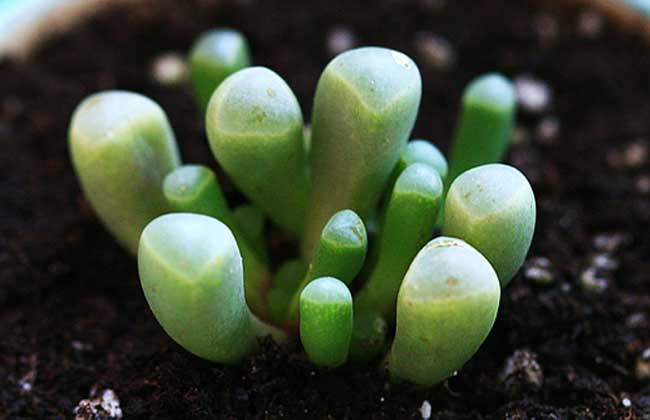
Fenestraria rhopalophylla, whose scientific name is Fenestraria rhopalophylla (orange-yellow club-leaved flower), is a succulent of the genus Fenestraria in the family Aizoaceae (ice plant family). Its place of origin is South Africa and Namibia, and it can now be cultivated in many places around the world. It forms clusters very easily and spreads quickly, and it has a peculiar plant shape and beautiful flowers. It is an excellent small indoor potted plant with extremely high ornamental value. Let us take a look below at how to care for Fenestraria rhopalophylla properly!
Growth habits of Fenestraria rhopalophylla
The Fenestraria rhopalophylla plant is very fleshy, densely clustered, with a clump diameter of 10 cm, and very fine roots. The fleshy leaves are club-shaped and grow almost vertically, but when there is insufficient light they lie horizontally and are arranged loosely. The leaves are pale green, slightly red at the base, and the leaf tips have transparent “windows”. It likes plenty of sunlight and is drought-tolerant. It can be watered appropriately during the growing season, watering should be restricted in summer, and in winter if 10°C or above cannot be maintained, watering should also be stopped. The planting pot should be small.
Propagation methods of Fenestraria rhopalophylla
1. Sowing: sow in spring from April to May. Because the seeds are very small, indoor pot sowing is generally used. After sowing, there is no need to cover with soil, otherwise it will not germinate. When the potting soil is dry, the soak-pot method should be used for watering. Do not water directly, so as not to wash away the seeds. The sowing temperature is 15-25°C, and germination occurs about half a month after sowing. After the seedlings emerge, let the young seedlings gradually receive light. The seedlings are only the size of soybean seeds, grow slowly, and management must be careful. Generally, after they appear, water once every 3-5 days. Seed-grown plants need 2-3 years to bloom.
2. Division: in spring each year, Fenestraria rhopalophylla grows new fleshy leaves from the gap in the middle, splitting the old leaves apart, and the old leaves also shrink and die. The new leaves grow rapidly, and by summer they again shrink and split open, and from the gap 2-3 small new plants grow out. The young plants can simply be divided and replanted.
How to grow and care for Fenestraria rhopalophylla
1. Light: Fenestraria rhopalophylla likes light, but it cannot be placed in the sun for long periods. Autumn, winter, and spring are the growing seasons. Place Fenestraria rhopalophylla on an indoor balcony facing south and ensure 3-4 hours of light each day, while ensuring sufficient scattered light the rest of the time. This can prevent the leaves from being scorched, and at the same time keep the leaves of Fenestraria rhopalophylla compact, tender, and attractive.
2. Watering: if you are not clear about the watering method at first, you can use the soak-pot method for watering. Supply water from the bottom of the pot, and the water level should not exceed 2/3 of the flower pot; about 15 seconds is enough. However, the soak-pot watering method should not be used often, once a month is fine. There are also requirements for watering time. When the leaf surface wilts and wrinkled skin appears, water promptly, and after 6 hours the leaves will gradually recover. Record the time when the leaves become wrinkled, and next time water slightly earlier to avoid this phenomenon.
3. Fertilizing: fertilizing should be done together with watering. Melt granular fertilizer in water, or mix in liquid fertilizer, and pour it directly. Note that fertilizer should be applied lightly and frequently, and do not apply a large amount of fertilizer all at once. Fertilizing 5-6 times a year is enough. The specific timing can be determined according to the plant's growth.
Daily care for Fenestraria rhopalophylla
1. In summer, do not water from above. During continuous stuffy heat, use the soak-pot method as much as possible. A ceramic pot can be soaked through, but for pots with poor air permeability it is best to soak only halfway. Avoid spraying water on the plant unless necessary.
2. Do not let Fenestraria rhopalophylla get rained on. If stuffy heat or the early stage of heavy rain occurs, because the air humidity is very high, it is best not to give water.
3. Sun exposure for 5 hours a day is enough. Do not avoid sunlight; in fact, it is even hotter in a greenhouse. If it does not get sunlight, first, the color will not look good, and second, the plant will not be strong. Air, sunlight, and water are the three essential elements for plant growth.
4. In winter in the north, if there is heating at home, water can be given at the appropriate time.
5. When wrinkles appear on the leaves, water after another 2-3 days. The place where the plant is usually placed is best mainly well ventilated.