A Detailed Guide to the Cultivation Methods and Precautions for Schefflera arboricola
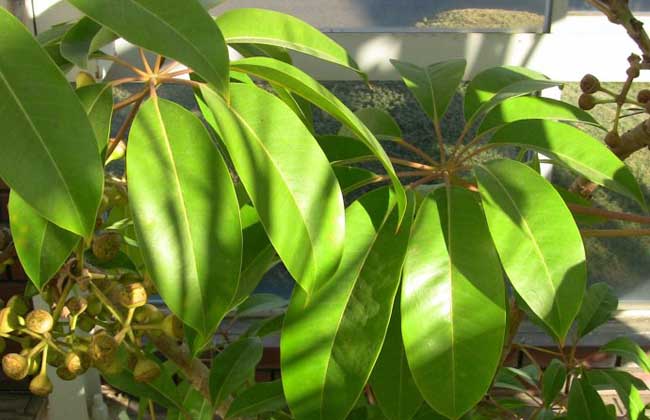
The scientific name of Schefflera arboricola is Schefflera arboricola (Dragon Claw Leaf), also known as Dragon Claw Tree, Large Schefflera, and Heptapleurum, among others. It is a large climbing plant in the family Araliaceae and genus Schefflera. It starts as an upright shrub or small tree, then branches and climbs to become a large liana. Its greenish-white flowers, palmate compound leaves, and spherical berries present a fine form under artificial cultivation, and it gives off a strong fragrance. Let us take a look below at the cultivation methods and precautions for Schefflera arboricola!
Propagation Methods for Schefflera arboricola
Schefflera arboricola grows in forests, clinging to other trees. It is distributed in southern Yunnan, and also in India, Bangladesh, Myanmar, Vietnam, Laos, and Cambodia. It can be propagated by leaf cuttings or stem cuttings, and leaf and stem cuttings are also done in spring. Cut 8-10 cm of one-year-old branches, remove the lower leaves, and insert them into a bed soil made of river sand or vermiculite, keeping them warm and moist. At 25°C, they root in 4-6 weeks.
Cultivation Methods for Schefflera arboricola
1. Temperature: Schefflera arboricola is suitable for growing in a high-temperature, high-humidity environment, and the soil can be easily draining or sandy culture soil. Seedlings are generally cultivated by sowing or cuttings. The ideal seedling temperature is 20-28°C, with a maximum not exceeding 30°C and a minimum not below 12°C, because too low a growing temperature will cause its leaves to drop and affect its ornamental value. Therefore, in winter when the temperature is below 5°C, cold protection and insulation must be carried out.
2. Light: Schefflera arboricola needs sufficient light, but in summer it must not be exposed to strong light for long periods, otherwise yellowing and leaf drop will occur. Therefore, appropriate shading should be carried out in spring and summer. In autumn and winter, the light is not strong, so some methods of increasing light can be used.
3. Fertilizer and water: Spring and autumn are not periods of extreme weather, and the soil can be dry or wet. Winter is cold and dry, growth is relatively slow, and the soil is generally rather dry. Summer is very hot, requiring constant watering to lower the temperature and replenish moisture, so moist soil is dominant. Since April to October is its vigorous growth period, fertilizer can be applied about once every 15 days.
4. Diseases: Schefflera arboricola is prone to anthracnose and leaf spot disease, and in terms of pests it is also susceptible to damage from leaf miners, red spiders, scale insects, thrips, and others, so prevention and control need to be strengthened, and some pesticides should be sprayed when necessary.
Precautions for Cultivating Schefflera arboricola
1. Soil: For cultivating Schefflera arboricola, peat soil can be used; leaf mold soil with a little base fertilizer or sandy soil can also be used for cultivation, ensuring that the soil has good air permeability and drainage.
2. Temperature: The general growing temperature for Schefflera arboricola is 15-25°C. Below 5°C it will drop leaves, so attention should be paid to ventilation at ordinary times.
3. Light: Schefflera arboricola is a semi-shade plant, and four hours of direct sunlight per day is enough. It cannot be exposed to the blazing sun.
4. Watering: In spring, summer, and autumn, Schefflera arboricola is generally watered about once every 3-4 days, but do not water too much, because water accumulation will cause root rot, while the soil must still be kept moist. Watering should be reduced in winter, and the water temperature is best close to that of the soil.
5. Fertilizing: Schefflera arboricola is mainly fertilized with a mixed fertilizer of nitrogen, phosphorus, and potassium. If it is a variegated variety, too much nitrogen fertilizer and weak light will make the patches on the leaves less obvious.
6. Pruning: Schefflera arboricola generally does not need pruning. If leaves drop and the lower branches are relatively bare, the upper part can be cut off to promote the sprouting of new branches. The cut-off parts can also be re-planted as cuttings.