What plant is the hooker's lips? Introducing this unusual flower
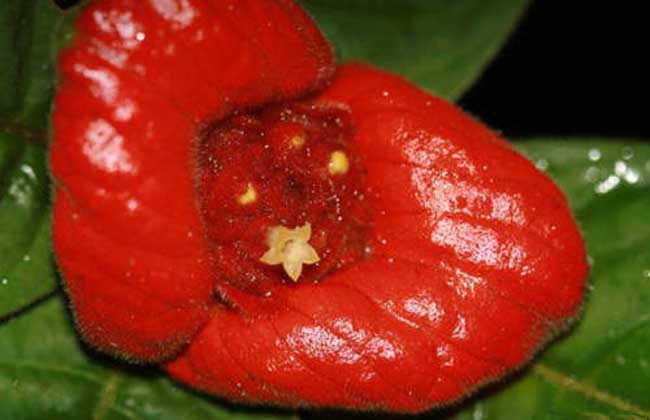
The hooker's lips gets its name because its shape closely resembles sexy, alluring lips. Also known as Ilata nine-joint and Hooker's lip flower, it is a shrub or small tree in the genus Psychotria of the family Rubiaceae. This plant is bright red and strangely shaped, making people marvel at nature's uncanny workmanship. It grows in the tropical rainforests of some countries in Central and South America.
The hooker's lips has opposite leaves, with stipules inside the petioles, often fused, with entire apices, and persistent. The flowers are small, bisexual, and white in color. They form terminal, corymb-like cymes, without an involucre, with bracts. The calyx tube is short, the calyx limb has 4 to 6 lobes, and the calyx lobes fall off. The corolla is funnel-shaped, the corolla tube is straight, the throat is hairless, and the corolla has 5 lobes arranged in valvate fashion. The stamens are equal in number to the corolla lobes, inserted at the throat or mouth of the corolla, with short filaments, and anthers dorsifixed near the base.
The hooker's lips has a 2-locular ovary, and the style is hairless, erect at the base. The drupe is small, sometimes twinned, smooth or with longitudinal ridges. There are 2 seeds, shaped like the small pyrenes, convex on the back, with longitudinal ridges, a thin seed coat, fleshy endosperm, a small basal embryo, flat cotyledons, and a cylindrical radicle, inferior. The red part shaped like lips is not a true petal, but the bract of the flower. The flowering period is from December to March.
The hooker's lips grows in the tropical rainforests of some countries in Central and South America, such as Colombia, Costa Rica, Panama, Ecuador, and others. This plant is bright red and strangely shaped, appearing as if it has been technically processed; however, it can be said with certainty that its alluring lips are natural, not technically processed.
The hooker's lips evolved this shape to attract pollinating insects such as hummingbirds and butterflies. Because of its brilliant color, people vividly call it Hooker's lips. It usually grows in broad-leaved forests, hillside forests, and tropical forest scrub at altitudes of 350 to 1300 m. However, due to uncontrolled deforestation in these countries, this plant is on the verge of extinction.