What are the care methods for a small-leaf red sandalwood bonsai?
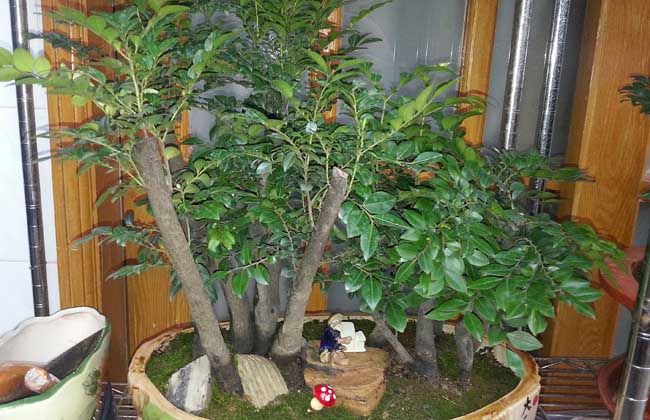
Small-leaf red sandalwood, also known as sandalwood red sandalwood, Indian small-leaf red sandalwood, etc., is a plant in the genus Pterocarpus of the Fabaceae family. Its notable characteristics are high density and small pores, and its wood is very stable and not prone to deformation or cracking. It is mostly found in tropical and subtropical virgin forests, with the best quality coming from the Mysore region of India and Myanmar. Now let us take a look at how to care for a small-leaf red sandalwood bonsai!
Light management
Many potted plants we like to place in rooms or in front of desks, without direct sunlight. For sun-loving plants, this is like a person who cannot eat, and they will slowly “starve” to death. Small-leaf red sandalwood bonsai should be placed on a balcony with ample sunlight to ensure the bonsai gets enough sunlight.
Watering at the right time
Small-leaf red sandalwood is a tropical plant and has relatively high water requirements. It is not drought-tolerant, so it should be watered once every two or three days. Watering also requires skill; it is not enough to just pour a basin of water on it. Watering cannot be done at noon when the sunlight is strongest, as this easily causes the plant to evaporate water vapor at high temperature, and doing it too many times will cause the plant to wither and die. When watering, water thoroughly, and do not only wet the soil surface.
Reasonable fertilization
Small-leaf red sandalwood itself has parasitic root nodules with nitrogen-fixing ability, so it does not need frequent fertilization. Once every one or two months, drip plant nutrient solution into water, mix it evenly, and pour it onto the soil. For potted plants, fertilization should not involve burying nutrient soil into the soil, especially after the plant has grown stably and the roots have penetrated deep into the soil. Large-scale soil disturbance will damage the plant roots, and burying a large amount of nutrient soil may burn the roots because the soil is too fertile, causing damage to the plant root system.
Fixed placement
Small-leaf red sandalwood bonsai itself also has the ability to adapt to the environment. Once the small-leaf red sandalwood bonsai has become accustomed to an environment, do not move it frequently, so as not to increase the growth burden on the small-leaf red sandalwood.
Pest control
Small-leaf red sandalwood bonsai is prone to anthracnose and black spot disease (leaves fade and then turn black) at the seedling stage and in young trees. It can be controlled with 1:100 Bordeaux mixture or 50% carbendazim 1000-fold solution. For leaf-eating pests such as flea beetles and scarab beetles, trichlorfon can be used for control.