The flower language, symbolism and legends of the daylily
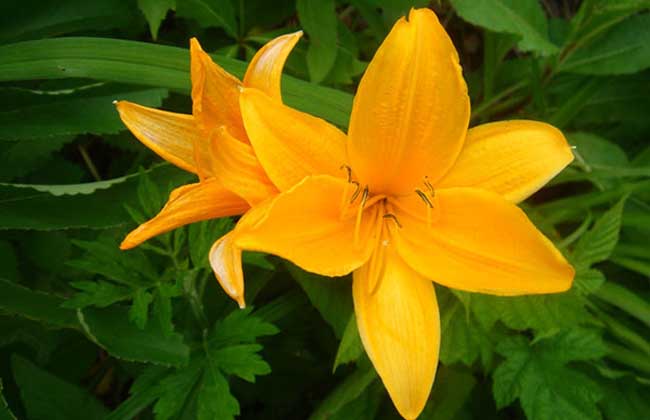
The daylily, whose scientific name is Hemerocallis citrina, also known as xuancao, golden needle vegetable, and xuancao flower, is a perennial herbaceous plant of the genus Hemerocallis in the Liliaceae family. It has short rhizomes and thick, spindle-shaped fleshy roots. In gardens it is mostly planted in clumps or in flower borders and along roadsides. It is cultivated throughout northern and southern China, and Quxian County in Sichuan is known as the "Hometown of Chinese Daylily." Now let us take a look at the flower language and legends of the daylily!
Common names of the daylily
What people often call the daylily is actually the golden needle vegetable, and the daylily has a great many common names. The usual ones include golden needle, golden needle vegetable, yinan grass, worry-healing, deer arrow, tiger lily, golden needle vegetable, xuancao flower, brain-boosting vegetable, calming vegetable, green scallion flower, deer scallion, Sichuan grass flower, wangyu, and danji. According to the Bencao Zhu, "Xuancao is sweet in taste, makes people happy, and lets them forget their worries." And according to the Book of Songs, in ancient times a woman, because her husband had gone on a distant campaign, planted xuancao at home to relieve her sorrow and forget her worries, and from then on people called it "the daylily."
The flower language of the daylily
1. Flower language one: The daylily is China's mother flower, and its flower language is loving your mother forever, great maternal love, and a kind mother.
2. Flower language two: Xuancao is also called yinan, and legend says that in ancient times a woman who wore yinan would bear a boy, symbolizing many sons and much blessing.
3. Flower language three: The daylily represents forgetting love, forgetting all unhappy things, and letting go of sorrow.
The legend of the daylily
It is said that before the Daze Township Uprising, Chen Sheng's family was extremely poor. Because there was no rice in the house to put in the pot, he had to go out and beg for a living. Added to his lack of nutrition, he developed generalized edema and could hardly bear the swelling and pain.
One day, Chen Sheng begged his way to the home of a mother and daughter surnamed Huang. Old Mrs. Huang was soft-hearted. Seeing Chen Sheng's pitiful appearance, she let him into the house and steamed three big bowls of xuancao flowers for him to eat. To Chen Sheng at that time, the xuancao flowers that could relieve his hunger and cold were so sweet and delicious that they were no less than delicacies from the mountains and seas. He wolfed them down, and in no time all three big bowls of xuancao flowers were in his belly. A few days later, the swelling all over his body subsided. Chen Sheng was very grateful to the Huang mother and daughter and said he would repay them in the future.
After the Daze Township Uprising, when Chen Sheng proclaimed himself king, he did not forget the Huang mother and daughter. To thank them for their kindness, he invited them into the palace. Every day he set out wine and held banquets, yet those countless fine dishes and delicacies could not stir Chen Sheng's appetite. Suddenly, Chen Sheng remembered the delicious taste of the xuancao flowers from those years before, and asked Old Mrs. Huang to steam another bowl for him to eat.
Old Mrs. Huang picked some more xuancao flowers and steamed them herself to give to Chen Sheng. Chen Sheng picked up the bowl, tasted just one mouthful, and found it hard to swallow. He kept saying, "What is going on? The taste is not as good as it was back then. This is too strange." Old Mrs. Huang said, "There is really nothing strange about it. It is truly that when you are hungry, xuancao is fragrant, and when you are used to wine and meat, xuancao is bitter!" These words shamed Chen Sheng so much that he fell to his knees and bowed again and again. Old Mrs. Huang repeatedly said, "You must not, you must not," and hurriedly helped Chen Sheng up.
From then on, Chen Sheng kept the Huang mother and daughter in the palace to specially cultivate xuancao and often ate it. At the same time, he gave xuancao two other names, one being "daylily" and the other being "golden needle vegetable." Because Old Mrs. Huang's daughter was named Jinzhen, and the leaves of xuancao are shaped like needles, people also called it "golden needle vegetable." Once the news spread, people used xuancao roots one after another to treat edema, and later it was discovered by physicians and, after repeated use, became a commonly used Chinese medicine.