What plant is the man-eating flower? A full analysis of its facts and legends
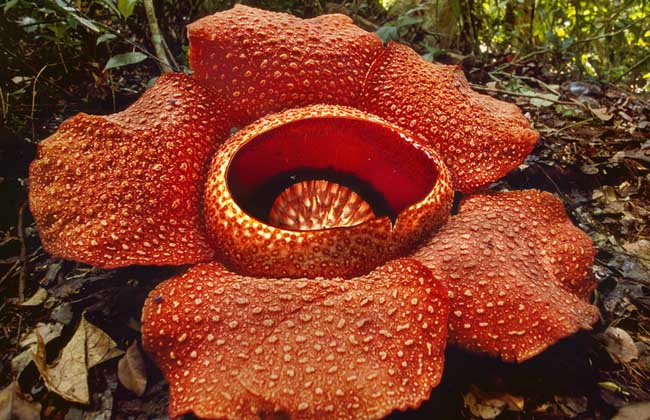
The man-eating flower grows in the primeval forests and swampy areas along the Amazon River in the Americas. It is very gorgeous in appearance, with a flower shape resembling a sun disk, a diameter of up to 1.5 m, petals about 1.4 cm thick, 5 petals per flower, and leaves 30 to 40 cm long. It relies on flies to pollinate it and lives by absorbing nutrients from other plants. Let us take a look below at the facts and legends of the man-eating flower!
Facts about the man-eating flower
The man-eating flower is a mysterious plant with some animal-like habits. It must swallow at least ten living lives before it can produce one flower, and only one in ten, that is, among ten flowers, only after being continuously nourished by living creatures can it set a small green fruit. However, according to local people, May to October each year is its main growing season. When it first emerges from the ground, it is only about the size of a table tennis ball. After several months of slow growth, the bud changes from the size of a table tennis ball to the size of a cabbage. Then the 5 fleshy petals slowly open, and by the time the flower is fully blooming, two days and two nights have already passed.
Reproduction of the man-eating flower
It is hard to believe that the huge flower the man-eating flower has worked so hard to produce can only last 4 to 5 days, and it is said that during these 4 to 5 days the flower continuously releases a peculiar stench, so that large animals naturally avoid it, while some insects attracted to foul odors come to pollinate it and act as matchmakers. When the petals wither, they turn into a pile of decayed black matter. Before long the fruit also ripens, hiding within it many tiny seeds, ready at any time to fall into the ground and seek a suitable place to germinate.
Legends of the man-eating flower
In recent years, many newspapers and magazines have continuously published reports about man-eating plants. Some said they were in the primeval forests of the Amazon River basin in South America, and others said they were on the island of Java in Indonesia. Although these reports described in detail the morphology, habits and locations of various different man-eating plants, it is very regrettable that in all the reports, no one produced direct evidence about man-eating plants——photos or specimens, nor did anyone accurately point out which family or genus the plant belonged to. For this reason, many botanists became doubtful about whether man-eating plants actually exist.
The earliest news tracing man-eating plants came from some explorers in the latter half of the 19th century. Among them, a German named Karl Leach said after returning from an expedition: “On the island of Madagascar in Africa, I saw with my own eyes a kind of tree that could eat people. The local residents revered it as a sacred tree. Once, a native woman, because she violated the tribe's commandments, was driven to climb the sacred tree. As a result, the 8 leaves with hard thorns on the tree wrapped her tightly, and a few days later, when the leaves opened again, only a pile of white bones remained.” Thus, terrifying rumors that man-eating plants existed in the world spread in all directions.
These rumored reports left botanists extremely puzzled. For this reason, in 1971 a group of South American scientists organized an expedition and made a special trip to Madagascar to investigate. They conducted an extensive search in areas where man-eating trees were rumored to exist, but as a result they did not find this terrifying plant. Instead, they saw there many pitcher plants that can eat insects and some nettle-type plants whose stinging hairs can cause sharp pain. The results of this investigation made scholars even more doubtful about the reality of the existence of man-eating plants.
In 1979, a British authority who spent his whole life studying carnivorous plants, Adrian Slack, said in his newly published monograph "Carnivorous Plants": So far, no formal record or report about man-eating plants has been found in academic circles. Even the famous monumental botanical work "Die natürlichen Pflanzenfamilien", edited by the German Engler, and the worldwide "Dictionary of Flowering Plants and Ferns" contain no description of man-eating trees at all.
In addition, the famous British biologist Wallace, in his celebrated work "The Malay Archipelago", written after he traveled throughout the South Sea islands, recorded many rare tropical plants of the South Seas, but he never mentioned man-eating plants either. Therefore, the vast majority of botanists tend to believe that perhaps no such kind of plant capable of eating people exists in the world.
Since botanists have not confirmed it, why did claims about man-eating plants appear? Adrian Slack and some other scholars believe that the most likely explanation is that they arose from imagination and exaggeration based on the insect-catching characteristics of carnivorous plants, and of course they may also have been misreported from certain unverified legends. According to current information, it is already known that on Earth there truly exists a kind of plant with unique behavior, the carnivorous plants, also called insectivorous plants. They are distributed in countries around the world, with more than 500 species in total. Among the most famous are the Sarracenia, the pitcher plant, and the bladderwort that catches underwater insects.