What kind of tree is the Bodhi tree exactly?
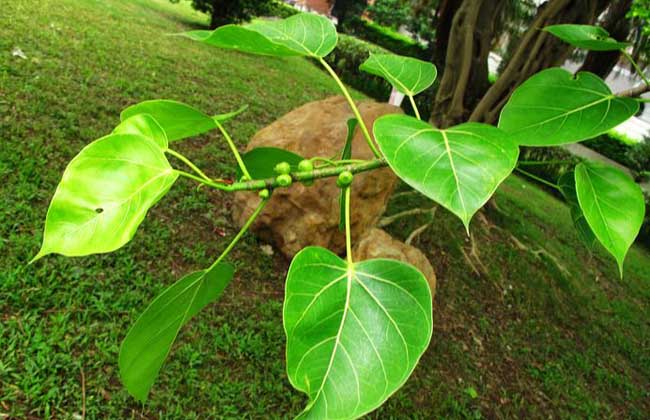
The Bodhi tree is a large tree of the genus Ficus in the tribe Ficeae of the family Moraceae, also known as the thinking tree. Legend has it that more than 2,000 years ago, the Buddha Shakyamuni attained enlightenment under the Bodhi tree. In India, whether Hinduism, Buddhism or Jainism, all regard the Bodhi tree as a “sacred tree,” and the government even grants the Bodhi tree “national treasure” level protection. With the spread of Buddhism to China, the Bodhi tree has also had a profound influence in China.
When young, the Bodhi tree grows as an epiphyte on other trees, reaching 15-25 m in height with a diameter at breast height of 30-50 cm. The bark is gray, smooth or slightly longitudinally striated, and the crown spreads widely. The branchlets are grayish brown and sparsely pubescent when young. The leaves are leathery, triangular-ovate, dark green and glossy on the upper surface, green beneath, with an abruptly acute apex extended into a tail-like point, a broadly truncate to shallowly cordate base, entire or wavy margins, three basal veins, and 5-7 pairs of lateral veins. The petiole is slender, jointed, equal to or longer than the leaf blade. The stipules are small, ovate, with an acute apex.
The figs are spherical to oblate, 1-1.5 cm in diameter, red and smooth when ripe. There are 3 basal bracts, ovate, and the peduncle is about 4-9 mm long. Male flowers, gall flowers and female flowers grow on the inner wall of the same fig. Male flowers are few, born near the mouth, sessile, with a 2-3-lobed perianth, involute, 1 stamen, and short filaments. Gall flowers are stalked, with a 3-4-lobed perianth, a smooth spherical ovary, a short style, and an enlarged 2-lobed stigma. Female flowers are sessile, with 4 perianth segments, broadly lanceolate, a smooth spherical ovary, a slender style, and a narrow stigma. The flowering period is March to April, and the fruiting period is May to June.
The Bodhi tree likes light, high temperatures and high humidity. It grows rapidly at 25°C, requires a winter temperature of around 12°C, is not tolerant of frost, has strong pollution resistance, and is not demanding about soil, but prefers fertile, loose, slightly acidic sandy loam. Young forests grow rapidly in tropical regions (areas with sufficient water). In China, it is mostly cultivated in Guangdong, Guangxi and Yunnan. It is also distributed in Japan, Malaysia, Thailand, Vietnam, Bhutan, Sikkim, Nepal, Pakistan and India, mostly as cultivated plants, but it grows wild in the Himalayan region from Rawalpindi in Pakistan to Bhutan.
The Bodhi tree has moderate resistance to sulfur dioxide and chlorine gas, and strong resistance to hydrofluoric acid. It is suitable as a greening tree species for polluted areas and is an excellent ornamental tree species, suitable for courtyard and roadside greening. The milky sap flowing from the branches and trunk can be used to extract hard rubber. The branches and leaves can be used as feed for elephants, cattle and other livestock. The heartwood and sapwood of the wood are not clearly distinguished, making it suitable for cutting boards, packing box boards and fiberboard raw materials. Moreover, the Bodhi tree is a traditional Chinese medicine for treating asthma, diabetes, diarrhea, epilepsy, stomach diseases and more, and it also has significant effects against cancer, cardiovascular diseases, neuroinflammatory diseases, neuropsychiatric diseases and parasitic infections.
In India, every Buddhist temple is required to plant at least one Bodhi tree, and great attention is paid to the “bloodline” of the Bodhi tree, with the direct descendants of the sacred Bodhi tree under which the Buddha attained sudden enlightenment held in the highest esteem. According to Hindu belief, the Bodhi tree is an incarnation of Vishnu, one of the three principal gods of Hinduism, and therefore has particularly important religious significance. Hinduism also holds that the Bodhi tree is where the gods live: Vishnu and his wife, the goddess Lakshmi, reside in the Bodhi tree on the dark night of the first day of each month. Vishnu lives in the roots, Lakshmi lives in the trunk, Narayana lives in the branches, King Hari lives in the leaves, and all the gods live in the fruit of the Bodhi tree.
With the spread of Buddhism to China, the Bodhi tree has also had a profound influence in China. In the early years of the Tang Dynasty, the monk Shenxiu and his senior fellow disciple Huineng conversed, and he wrote the verse “The body is a Bodhi tree, the mind is like a bright mirror stand. Polish it diligently at all times, and let no dust be stirred.” After reading it, Huineng wrote in reply, “Bodhi is fundamentally no tree, nor is the bright mirror a stand. Originally there is not a single thing, so where could dust be stirred?” This exchange between the two fellow disciples, using objects to express meaning and borrowing things to discuss the Way, spread widely and greatly enhanced the fame of the Bodhi tree.