Detailed Guide to Making and Caring for Apple Bonsai
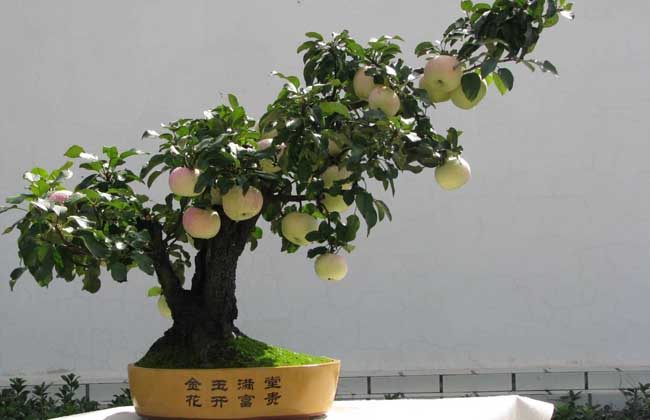
Apple bonsai, as the name suggests, is the practice of cultivating apples in bonsai form for people to admire, offering extremely high ornamental value. Moreover, apple bonsai takes the sound of "ping" from "apple," symbolizing peace and safety. It can be enjoyed visually and eaten as well, refreshing to the eye and sweet and crisp to the taste, truly an excellent gift. Let us now take a look at apple bonsai making and care!
Variety Selection
When selecting materials for apple bonsai, one should choose varieties with characteristics such as dwarfed tree body, thick roots, short branches, small leaves, large and brightly colored fruit, late ripening period, easy flower formation and early fruiting, high fruit-setting rate and self-pollination fertility rate, and strong disease resistance and ability to adapt to potted environments.
Pot Selection and Soil Mixing
For apple bonsai, choose clay pots, wooden buckets or wooden boxes with a diameter of 40 cm, a bottom diameter of 35 cm, and a height of 30 cm with drainage holes. The nutrient soil formula is 6 parts fertile mature soil, 2 parts river sand, 1 part decomposed sheep manure, and 1 part rotted leaves and horse hoof fermented fertilizer. Mix evenly in proportion and sift.
Timely Potting
Select seedlings that are robust, with plump buds and free from pest and disease damage, and pot them in early to mid-April. When planting, soak the roots in 5-degree lime sulfur mixture for disinfection, and cut off necrotic roots. First place a small amount of nutrient soil into the bottom of the pot, put in the seedling, spread the root system evenly, firm the soil, and water promptly to ensure survival.
Fertilizer and Water Management
For apple bonsai, apply 0.2% quick-acting nitrogen fertilizer once before and after budding. Starting from May, apply liquid fertilizer once about every 10 days, mainly 200-times-diluted organic cake fertilizer, supplemented by 0.2% inorganic liquid fertilizers such as urea, diammonium phosphate, and ammonium sulfate. During the fruit enlargement period, carry out foliar fertilization, spraying 0.3-0.5% urea and 3-5% wood ash extract. During the vigorous growth of autumn shoots and when the fruit is approaching maturity, apply 200-times-diluted organic liquid fertilizer once every half month. When new shoots stop growing and the fruit ripens, according to the plant's growth condition, apply fertilizer once about every 10 days, mainly 200-times-diluted organic liquid fertilizer, combined with 0.2% inorganic nitrogen fertilizer. The soil should be watered thoroughly after drying out. During the budding period, flowering period, and fruit enlargement period, replenish water promptly. In June, to promote flower bud differentiation, appropriately control water. In the rainy season of July-August, water less.
Shaping and Pruning
To control the canopy of apple bonsai, start from 1-year-old seedlings. The trunk height should preferably be equivalent to the pot height or twice the pot height. Use a coiling-style branch-pulling method to suppress growth vigor and promote branching. You can also pinch the top of 1-year-old seedlings at the desired height to strengthen the trunk and encourage new branches. For new branches, train the tree shape by pulling branches. For water sprouts and competing branches, twist the shoots between the 5th and 7th leaves of the branch, which can effectively control tree height, prevent excessive growth, and promote flower bud formation. For vigorously growing water sprouts and competing branches, make full use of them by combining branch pulling with shoot twisting, top pinching, scoring, and ring-barking, which can cultivate a large number of fruiting branches and promote flower bud formation, achieving the goal of early fruiting and abundant fruiting.
Pest and Disease Control
Because potted apples are managed carefully, with good ventilation and light transmission, they grow robustly and have fewer pests and diseases. Once pests or diseases occur, promptly remove diseased branches, leaves, and fruits, scrape off diseased spots, and manually capture pests. When pests and diseases are severe, spray fungicides such as carbendazim, thiophanate-methyl, and chlorothalonil 1-2 times after flower drop to control fruit and leaf diseases. In April-May, spray insecticides mainly based on pyrethroids 2 times to control pests such as aphids and leaf rollers. In June-July, spray insecticides and acaricides such as fenpropathrin and hexythiazox 1-2 times to control red spiders and peach fruit borers. In July-August, spray fungicides such as carbendazim, thiophanate-methyl, and Bordeaux mixture to control early defoliation disease, ring rot, and anthracnose.
Repotting and Soil Replacement
For potted apples, in order to apply fertilizer, prune roots, improve nutritional conditions, and make the tree grow strong, repot before winter dormancy or before spring germination each year, replacing the old soil with newly prepared cultivation soil (containing applied organic fertilizer and pesticides to eliminate underground pests). When repotting and replacing soil, first use a bamboo strip to go around the inner wall of the pot, then invert the pot, hold the apple plant and soil ball with your hand, and let it tip out under gravity. Then use a sharp knife to cut off the old soil and root system 3-4 cm thick from the outer periphery of the soil ball, then place it into a new pot filled with cultivation soil, fill new cultivation soil around it and firm it, and water thoroughly.
Flower and Fruit Management
1. Artificial pollination: To ensure the fruit-setting rate of potted apples, 2-3 days before apple flowering, collect flowers from pollinator varieties in orchards with similar phenological periods to obtain pollen. At the early full-bloom stage of potted apples, carry out artificial pollination on the morning of the day the flowers open. During the flowering period, spray 0.25% borax to increase the fruit-setting rate.
2. Timely bagging: After physiological fruit drop, to improve fruit quality and prevent pests and diseases from damaging the fruit, bag the fruit. Remove the fruit bags 15-30 days before the fruit ripens to allow the fruit to color.
3. Coloring and character pasting: Potted apples have the characteristic of being convenient to manage. In the later stage of fruit growth, rotate the pot to allow the fruit to color evenly. Remove the fruit bags 15-30 days before maturity, and paste characters or patterns such as Fu, Shou, Xi, Lu, Fa, and Jixiang, or decorative patterns and designs, onto the sun-facing side of the fruit. When the fruit has colored and ripened, peel off the stickers, and the characters and various beautiful patterns will be revealed on the fruit, making the potted apple even more beautiful.