How to prune bonsai? Practical tips to help you create a good shape
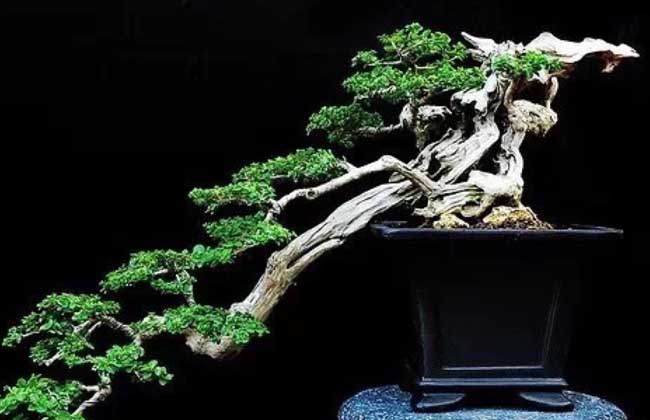
Bonsai uses plants, rocks, soil, water and other materials, and through artistic creation and horticultural cultivation, it typically and intensively recreates the beautiful scenery of nature in a pot, achieving the artistic effect of shrinking a dragon to an inch and seeing the great in the small, while also expressing feelings through the scenery and conveying a profound artistic conception, just like a three-dimensional beautiful miniature version of a landscape scenic area. Now let us take a look at bonsai pruning techniques!
Bonsai pruning techniques
1. Prune late rather than early: It is generally believed that winter, when trees stop growing, is the best time to prune branches, and it is emphasized that one should "prune in winter." This view is not comprehensive enough. To be precise, only some tree species can be pruned in winter. For example, after short pruning in winter, crape myrtle branches may look dry, but as soon as spring arrives, new buds will grow on the short branches. In fact, "spring pruning" is better than "winter pruning." Pruning before trees bud in early spring, when the air temperature is somewhat higher and new buds will sprout within a relatively short time, leaves no risk of branches drying out. Compared with "winter pruning," "spring pruning" has no other disadvantages either. Trees that bloom in spring, such as azaleas and plum blossoms, must be pruned even later, after they finish flowering; otherwise, cutting off the flowering branches will defeat the purpose.
2. Prune thick branches rather than thin ones: Some people pursue rapid shaping of bonsai and impatiently short-prune new branches that have not yet become woody, hoping to grow side branches again that same year and then prune again, pruning two or three times in one year to make the bonsai quickly form several levels of branch pads. The correct approach is to wait until the branch has become woody and has roughly grown to the predetermined thickness before pruning, so that the side branches that grow out will inevitably form a better angle. One must overcome impatience. For a branch intended as a branch pad, be sure to let it grow to the predetermined thickness, generally at least one year, and if it is not thick enough, do not hesitate to let it grow another year.
3. Prune fat rather than thin: After a branch is short-pruned, if the branch pad does not sprout new buds for a long time, and even if it does sprout, the side branches do not grow vigorously, this is because of a lack of fertilizer. To encourage the branch pad to quickly produce strong buds and grow new branches quickly, the amount of fertilizer used, on the premise that it does not cause "fertilizer damage," the more the better. In the peak growing season, you can alternate watering once and fertilizing once. But be careful not to make it too concentrated. In this way, during the growing season with suitable temperatures, the side branches should grow continuously.
How to prune bonsai?
1. Keep branches and set pads: When cultivating the stump material, branches and buds grow in clusters, and it is uncertain what to remove and what to keep, making it difficult to start pruning, or a flawed concept or idea may lead to incorrect pruning. Although this can still be adjusted, it prolongs the time for cultivating branches and shaping, because setting pads is the premise of the structural framework. According to the individual characteristics of the stump material, such as straight, slanting, curved, lying, hanging, or waterside, and integrating the author's conceived imagery, keep branches and set pads, remove all miscellaneous branches and superfluous buds, concentrate nutrients, and cultivate the retained branches, so as to enter the pruning and production stage as early as possible.
2. Coordinated pruning: When branch pads are cultivated and growing wildly, when to prune and where to cut should involve a comparison of thickness and length. This runs through the entire process of shaping and producing the potted tree and relates to every part of the potted tree's structural framework. In this process, the ratio between branches and trunk, the ratios among branch pads, the hierarchical contrast between main and secondary veins within a branch pad, and so on, must all be clearly understood before pruning, with a well-thought-out plan, and the intention formed before cutting. Only in this way can you cut precisely and appropriately.
3. Precise fine pruning: The angle of branches and buds, the direction in which branch forks extend, and the irregular crisscrossing among them reflect how branch pads extend, retract, and turn in space up, down, left, and right. If the angle is chosen improperly, although it can be compensated for by wiring, it is after all not as good as the natural state. Therefore, when choosing the angle of a bud point, one cannot consider only one aspect and ignore another. That is, regarding the direction of the branch, its spatial state, and its relationships with other branch pads, one must not only be clear but also conceive "ahead of time" and make judgments, avoiding mechanical, rigid, and formulaic results.
4. Integrated pruning: The outer outline displays the overall tree form of the potted tree, that is, what is usually called a triangular or scalene triangular composition. Here, the length of individual branch tips should be subordinate to the whole, grasping points and lines while blending them into the overall surface. Observe the whole, prune locally, and adjust comprehensively. At this time, the potted tree is basically becoming full and mature, and this belongs to the finishing stage of shaping and production. Its focus is on the length and opening-closing of branch pads and the overall relationship of the outer outline.
Bonsai pruning methods
1. Unbalanced pruning: Unbalanced pruning is not comprehensive pruning, but rather a local pruning method adopted according to the plant's physiological characteristics to benefit shaping and healthy branch growth and to avoid pathological branch dieback. It includes thinning pruning and branch control.
① Thinning pruning: Generally, when a new stump has survived and branches are being retained and pads set, excess branches are removed without reservation, so that the retained branches receive ventilation and light while also receiving a concentrated supply of nutrients, grow quickly and robustly, and shorten the time for cultivating branch pads.
② Branch control: Generally, in the initial stage of branch pad cultivation and shaping, due to the plant's phototropism, apical dominance, and various other reasons, branch growth is often not synchronized, with some growing fast and some slow. To make weak branches develop and grow as quickly as possible, one must consciously trim back some branches whose proportions are relatively appropriate (cutting off most of the branch tip or side branches) to control them, so that weak branches can obtain sufficient light and nutrients, avoiding the situation where individual branches are immature and affect the pruning for the overall shape.
2. Balanced pruning: Balanced pruning is all-around pruning, generally when the potted tree is close to being formed or before an exhibition. At this time, comprehensive pruning can be carried out repeatedly, not only making the branches mature and full but also maintaining the beauty of the tree form.
3. Pruning with leaves: Pruning with leaves means that the branch node left by the cut must have leaves. In particular, the bud position determined to be retained on a branch node must have leaves. If there are no leaves, the cut on that branch node should be moved down to a place with leaves. By forcing buds, after the retained bud position has normally sprouted, prune again into place. This is due to the plant's physiological characteristics and the conductive function of the tree sap it contains. Therefore, as with unbalanced pruning in general, it must be done with leaves; otherwise, it may cause the cut to shrink or even branch dieback.
4. Reserved pruning: According to differences in tree species' wound-healing ability and special circumstances, in the pruning process, make reservations with prevention as the priority, that is, do not cut into place all at once but cut in two stages, leaving one to two extra bud positions, and then prune again after the retained buds have become slender, strong branches or when the reserved nodes have naturally withered. This method is often used in the pruning of species such as Japanese bush cherry and Chinese hackberry. In actual practice, thick branches create large wounds and are prone to shrinking, so they can be left longer; thin branches shrink relatively less, so they can be left shorter.