Detailed Guide to Making and Caring for Nandina Bonsai
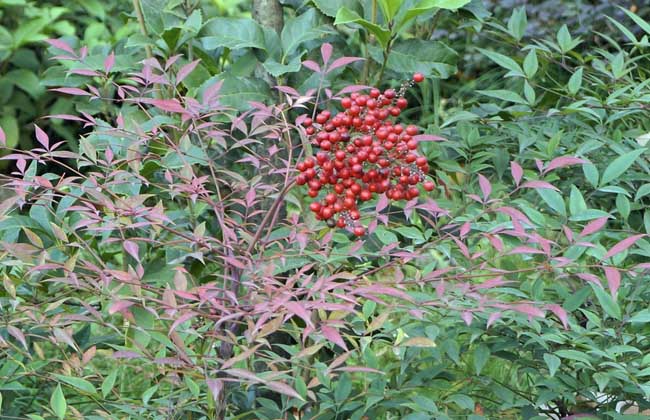
Nandina (Nandina domestica) is a common woody flowering plant species in southern China, also known as Nantianzhu, Hongpazi, Tianzhuzi, Honggouzi, and so on. It is an evergreen small shrub of the genus Nandina in the family Berberidaceae, with strong adaptability to the environment. It often appears in garden applications and is also commonly used to make bonsai or potted plants to decorate windowsills, entrance halls, conference venues, and so on. Let us take a look at how to make and care for nandina bonsai!
Sourcing Materials for Nandina Bonsai
To make nandina bonsai, you can obtain seedlings through sowing, cuttings, or division, or you can dig up old stumps by the stream; after 2 to 3 years of growing the raw material, it can be potted in a fine pot for viewing. For sowing, you can sow the seeds as soon as the fruit ripens, or sow in spring. Division should be done before budding in spring or in autumn. Cuttings should be taken before new buds sprout or in summer when new shoots stop growing. Indoor care should strengthen ventilation and light transmission to prevent the occurrence of scale insects.
Making Nandina Bonsai
1. Single-trunk style: A single plant with multiple branches is the single-trunk style. The trunk (branches) is required to be upright or basically upright. Select three to four branches sprouting from the root crown as scenic branches. One of them is the standing branch, which should be tall, and the other branches are arranged in an oval pot. A certain empty space should be left in front of the plant to give a sense of spaciousness. This kind of nandina bonsai resembles a tree in the open wilderness, standing towering and reaching into the clouds.
2. Stump-head style: Select a plant with a withered, gnarled root crown that has sprouted several new branches. Take one or two of them as the central main branches, and the rest as secondary branches. The secondary branches may have straight or curved postures. This kind of bonsai, with green branches and jade-like leaves, is like a withered tree meeting spring, vigorous and striving.
3. Figurative style: The key to figurative nandina bonsai lies in the selection of materials. Generally, roots and trunks resembling animals are sought, and after pruning and shaping, they are made into figurative bonsai resembling deer, monkeys, dogs, and so on.
4. Stone-companion style: Nandina is upright. If there are no small branches in the middle and lower parts (commonly known as "bare legs"), it appears empty and not full. A mountain stone can be placed on the right side of the back to make up for this defect. This kind of nandina bonsai, leaning against the mountain and stone, forms a delightful contrast.
Shaping Nandina Bonsai
1. Tidying miscellaneous branches: Nandina bonsai requires very little care pruning; it is mainly about tidying miscellaneous branches. After fruiting each year, that is, in early spring, cut off the remaining fruit spikes, and in combination with clearing the branches, thin out dense branches and shorten a small number of long branches. The remaining branches are usually left to grow freely, and the technique of changing the leader is generally not used. If an old stalk grows too tall, fruiting will decrease markedly, so the stalk can be cut off at ground level for partial renewal.
2. Pruning time: Pruning of nandina bonsai is mainly carried out during the dormant period in combination with repotting. When pruning, no matter where the branches are shortened to, new branches can sprout from the nodes below the cut, so if the branches grow too long and affect their appearance, the branches can be shortened to an appropriate position, making the clustered branches appear uneven in height. Never cut them into a flat top of uniform height, and make the spacing between stems and trunks well-proportioned.
3. Branch pruning and cutting: The branches of nandina bonsai should be shortened once every year. Newly planted bonsai should be pruned once according to the height of the trunks and the density of branches and leaves. In the early spring of the second year, cut off the shoot tips grown in the previous year. The length of the cut for each trunk should follow the arrangement requirements of the forest style and multi-trunk style. At the same time, cut off dead branches and withered leaves. Through annual shoot pruning, the phenomenon of the main trunk growing taller year after year while the companion trees become shorter and weaker can be avoided.
4. Repotting and pruning: Nandina bonsai should be repotted once every 2 to 3 years. During repotting, cut off some old roots, thin out weak branches, dead branches, and diseased and pest-damaged branches from the base so as to promote the sprouting of new branches, and make the height of the clump basically uniform and the branches evenly spaced. Generally, it is appropriate to retain 3 to 5 branches per clump.
5. Adjusting the arrangement: When repotting nandina bonsai, root pruning and soil replacement should be combined. When adjusting the arrangement and distribution of the trees, they can be replanted anew. Generally, choose trunks with thick stems to plant in the main position, and use thinner trunks as companions planted to the left, right, front, and back of the main tree, so that the height distribution of the trunks is natural.
Caring for Nandina Bonsai
1. Soil: The cultivation soil for nandina requires fertile, well-drained sandy loam soil. Slightly acidic soil is suitable, and it can be prepared in a ratio of 5 parts sandy soil, 4 parts leaf mold, and 1 part manure soil.
2. Watering: Nandina should be watered by the principle of "dry when it should be dry, wet when it should be wet." In dry seasons, water frequently to keep the soil moist. In summer, water once a day and spray the leaves 2 to 3 times to keep the leaf surface moist and prevent the leaf tips from scorching, which would harm the appearance. During flowering, special attention should be paid to watering so that the pot soil does not dry out, and water should be sprinkled on the ground to increase air humidity so as to help increase the pollination rate. In winter, the plant is in a semi-dormant state, so do not let the pot soil become too wet.
3. Sunlight: Nandina is best cared for in a semi-shaded, cool, and humid place. Under strong light, the stems become thick and short and turn dark red, young leaves are "burned," and mature leaves turn red. In a very shady place, the stems are thin and the leaves are long, and the clump is loose, which harms its ornamental value and is also unfavorable for fruiting.
4. Temperature: The suitable growth temperature for nandina is about 20°C, and the suitable temperature for flowering and fruiting is 24 to 25°C. The temperature requirements in winter are very strict. When the ambient temperature is below 8°C, growth stops, so in winter it should be moved into a greenhouse.
5. Fertilizing: During the growth period, thin seedlings should be given a light fertilizer about once every half a month (it is suitable to apply organic fertilizer rich in phosphorus). Adult plants should be given dry fertilizer three times a year, in May, August, and October respectively. The third application should be given when they are moved indoors for overwintering. Fertilizers such as fully fermented cake fertilizer and sesame paste residue can be used. As for the amount of fertilizer, generally the first and second applications should be less, and the third application can be increased.