What Plant Is "Thick-Skinned"? A Guide to Getting to Know It
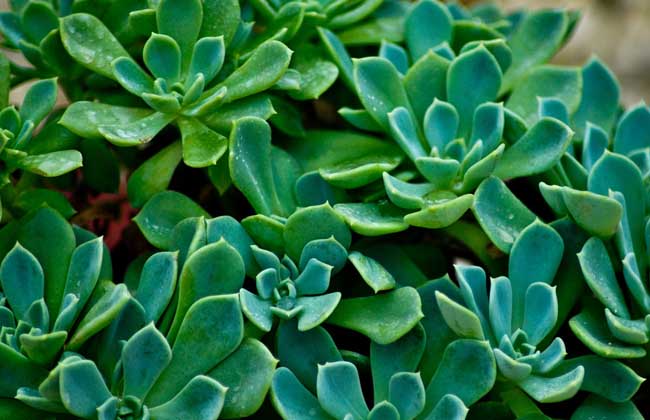
"Thick-skinned" is a rather distinctive plant, and many people find the name odd and wonder what it actually is. In fact, "thick-skinned" is an evergreen small shrub in the Crassulaceae family, genus Kalanchoe, also known as jade plant, jade tree, "won't die," air plant, leaf-rooting plant, and so on, while "thick-skinned" is simply a common folk name we use for it in everyday speech. It belongs to the succulent plants and has high ornamental value.
"Thick-skinned" is a perennial succulent herb, 40-150 cm tall. The stem is erect, much branched, hairless, with conspicuous markings, purple-red on the upper part, densely covered with elliptical lenticels, and sometimes slightly woody at the lower part. The leaves are opposite, simple or pinnately compound, with the compound leaves having 3-5 leaflets. The two leaf bases are purple, 2.5-5 cm long, broad and flat at the base, half-clasping the stem. The leaf blades are fleshy, elliptical or oblong-elliptical, 6-10 cm long and 3-6 cm wide, with a rounded-obtuse apex and crenate margins; buds readily form at the base of the crenations and develop into a new plant once they fall to the ground.
The panicle of "thick-skinned" is terminal, with large, bisexual, nodding flowers. There are two bracts, leaf-like. The calyx is bell-shaped, membranous, swollen, 2.5-4 cm long, pale green or yellowish-white. The corolla is tubular, 3-4.5 cm long, pale red or purple-red, swollen and spherical at the base, constricted in the middle, with 4 lobes at the apex, the lobes extending beyond the calyx tube. The stamens are inserted at the base of the corolla tube and adnate to it, with long filaments and purple anthers. The follicle is enclosed within the calyx and corolla. The seeds are tiny, numerous, and striated. The flowering period is March to May, and the fruiting period is April to June.
"Thick-skinned" is native to South Africa. It is fairly drought-tolerant but not cold-tolerant, and greatly favors a warm environment with ample sunlight; at the same time, it can also survive in semi-shaded environments. In winter, the survival temperature and environment must not be below 6°C. It often grows on hillsides, damp grasslands by ditches and roadsides, and is commonly cultivated in greenhouses and gardens in various places. In China, it is mainly distributed in Fujian, Taiwan, China, southern Zhejiang, Guangdong, Guangxi, Yunnan, and other places.
The whole plant of "thick-skinned" is used as medicine, with the effects of cooling blood and stopping bleeding, and clearing heat and detoxifying. It mainly treats traumatic bleeding, bruises and injuries, boils and sores, breast abscess, breast cancer, erysipelas, ulcers, scalds, stomach pain, joint pain, sore throat, cough due to lung heat, and other conditions. For internal use, it is decocted in water, using 30-60 g of fresh whole plant or 3-6 g of root, or the juice is squeezed; for external use, an appropriate amount is pounded and applied, or the juice is squeezed, dried, ground into powder and sprinkled on, or the juice is pounded and used as a gargle. Note that it is contraindicated for those with deficiency-cold of the spleen and stomach.
"Thick-skinned" is the most common succulent plant, cultivated for ornamental purposes. Its leaves are thick and juicy, and neat, attractive adventitious buds grow along the margins, resembling a group of small butterflies that fly down to the ground and immediately take root to propagate future generations, which is quite fascinating. Used as a potted plant, it is a good material for greening windowsills, and it also adds elegant charm when used to accent a study or guest room.