Where Do Baobab Trees Grow? Main Producing Areas and Distribution Regions
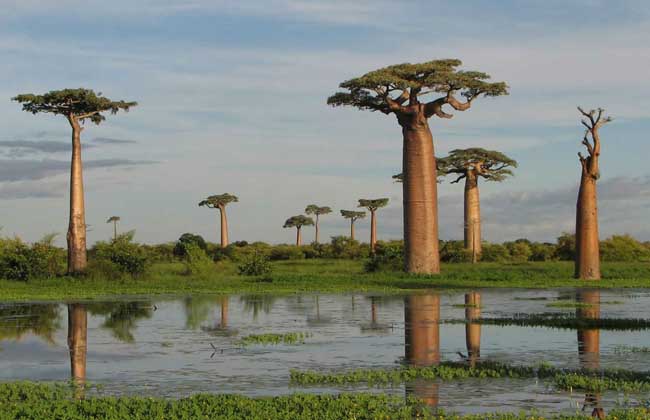
The baobab is a large deciduous tree of the genus Adansonia in the family Malvaceae, also known as the boabab tree, monkey tree, and sour gourd tree. Its fruit is huge, like a football, sweet and full of juice, and is the favorite food of monkeys, gorillas, elephants and other animals. When the fruit ripens, monkeys come in droves, climb up the tree and pick the fruit to eat, and that is how the name "baobab" came about. Let us take a look below at where baobab trees grow!
Where do baobab trees grow?
The baobab is native to tropical Africa. Besides Africa, baobab trees can also be seen on the islands of the Mediterranean, the Atlantic and the Indian Ocean, and in northern Australia, with a small amount cultivated in the tropical regions of Fujian, Guangdong and Yunnan in China. As one of the ancient and unique tree species on this earth, the baobab is distributed across the African continent, parts of North America and the island of Madagascar. Although the baobab is not unique to Madagascar, Madagascar is the only place in the world where continuous stands of baobab forest are still preserved. The most common and widespread species is called the African baobab, which is distributed in the drier parts of the African continent, as well as in Yemen, Oman and the Arabian Peninsula.
The producing environment of the baobab
The baobab is a warmth-loving tropical tree species. It can tolerate a maximum average temperature of 40°C and above, and an extreme minimum temperature of 0°C. Frost has a huge impact on the tree. In its natural distribution area, the annual average temperature is 20-30°C. It is extremely drought-tolerant. In suitable areas, the annual average precipitation is 300-800 mm, and it grows poorly under hot and humid climate conditions or where precipitation exceeds 1000 mm. It is commonly found at altitudes of 450-600 m, but in Ethiopia and its marginal distribution areas the altitude is 1000-1500 m. The baobab is suited to all types of soil, from clay soil and sandy soil to various soils, but stony loam and laterite are the most common. It can grow very well on acidic and alkaline soils, sandy loam, and well-drained fertile soil.
Common varieties of baobab
1. Boab tree: The boab tree is the only kind of baobab found in the Australian region. It generally does not grow tall, at about 5 to 15 m, but like its relatives it has an enormous, water-rich trunk (about 5 m in diameter), and sometimes the trunks are joined together.
2. African baobab: The African baobab can grow to 25 m tall, and its water-filled trunk can reach 12 m in diameter. The huge flowers it produces are yellow-white and give off a rotten smell. This tree is usually pollinated by fruit bats or flying foxes. Its fruit contains a large amount of trace elements, vitamins and nutrients, so it is also often called a "superfruit."
3. Grandidier's baobab: Grandidier's baobab is one of the six species of baobab native to Madagascar, and has been listed as an endangered species by the International Union for Conservation of Nature. It is the largest tree species found on the island of Madagascar, with branches that can grow to 30 m tall. Grandidier's baobab, which has smooth, grape-grey bark, is relatively numerous in the western part of Madagascar near the Morondava and Morombe areas.
4. Madagascan baobab: The Madagascan baobab looks different from ordinary baobabs. It generally grows in dry or moist forests rather than on typical shrubby savanna. Its growing sites may not be so arid, but these trees, 5 to 20 m tall, still stand out in the forest thanks to their thick trunks, smooth bark and dark red flowers.
5. Perrier's baobab: Perrier's baobab has lost a large amount of habitat because of agricultural development and has been listed as an "endangered species" by the International Union for Conservation of Nature. It is perhaps the rarest baobab on the island of Madagascar, with only 10 known trees. They can be found only in the area north of Antsiranana. They can grow to 30 m tall and can produce fruit up to 30 cm long.
6. Fony baobab: The fony baobab grows only in the dry deciduous forests of Madagascar and is the smallest member of the Madagascan baobab family. Few fony baobabs can reach a height of more than 20 m; an ordinary fony baobab is only 4 to 5 m tall. Its bottle-shaped trunk benefits from the luxuriant branches and leaves above it. The flowers come in bright yellow and orange-yellow.
7. Suarez baobab: The Suarez baobab has white flowers and also grows in the northern part of Madagascar. But unlike the more numerous fony baobab, the Suarez baobab has been listed as an "endangered species" by the International Union for Conservation of Nature. This large baobab can grow to 25 m tall, and its width can reach about 2 m.
8. Za baobab: The za baobab is the most common baobab species on the island of Madagascar. A mature za baobab has smooth rose-brown bark, and some can grow to 40 m tall. Its fruit has a black outer skin and seeds with an oil content as high as 11%. Its flowers have yellow and red petals and can give off a slightly sweet scent to attract its main pollinators (fruit bats and hawkmoths).