How to grow succulents so they look beautiful? Master these care methods
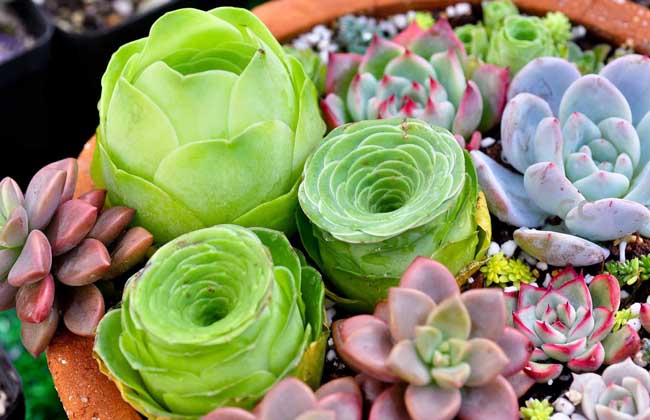
Succulents are higher plants with enlarged vegetative organs, usually having three vegetative organs - roots, stems, and leaves - and three reproductive organs - flowers, fruits, and seeds. In horticulture they are also called succulents or succulent flowers, but the name "succulents" is the most commonly used. They have extremely high ornamental value. Let's take a look below at how to grow succulents so they look beautiful!
Seed propagation
Among succulents, apart from a few species capable of self-pollination, most are insect-pollinated or bird-pollinated flowers and must be artificially pollinated in order to set fruit. Succulent seeds have a short lifespan; for example, the seeds of Haworthia cooperi var. pilifera last only a few weeks. Generally, succulent seeds stored under normal temperature conditions for 1 year show a rapid decline in germination rate. For this reason, many succulents are sown immediately after the seeds mature or stored for sowing in the following spring. The germination time after sowing also differs among families and genera; the earliest can germinate in 2 days, while the latest takes 25 days to germinate.
Leaf cutting propagation
Succulents often use their thick, fleshy leaves placed on a slightly moist sand bed or loose soil surface; they will soon take root, and adventitious buds grow from the base of the leaf to form small plants, such as Adromischus, Echeveria, and Kalanchoe daigremontiana.
Stem cutting propagation
Succulents are suitable for pruning and shaping; cut branches into sections as cuttings, such as Adenium obesum, Stapelia, Euphorbia milii, and Euphorbia trigona. For Adenium obesum, Pachypodium lamerei, and Euphorbia tirucalli, whose cut wounds exude white milky sap, the wound must be cleaned thoroughly and dried slightly before cuttings are taken, for better results.
Root cutting propagation
For the relatively precious varieties of the Haworthia genus in the Liliaceae family, the roots are very thick and well developed. Cut off the relatively mature fleshy roots and bury them in a sand bed with the upper part slightly exposed, maintaining a certain moisture and bright light; new buds can sprout from the top of the roots to form complete small plants.
Grafting propagation
Grafting of succulents is often used to propagate variegated and cristate cultivars, such as using Euphorbia neriifolia as rootstock to graft Euphorbia neriifolia cristata, Portulacaria afra as rootstock to graft Euphorbia tirucalli, Pachypodium lamerei as rootstock to graft its cristate form, and Stapelia gigantea as rootstock to graft Stapelia, etc., with good ornamental results. However, during grafting, because the plants contain white latex that is highly sticky, the grafting operation must be performed quickly and skillfully in order to succeed.
Division propagation
Division is the simplest and safest method of propagating succulents. As long as they have rosette leaf clusters or grow in clumps, succulents can be propagated by division through their offsets, stolons, bulbs, tubers, and small plants, and this can be done when repotting in spring. Of course, among succulents, variegated cultivars such as Sansevieria trifasciata 'Laurentii', Dyckia 'Naked Lady' variegata, Agave 'Night City' variegata, and Haworthia truncata variegata must be propagated by division in order to maintain the purity of the cultivar.
That's all for now on succulent propagation methods. Let's continue below and take a look at how to grow succulents so they look beautiful!
Temperature
When growing succulents indoors, the temperature is best kept at around 15-28 degrees. General indoor temperatures are suitable; the absolute minimum must not go below 5 degrees, and the maximum must not exceed 35 degrees.
Light
Try to choose the spot with the longest light exposure to place succulents. If there is insufficient light, do not easily move succulents outdoors.
Watering
For succulents, misting to water gives relatively ideal results. The best time to water is when sunlight is abundant. You can adjust the watering frequency yourself; in dry-air places, pay attention to watering more.
Fertilizing
Succulents do not need fertilizing in summer. In winter, if conditions permit, you can fertilize the succulents once a month. The fertilizer can be well-rotted dilute liquid fertilizer or compound fertilizer.
Pest control
The number of succulents kept at home is usually not large, so you can often check them yourself for insects. Common insects on succulents include red spider mites, scale insects, and whiteflies; these can all be removed by hand.
Rot prevention
Overwatering, air that is too humid, and failure to control pests can all cause succulents to rot. Rotten succulents appear faded and softened. If you find a rotten succulent, you need to cut it off as soon as possible; the tools used are best disinfected to avoid infecting other plants.
Note: The sap of many succulents is toxic. If accidentally touched, it can cause itching, redness, and swelling, and in severe cases may even endanger life. Some families and genera, especially Euphorbiaceae, Apocynaceae, and the genus Euphorbia, are concentrated sources of “toxic plants”. However, there is no need to be afraid of growing these plants out of worry about toxins; just be careful not to break them or taste them, and keep children in the household at a distance from them.