A detailed guide to bougainvillea cultivation methods, from planting to care, all mastered
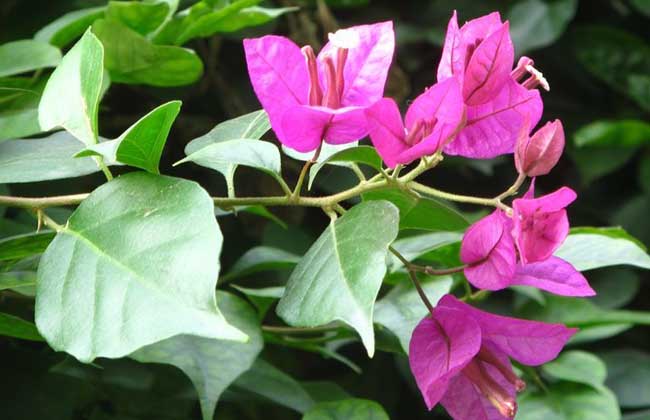
Bougainvillea, scientific name Bougainvillea glabra, also known as San Ye Mei, Mao Bao Jin, Le Du Juan, San Jiao Hua, etc., is a vine-like shrub plant of the genus Bougainvillea in the family Nyctaginaceae, native to Brazil. In southern China it is planted in courtyards and parks as an ornamental plant, while in the north it is cultivated in greenhouses; it can also be used for bonsai, hedges and pruning shapes. Now let us take a look at the cultivation methods of bougainvillea!
How much does bougainvillea cost?
The price of bougainvillea is generally set according to its height, crown width and ornamental performance. Generally, a bougainvillea with a trunk diameter of 2 cm, a height of 200 cm and a crown width of about 100 m costs about 100 yuan per plant. Of course, for smaller saplings with a height of about 30 cm and a crown width of about 30 cm, the price is generally 10 to 20 yuan per plant.
The cultivation environment for bougainvillea
Bougainvillea is a tropical plant that likes a climate with high temperature and high humidity, and is also relatively tolerant of dry heat. It is not tolerant of cold and avoids frost. In China, south of the Tropic of Cancer it can overwinter safely outdoors, while in the vast areas from northern South China to Central China and North China it is only suitable for pot cultivation, and in winter it should be moved indoors or into a greenhouse. Bougainvillea does not demand much from soil fertility; sandy soil or clay soil are both suitable, and it can tolerate waterlogging and is also relatively tolerant of drought. Potted bougainvillea enters a forced dormant state when the temperature drops to a certain level. During the non-dormant period, bougainvillea may drop flowers abnormally due to insufficient light, and with sufficient water the flowers fade early. In the dormant state, bougainvillea is not sensitive to light intensity, but because of low temperature it shows a longer lifespan, and because of less water it also shows a longer lifespan.
Propagation of bougainvillea by cuttings
Bougainvillea is commonly propagated by cuttings and is easy to raise from seed. In May and June, cut mature woody branches; cut 2-year-old branches into 10 cm long cuttings and insert them into culture soil (use plain sandy soil plus one third humus or sawdust, add an appropriate amount of water and stir evenly), then seal well with plastic film after inserting. At a temperature of 20°C to 25°C, roots can form in 25 days, and after 2 to 3 months they can be divided into pots. If you want to obtain more ideal new seedlings, you should use the air layering method for propagation. This method does not affect the growth of the original plant and can also produce complete new seedlings, so it is often used by home flower growers, and the method is simple, the survival rate is high, later transplanting is convenient, and it is easy to manage.
Bougainvillea cultivation methods
1. Choosing culture soil: Bougainvillea is not strict about soil requirements, but it fears water accumulation and is not tolerant of waterlogging, so a loose culture soil with good drainage must be selected. Generally, a culture soil made of 4 parts humus soil, 4 parts garden soil and 2 parts sand can be used. Dried pond mud mixed with some coal cinder can also be used as potting soil. When potting, 30 grams of decomposed cake fertilizer should also be mixed in as base fertilizer.
2. Reasonable fertilization: Bougainvillea generally needs liquid fertilizer once every 7 to 10 days during the vigorous growth period from April to July. Fertilizers such as 10 to 20% decomposed soybean cake or rapeseed cake water, or human feces water, can be used. From August onward, in order to promote flower bud formation, apply fertilizer mainly based on phosphorus fertilizer once every 10 days; 20% decomposed chicken, duck and pigeon manure and fish scraps and other liquid fertilizers can be used. From October, it enters the flowering period. From this time until mid-November, apply a phosphorus-based fertilizer once every half month, with a fertilizer water concentration of 30 to 40%. After each flowering, an additional topdressing should be applied once, so that the flowering period is continuously supplemented with nutrients.
3. Water control before flowering: Usually watering should follow the principle of "do not water if not dry, water thoroughly when watering." However, for neat and abundant flowering, water control must be carried out before flowering. Starting in September, control watering of bougainvillea; each watering should wait until the potting soil is dry and the branches and leaves hang softly, repeating this continuously for half a month, then after half a month restore normal watering. During the water control period, fertilization must be strictly avoided to prevent fertilizer from burning the root system. In this way, flower buds will appear and bloom in about one month, and the flowers will open neatly and abundantly.
4. Loosening soil and repotting: Due to long-term watering, fertilizing and rain washing, the potting soil easily becomes compacted, so the soil must be loosened regularly, and weeds in the potting soil should be removed at the same time, to benefit the growth of bougainvillea. Otherwise, compacted potting soil and water accumulation can easily cause root rot or poor growth. In addition, bougainvillea grows quickly, has a well-developed root system and very many fibrous roots, so it needs to be repotted once a year.
Cultivation and management of bougainvillea
1. Temperature management: The suitable growth temperature for bougainvillea is 15 to 30°C, of which 19 to 30°C from May to September, and 13 to 16°C from October to April of the following year. In summer it can withstand high temperatures of 35°C. When the temperature exceeds 35°C, appropriate shading or measures such as spraying water and ventilation should be taken. In winter, an environmental temperature of no less than 5°C should be maintained; otherwise, when the temperature is below 5°C for a long time, it is prone to frost damage and leaf drop. Flowering requires a temperature above 15°C. To prolong the flowering period, it should be moved indoors promptly before the cold current arrives in early winter, placed in a sunny place, and a relatively high environmental temperature should be maintained.
2. Light control: Bougainvillea likes light and is a sun-loving flower. Insufficient light during the growing season will cause the plant to grow weakly and affect flower bud formation and flowering. Therefore, throughout the year, except that newly potted young seedlings should first be placed in semi-shade. In winter it should be placed in front of a south-facing window, and the light duration must not be less than 8 hours; otherwise, a large number of leaves will fall. It is a short-day flower; controlling the daily light duration to about 9 hours can promote flower buds and flowering after one and a half months.
3. Reasonable pruning: Bougainvillea grows rapidly, so during the growing period attention should be paid to shaping and pruning to promote side branch growth and produce more flowering branches. The number of prunings is generally 1 to 3 times, and it should not be too many; otherwise, it will affect the number of flowerings. After each flowering, remove spent flowers promptly to reduce nutrient consumption. After the flowering period, thin out overly dense branches, inner branches, leggy branches and weak branches. Other branches are generally not pruned, or only the branch tips are slightly pruned. Heavy pruning is not suitable, as it shortens the next growth period and promotes earlier flowering and repeated flowering.
4. Flowering period control: If you want to see bougainvillea on National Day, you can move the pot into a dark room in advance for light avoidance treatment, because it is a short-day flower. Around early August, place the potted bougainvillea in an environment that does not let light through, with complete absence of light from 5 p.m. each day until 8 a.m. the next day, maintaining this for 50 days, spraying water daily to lower the temperature. Water normally, and once a week apply additional phosphorus and potassium liquid fertilizer or hoof piece fertilizer. In this way, brilliant bougainvillea can be seen on National Day.
What to do if bougainvillea does not bloom?
1. Light: Bougainvillea loves light, so it can be placed in a sunny place. This is not only beneficial to its vegetative growth, but also favorable to reproductive growth. Plants treated with strong sunlight have shorter internodes, fuller growth, more flowers, deeper flower color and a longer flowering period.
2. Pruning: Bougainvillea has a long and fast growth period, so it should be pruned and pinched appropriately.
3. Water: Bougainvillea should begin water control in mid-August. After watering once, water again only after the leaves and young buds all droop. The degree of water control is based on the plant not drying to death. Repeat this treatment until flower rudiments appear in the leaf axils at the branch tips, then gradually restore normal watering. Water control can increase the concentration of cell sap in bougainvillea and can promote flower bud differentiation and formation.
4. Fertilization: Bougainvillea is very sensitive to urea. If the fertilization period is improper or the ratio is improper, it may produce the phenomenon of luxuriant branches and leaves but few flowers, so applying urea must be done with special caution. In summer, the temperature is high and there is much rain, and the plant is prone to leggy growth, so urea should not be applied alone. Some fertilizer made by composting rotten vegetable leaves can be applied. It is best to use a 0.2%-0.3% potassium dihydrogen phosphate solution as foliar topdressing once every half month. In the early stage of flowering branch growth, urea can be applied once to benefit the growth of flowering branches.
Precautions for growing bougainvillea
1. During the growing period of bougainvillea, the temperature should be appropriately maintained; generally in winter it should be kept above 5°C, and at the lowest it must not be lower than 3°C.
2. Bougainvillea relatively likes sunlight, but in summer appropriate shading treatment should be carried out, and at the same time in winter 8 hours of light should be ensured.
3. In terms of soil selection, bougainvillea cultivation should choose relatively fertile, loose soil with strong drainage performance.
4. Bougainvillea should be watered appropriately. During the plum rain season, a certain drainage capacity must be ensured; otherwise, root rot may occur.
5. Before bougainvillea blooms, the pot can be turned and the soil changed appropriately, and appropriate pruning can be carried out at the same time.
Pest and disease control of bougainvillea
1. Leaf spot disease
[Symptoms of damage] The lesions are initially yellow-brown, surrounded by a yellow-green halo, then expand into nearly round or irregular lesions with dark brown edges. In the later stage, small black dots appear on the lesions.
[Control method] If a small number of lesions are found, apply Dakening cream ointment on them, and cut off the branches with more disease. In the early stage of the disease, 50% carbendazim wettable powder 500-fold solution can generally be used for control, spraying once every 7 to 10 days. In severe cases, according to actual experience, spray once again on the fourth day, then once every 7 days. For 3 to 4 consecutive times, the control effect is good.
2. Brown spot disease
[Symptoms of damage] On the affected leaves, yellow-brown to light brown lesions with a diameter of 0.1 to 0.5 cm are produced on the leaf surface.
[Control method] If a small number of diseased leaves are found, remove and burn them promptly. In the early stage of the disease, use 70% mancozeb wettable powder 400-fold solution, spraying once every 10 days, for 3 consecutive times.
3. Scale insects
[Symptoms of damage] In environments with poor light, poor ventilation and high temperature and high humidity, various scale insects are prone to occur.
[Control method] 45% malathion emulsifiable concentrate 1000-fold solution can be used for spraying and killing.