What are the cultivation methods for four-season peonies?
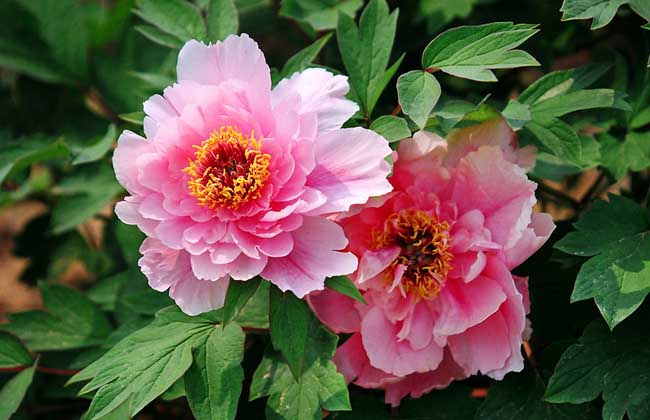
The peony is a perennial deciduous plant of the genus Paeonia in the family Paeoniaceae. Its flowers are brilliantly colored, jade-like in their smile and pearl-like in fragrance, elegant and free-spirited, magnificent and splendid, and it has long enjoyed the reputation of "king of flowers." In May 1985 it was rated second among China's top ten famous flowers. It is not only a flower loved by the Chinese people, but also cherished by people around the world. Let us take a look below at the cultivation methods for four-season peonies!
Growth Habits of Four-Season Peonies
Four-season peonies prefer a warm, cool, dry, and sunny environment. They like sunlight but also tolerate partial shade, tolerate cold, tolerate drought, and tolerate weak alkalinity. They dislike waterlogging, fear heat, and fear direct exposure to blazing sun. They are suitable for growing in loose, deep, fertile, high-lying, well-drained neutral sandy loam, and grow poorly in acidic or heavy clay soil. Sufficient sunlight is fairly beneficial to their growth, but they cannot withstand the scorching sun of summer. When the temperature is above 25°C, the plants will enter a dormant state. The suitable temperature for flowering is 17-20°C, but before flowering they must undergo low-temperature treatment at 1-10°C for 2-3 months. They can withstand low temperatures down to -30°C, but in cold northern regions appropriate cold-protection measures are needed in winter to avoid frost damage. The hot and humid weather of the south is extremely unfavorable for peony growth, so cultivating peonies in the south requires giving them specific environmental conditions before one can admire their wondrously beautiful flowers.
Propagation Methods for Four-Season Peonies
1. Division: The mother plants used for peony division are generally robust clumps. The mother plants used for division propagation should retain as many root suckers as possible, and all roots on the new seedlings should be retained so that after 5 years of growth they can produce more new shoots from division. Such divided seedlings are easy to establish after planting and grow fairly vigorously; the more roots retained, the more vigorous the growth.
2. Grafting: Peony grafting propagation is divided into two types depending on the rootstock used: one uses wild peony, and the other uses peony rootstock (Paeonia lactiflora roots). The commonly used peony grafting methods mainly include three: inlay grafting, side grafting, and bud grafting.
3. Cuttage: Cut the cuttings from the branches first, detach them from the mother plant, and then insert them into soil or another medium so that they take root and become new plants. For the branches, choose current-year soil shoots emerging from the peony roots, or when pruning and shaping the peony, choose branches with solid stems and plump terminal buds and free of pests and diseases as cuttings, 10-18 cm long.
4. Sowing: Before sowing, the soil must be rather carefully prepared and disinfected. The land should be deeply plowed and finely worked, with sufficient base fertilizer applied. Then build small beds 70-80 cm wide; either hole sowing or drill sowing is acceptable. Do not sow too deeply; 3-4 cm is the limit. After sowing, cover with soil level with the surface. Then gently firm the soil and water thoroughly immediately.
5. Layering: The peony layering method is a propagation method that uses the principle that branches can produce adventitious roots. Press the branches down or bury them with soil while still on the plant, without detaching them from the mother plant, and keep the soil moist. The buried part of the branch takes root, and then it is cut off and planted to become a new plant. This likewise belongs to the asexual propagation methods of peonies.
Cultivation Methods for Four-Season Peonies
1. Planting: The soil for planting four-season peonies is required to be loose in texture, fertile, and neutral to slightly alkaline. Cut off broken and diseased roots of the peony seedlings to be planted, soak them in insecticide and fungicide, and place them into a previously prepared pot or hole. The root system should be spread out. Fill soil to more than half of the pot or hole, gently lift and shake the seedling, firm the soil and seal it, with the depth such that the root crown is slightly below the pot surface or ground level.
2. Watering: After planting four-season peonies, water once thoroughly. Avoid waterlogging. Water as appropriate during the growing season. In arid northern regions, generally water before flowering, after flowering, and before the soil freezes. For pot cultivation, to make management easier, after flowering the faded flowers can be cut off and the whole pot buried in the ground.
3. Fertilizing: One year after planting four-season peonies, fertilizing can be done in autumn, mainly with decomposed organic fertilizer, and it can be applied together with loosening the soil, by broadcasting, or by hole application. In spring and summer, chemical fertilizers are mostly used, applied together with watering as pre-flowering and post-flowering fertilizer. For pot cultivation, liquid fertilizer can be applied together with watering.
4. Pruning: In the year of planting, four-season peonies are mostly cut back level. After sprouting in spring, leave about 5 branches and remove the rest to concentrate nutrients, so that the flowers in the second year will be large and brightly colored. In autumn and winter, along with clearing the garden, cut off dried flower stalks and thin, weak, flowerless branches. For pot cultivation, trim into whatever shape you like as needed.
5. Cultivating: During the growing season of four-season peonies, cultivate the soil in time, pull out weeds, and pay attention to the occurrence of diseases and pests. In autumn and winter, carry out plowing of the soil blocks of peonies more than two years old.
6. Repotting: When potted four-season peonies have grown for three or four years, they need to be moved in autumn into a larger pot with added new fertile soil, or divided and replanted separately.
7. Spraying: For four-season peonies, spray lime-sulfur mixture before sprouting in early spring, and in summer use a mixed solution of insecticide and fungicide, once every 2 weeks depending on the condition of the disease. Together with fertilizing, chemical fertilizers and growth regulators, etc., may also be added.
8. Forcing: To add to festivals or celebratory events, peonies can be warmed about 50 days in advance, with the temperature controlled at 10-25°C, averaging around 15°C. In the early stage, pay attention to keeping the plants moist; after buds appear, pay attention to ventilation and light; after the buds are formed, control the temperature according to the requirements of the flowering period. Normally, foliar feeding should be carried out to ensure an adequate water supply. In this way, flowers can be seen at any time in both winter and spring.