Detailed Explanation of Oil Peony Planting Techniques and Management Methods
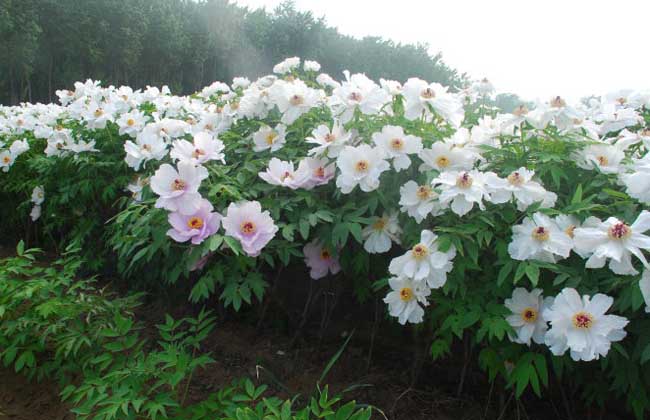
Oil peony is a shrub plant, mainly distributed in the wild in Heze, Shandong Province, Luoyang City, Henan Province, Bozhou City, Anhui Province, Fenghuang Mountain in Tongling City, Gansu Province, Shaanxi Province, etc. Currently, only two varieties of oil peony are used in production: Fengdan and Ziban. Among them, Ziban is further divided into grafted and seedling varieties. Let's take a look at oil peony planting techniques together!
Site Selection and Land Preparation
For oil peony seedlings, choose sandy soil with good drainage and full sun. For larger plants, depending on the situation, you can choose partially shaded fruit tree orchards or woodland with less than 50% shade for planting. The suitable soil pH is 6.5-7.5. Taking plains as an example for land preparation, deep plow 30-40 cm, apply 1000 kg of farmyard manure per mu, plus 50 kg of compound fertilizer and 10-15 kg of sulfur-phosphorus granules, then plow twice more and set aside.
Variety Selection
From the Yellow River Basin southward, including the Yangtze River Basin, at altitudes below 2000 m, Danfeng is the main variety. It dominates the market with strong growth vigor, wide adaptability, high seed yield, and high oil content. With development, ornamental-oil dual-purpose varieties and other colored oil peonies will gradually be introduced to the market.
Planting Time
In the Central Plains region, it is suitable from early September to mid-October. If later, plastic film mulching is needed; if earlier, it tends to autumn growth, and the seedlings will be weak the next year. In the Yangtze River Basin, it is suitable from the end of September to the end of November. In the Northwest and Northeast, it is suitable from the end of August to the end of September. Generally, 2-3 year old Danfeng seedlings are selected. 1-year-old seedlings are too small, have poor adaptability, and waste land. 4-5 year old seedlings are too large, costly, and need 1 year to recover. 2-3 year old seedlings are the most economical. Soak the selected seedlings in 1000 times thiram plus 1000 times carbendazim for 30 minutes, then air-dry the seedlings and set aside.
Planting Techniques
Make rows on the prepared land with a row spacing of 60-70 cm and a plant spacing of 30-35 cm. Each mu requires 3000-3700 seedlings. The ends of the seedlings can be removed to facilitate planting. Use a shovel to dig holes 25-30 cm deep and 10-15 cm wide, or insert the shovel into the prepared soil to a depth of one shovel head, push the shovel back and forth to make the hole 10-15 cm wide, take out the shovel, place the treated seedlings separately into the holes, keeping the roots 2-3 cm below the ground surface, then cover with soil and firm it by stepping. Mound soil to form ridges 15-20 cm high to help retain warmth and ensure overwintering.
Field Management
1. Before oil peony blooms and sets seed, field weeding is the main daily task. Weed promptly. After planting, generally no additional fertilization is needed in the first year. Peonies have few pests and diseases, and generally there will be no major damage. In the first year after planting, there are relatively few new roots, so in excessively dry years, water once appropriately. After autumn and before winter, remove fallen leaves and mound soil at the base for overwintering.
2. For 2-3 year old oil peonies, thinning should be carried out in the fourth or fifth year after planting, that is, keep the row spacing unchanged and remove every other plant in the row, while combining with fertilization. The larger seedlings removed can be planted in new land, with a row spacing of 70 cm and a plant spacing of 70 cm, 1300-1500 seedlings per mu. Before flowering, apply 100 kg of nitrogen fertilizer.