What Does a Peony Look Like? A Full Breakdown of the Peony's Appearance and Characteristics
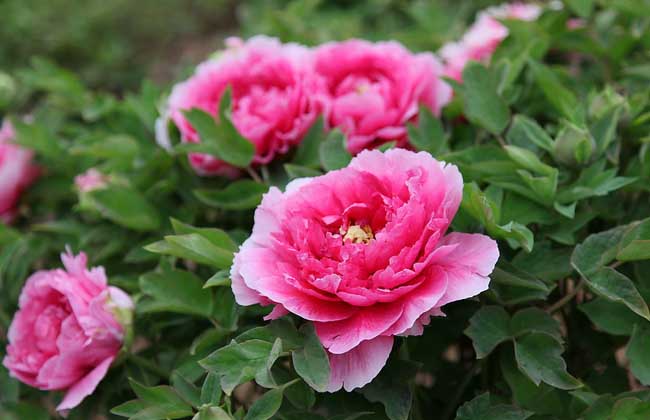
The peony is also known by other names such as Shugu, Lujiu, Bairong, Mu Shaoyao, Baiyujin, Luoyang flower, and fuqui flower. It is a perennial deciduous small shrub in the family Paeoniaceae, genus Paeonia. Its flowers are brilliantly colored, jade-like in beauty and pearl-like in fragrance, elegant and unrestrained, magnificent and splendid, and it has long enjoyed the reputation of “king of flowers.” Among cultivated types, it can be divided into hundreds of varieties mainly according to flower color. It is widely cultivated in China and was long ago introduced to various parts of the world, and there is a rich body of related cultural and painting works.
The peony stem reaches up to 2 m tall, with short and thick branches. The leaves are usually bipinnately trifoliolate compound leaves, occasionally the leaves near the branch tips have 3 leaflets. The terminal leaflet is broadly ovate, 7-8 cm long and 5.5-7 cm wide, 3-lobed to the middle, the lobes not lobed or 2-3 shallowly lobed, green and hairless on the surface, pale green on the underside, sometimes with a white bloom, sparsely covered with short soft hairs along the veins or nearly hairless, the petiolule 1.2-3 cm long; the lateral leaflets are narrowly ovate or oblong-ovate, 4.5-6.5 cm long and 2.5-4 cm wide, unequally 2-lobed to 3-shallowly lobed or not lobed, nearly sessile; the petiole is 5-11 cm long and, like the leaf rachis, hairless.
The peony flower is solitary at the tip of the branch, 10-17 cm in diameter, the pedicel 4-6 cm long, with 5 bracts, oblong, of unequal size; 5 sepals, green, broadly ovate, of unequal size; 5 petals, or double petals, rose-colored, red-purple, pink to white, usually highly variable, obovate, 5-8 cm long and 4.2-6 cm wide, the apex irregularly wavy; stamens 1-1.7 cm long, the filaments purple-red or pink, white in the upper part, about 1.3 cm long, the anthers oblong, 4 mm long; the disk leathery, cup-shaped, purple-red, with several sharp teeth or lobes at the apex, completely enclosing the carpels and splitting open when the carpels mature; 5 carpels, rarely more, densely covered with soft hairs. The follicle is oblong and densely covered with yellow-brown bristles. The flowering period is May, and the fruiting period is June.
The peony likes a warm, cool, dry, and sunny environment. It likes sunlight but also tolerates partial shade, tolerates cold, tolerates drought, and tolerates weak alkalinity; it dislikes waterlogging, fears heat, and fears direct scorching sun. It is suitable for growing in loose, deep, fertile, high and dry, well-drained neutral sandy loam, and grows poorly in acidic or heavy clay soil. Sufficient sunlight is relatively favorable for its growth, but it does not tolerate the scorching sun in summer, and temperatures above 25°C will cause the plant to enter a dormant state.
China is especially rich in peony resources. According to a survey by the special team staff of the Chinese Peony National Flower Competition Office, peonies are planted in Yunnan, Guizhou, Sichuan, Tibet, Xinjiang, Qinghai, Gansu, Ningxia, Shaanxi, Guangxi, Hunan, Guangdong, Shanxi, Henan, Shandong, Fujian, Anhui, Jiangxi, Jiangsu, Zhejiang, Shanghai, Hebei, Inner Mongolia, Beijing, Tianjin, Heilongjiang, Liaoning, Jilin, Hainan, Taiwan, China, Hong Kong, China and other places, and they roughly fall into several types: wild species, semi-wild species, and horticultural cultivars. The largest and most concentrated peony cultivation areas in China include Heze, Luoyang, Pengzhou, Beijing, Linxia, Tongling County, and others.
The peony is a specialty flower native to China, with thousands of years of natural growth and more than two thousand years of artificial cultivation history. Its flowers are large, beautiful in form, brilliant in color, and rich in fragrance, and it has been praised by people of all dynasties. It has high ornamental and medicinal value. Since it was recorded as a medicinal plant in the Shennong Bencao Jing during the Qin and Han dynasties, there has been no lack of writing about it scattered through ancient books of various dynasties. Peony culture is compatible with many disciplines, and its composition is very broad, including philosophy, religion, literature, art, education, customs, folkways, and all cultural fields.