How to propagate tree peony seedlings? Detailed propagation techniques
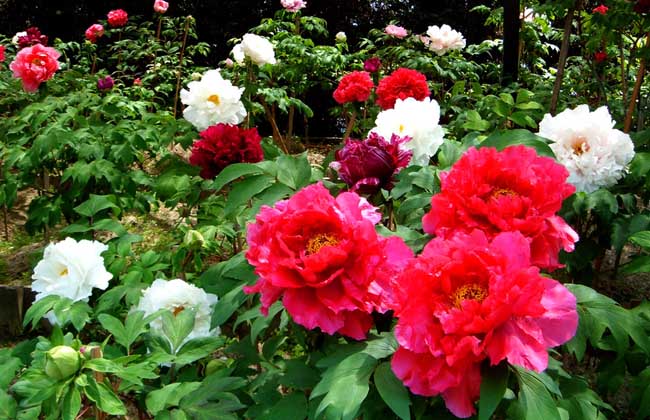
The tree peony is a precious woody flowering plant unique to China. It is a perennial deciduous small shrub of the genus Paeonia in the family Paeoniaceae, and has long been known as the “king of flowers.” In May 1985 it was rated second among China's top ten famous flowers. Its propagation methods include division, grafting and sowing, but division and grafting are the most common, while sowing is mostly used to breed new varieties. Let's take a look at the propagation techniques for tree peony seedlings below!
Division propagation
Dig up a large, vigorously growing tree peony as a whole, and separate it at the junctions of the root system's veins. The number of divisions per plant depends on the size of the original plant: large ones can be divided into more, small ones into fewer. Generally, every 3 to 4 branches form one division, and each should have a relatively complete root system. Then mix a little sulfur powder with mud and spread it evenly over the wounds on the roots, and it can be planted separately. The time for division propagation is from the Autumn Equinox to Frost's Descent each year, and it is best done at the right time. At this time, the air and soil temperatures are relatively high, and the tree peony is in a semi-dormant state, but there is still a fairly long period of vegetative growth, so division planting has little serious effect on root growth, and after division planting some new roots and a small number of buds can still emerge. If division planting is too late, root growth that year will be very weak, or no new roots will form, and the following spring the plant will develop even more weakly; weak roots cannot tolerate drought and the plant may easily die. If division is too early, when air and soil temperatures are relatively high, it can still grow rapidly and may easily cause autumn growth.
Cutting propagation
Cutting propagation is a method that uses the tendency of tree peony branches to produce adventitious roots to propagate new plants, and is one of the asexual propagation methods. The method is to first cut off the branches for cutting, detach them from the mother plant, and then insert them into soil or another medium so they take root and become new plants. For tree peony cutting propagation, choose current-year soil shoots sent up from the base of the tree peony, or, when pruning and shaping the tree peony, choose branches with solid stems, plump terminal buds and no pests or diseases as cuttings, 10 to 18 cm long. The tree peony's roots are fleshy roots; they like dryness, dislike moisture and tolerate drought. Therefore, the seedling bed should be chosen in a ventilated, sunny place and built up into a raised bed for raising seedlings. When cutting, water each bed immediately after it is planted, giving one thorough watering.
Seed propagation
Seed propagation is the use of seeds to reproduce offspring or select and breed new varieties, and is a sexual propagation method. Before sowing, the soil must be carefully prepared and disinfected; the land should be deeply plowed and carefully worked, with sufficient base fertilizer applied. Then build small beds 70 to 80 cm wide; both hole sowing and drill sowing are acceptable. Do not sow too deep; 3 to 4 cm is the limit. After sowing, cover with soil level with the bed surface. Then gently firm the soil and water thoroughly immediately.
Layering propagation
Tree peony layering propagation is a propagation method that uses the principle that branches can produce adventitious roots. Press the branches down or bury them with soil while still on the plant, without detaching them from the mother plant, and keep the soil moist; the buried part of the branch takes root, then it is cut off and planted to become a new plant. It is likewise an asexual propagation method for tree peonies. This method mainly includes: the pot-layering and soil-mounding method and the double-flat method.
Tissue culture
Tissue culture propagation is based on the totipotency of plant tissue cells, using tree peony embryos, flower buds, stem tips, young leaves and petioles for in vitro culture. Generally, these materials are placed in 75% alcohol and soaked for 5 to 10 minutes, then immediately put into sterile water for washing, then soaked in 5% Antiformin solution for 7 to 10 minutes for surface sterilization, then rinsed 3 to 4 times with sterile water, and finally placed on the culture medium for sterile culture. The basic medium is MS, and the other additional components mainly include different concentrations or different combinations of indoleacetic acid, naphthaleneacetic acid, indolebutyric acid, gibberellin, hydrolyzed protein and so on.
Grafting propagation
1. Inlay grafting: Use peony root as the rootstock. Because peony root is soft and has no hard core, it is easy to graft; the root is thick and short, rich in nutrients, and growth is vigorous in the early stage after the graft takes. If tree peony root is used for grafting, the xylem is harder and grafting is relatively difficult, but the lifespan is longer. The best time for grafting is generally late September to early October each year, and the rootstock used is a thick, strong peony root 2 to 3 cm in diameter and 10 to 15 cm long, free of pests and diseases.
2. Side grafting: Side grafting is a method of top grafting to change the head and improve varieties, using the many branches on inferior tree peonies or 8-to-10-year-old medicinal tree peony plants to graft superior varieties of different colors. The grafting time is early July to mid-August. First choose a tree peony plant with excellent variety, a stout plant and no pests or diseases, and cut soil shoots sent up from the ground, or current-year short branches 5 to 7 cm long; it is best to use short branches with 2 to 3 strong buds as scions. Leave one petiole on the scion. After selecting the scion, make a slanted cut on the back of the lower bud of the scion into a horse-ear shape, then make another slanted cut on the other side of the horse-ear shape into a wedge shape, so that after grafting both sides can contact the cambium tissue between the xylem and phloem, which makes it easier to survive. Before and after side grafting of tree peonies, except that no irrigation is given during the rainy season, suitable moisture for normal plant growth should be maintained.
3. Bud grafting: Bud grafting is carried out from May to July, and it is best to do it on a sunny day. There are two methods: the bark-patch method and the bud-exchange method. The bark-patch method is to cut out a rectangular or shield-shaped incision together with the xylem on the current-year branch of the rootstock, then cut off the axillary bud of the scion together with the xylem into a bud piece the same size and shape as that on the rootstock, then quickly press the bud piece onto the incision on the rootstock and tie it tightly with plastic string. The bud-exchange method is to remove the axillary bud together with the cambium at the grafting site on the rootstock, keeping the intact bud embryo on the xylem, then in the same way peel off the axillary bud of the scion, quickly fit it onto the bud embryo of the rootstock, taking care that the two match, and finally tie it tightly with plastic string. After grafting, the plant should be watered, the soil loosened and fertilizer applied in good time to promote healing.