What are the cultivation methods for ranunculus?
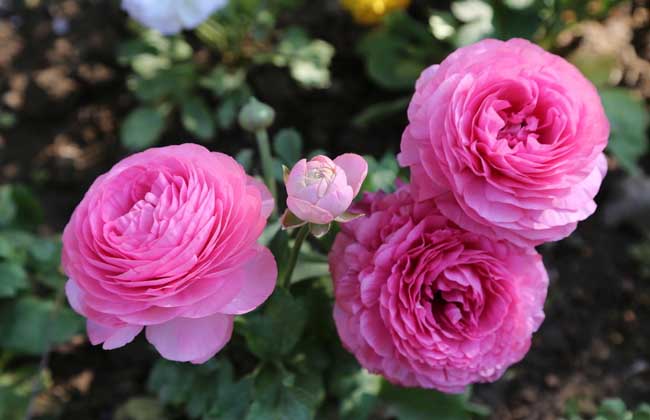
Ranunculus, also known as Persian buttercup, celery flower, Persian crowfoot, and buttercup, is a perennial herbaceous flower of the genus Ranunculus in the buttercup family. It has rich flower colors and flower shapes similar to peonies, but smaller. It is native to southeastern Europe and southwestern Asia. In 1596, the British introduced it for artificial cultivation, and it is very common in gardens and cut flowers. Let's take a look below at how to grow ranunculus!
Cultivation environment for ranunculus
Ranunculus prefers a cool and semi-shaded environment and avoids intense heat. The suitable growing temperature is around 20°C during the day and 7-10°C at night. It fears both moisture and drought, and is best planted in well-drained, fertile, loose neutral or slightly alkaline soil. After June, the tubers enter dormancy. It prefers a mild climate, fresh and humid air, and a loosely shaded growing environment. It is not tolerant of severe cold and freezing, and is even more afraid of summer heat and strong sun. In most parts of China, it enters dormancy in summer. For pot cultivation, it requires a sandy culture soil rich in humus, loose and fertile, with strong permeability.
Propagation methods for ranunculus
The propagation methods of ranunculus mainly include tuber division propagation, seed propagation, and tissue culture propagation. Tuber division propagation has the characteristics of a short growth cycle, early flowering, larger plant type, more flowers, and relatively easy cultivation. However, its division propagation coefficient is low and the propagation speed is slow, far from meeting the needs of large-scale production. Seed propagation has a high multiplication rate and bright colors, but fewer flowers and a longer growth period. If no cooling measures are taken and sowing is not advanced, it will not bloom until March or April, and it has relatively high requirements for cultivation skill. Although tissue culture propagation of ranunculus tubers has a high propagation coefficient and fast speed, it has relatively strict requirements for inoculation timing and explant selection, and the propagation technology is difficult and the cost is relatively high, so there is a certain degree of difficulty in actual production. Therefore, the seeding method is used to produce commercial ranunculus tubers, and then the tubers are used to produce finished ranunculus plants to improve the cultivation efficiency of potted ranunculus.
How do you cultivate ranunculus?
1. Light management: Ranunculus is not tolerant of strong light and prefers a semi-shaded environment. In winter, light should be sufficient. In spring, as the temperature rises and light intensity increases, moderate shading should be applied and ventilation strengthened. Ranunculus is a relatively long-day plant, so long-day conditions can promote flower bud differentiation, advance the flowering period, terminate vegetative growth earlier, and begin tuber formation earlier. Under short-day conditions, the flowering period is delayed, but it can promote more lateral buds, increase the crown width, increase the number of flowers, and further improve the quality of potted flowers. In production, long-day and short-day regulation should be carried out according to actual needs to achieve the purpose of advancing or delaying the flowering period.
2. Water management: Ranunculus prefers moisture and fears waterlogging. It is relatively drought-tolerant, but should not be excessively dry, especially in the later stages of growth. Excessive drought will cause ranunculus to enter a forced dormant state, resulting in poorer tuber quality. After planting, the first watering should be thorough, and subsequent watering should be timely and balanced, and it must not be too dry or too wet. The degree of watering should be based on the soil surface being dry while the leaves do not show wilting.
3. Fertilizer management: Before planting ranunculus, decomposed cake fertilizer or livestock manure and other organic fertilizers should be selected as base fertilizer and spread evenly. After transplanting, topdressing should begin when the plants show obvious growth or grow new leaves. The fertilizer concentration should be 0.1% in the early stage and 0.15-0.2% in the later stage. Use 46% urea and 45% water-soluble compound fertilizer alternately. In the early stage, urea should be the main fertilizer, and in the later stage, compound fertilizer should be the main fertilizer, applied once every 7 days. In winter, compound fertilizers containing nitrate nitrogen should be used as much as possible, and compound fertilizers containing chlorine should not be used. After flowering, apply 1-2 times of liquid fertilizer mainly containing potassium to promote tuber enlargement.
4. Temperature management: Ranunculus prefers a cool environment. The optimum growth temperature is 15-20°C during the day and 7-8°C at night. The temperature should not be too high or too low, and the temperature difference between day and night should not be too large, otherwise the growth and development of ranunculus will be affected, leading to a decrease in flower number and quality. During production, the maximum temperature inside the plastic greenhouse should not be higher than 22°C, and the minimum should not be lower than 0°C. Generally, using one layer of greenhouse covering in winter results in better growth. After planting, normal temperature management can be carried out when the central leaves show obvious growth.
5. Flowering period management: After flowering, attention should be paid to adjusting the greenhouse temperature to 15°C to prolong the flowering period. Spent flowers and diseased plants should be promptly removed and cleaned out. Watering should be balanced, avoiding excessive dryness or moisture.