What colors do chrysanthemums come in? A big roundup of common flower color varieties
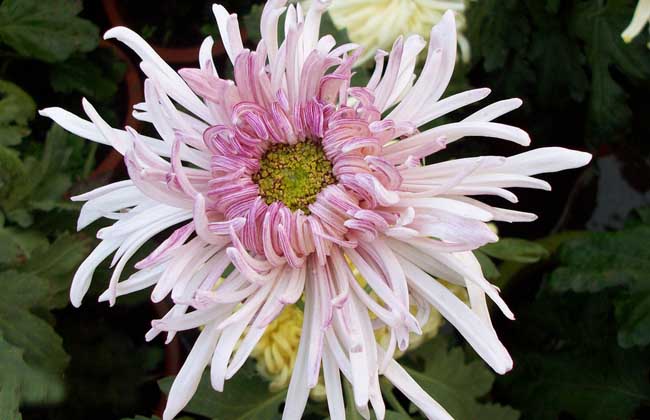
The chrysanthemum is a perennial herbaceous plant of the genus Chrysanthemum in the Asteraceae family. By cultivation form, it is divided into types such as spray chrysanthemums, disbudded chrysanthemums, large trained chrysanthemums, cascade chrysanthemums, artistic chrysanthemums and desk chrysanthemums; by petal appearance and form, it is divided into types such as inward-curling, reflexed, reversed, irregular, open-centered and flying-spoon. Let's take a look below at what colors chrysanthemums come in!
What colors do chrysanthemums come in?
The chrysanthemum's flower head is terminal or axillary, borne singly or several clustered together. The ray florets are female flowers, and the tubular florets are bisexual flowers. Ray florets are divided into four types: flat, spoon, tube and irregular, with rich colors including red, yellow, white, dark, purple, green, orange, pink, brown, lavender-blue, pale green and so on. The tubular florets develop into variously colored "anemone-centered petals", with color series including red, yellow, white, purple, green, pink, bicolor, and intermediate colors.
What varieties of chrysanthemums are there?
1. Classification by flower diameter: flowers with a diameter above 18 cm are called large chrysanthemums, those with a flower diameter between 6 and 18 cm are called medium chrysanthemums, and those with a flower diameter below 6 cm are called small chrysanthemums.
2. Classification by flowering season: divided into summer chrysanthemums, autumn chrysanthemums and cold chrysanthemums.
3. Classification by flower type: the flower heads of chrysanthemums form different flower types according to the different arrangement of their ray florets, mainly including single-petal type, curled-spreading type, dancing-ring type, spherical type, rosette type, dragon-claw type, anemone-centered type, hanging-bead type, hanging-thread type, burr type and so on.
4. Classification by commercial application: divided into spray chrysanthemums, specimen chrysanthemums, trained chrysanthemums, cascade chrysanthemums, high-grafted chrysanthemums, tied chrysanthemums, flowerbed chrysanthemums and so on.
5. Classification by photoperiodic response: short-day hybrid chrysanthemums used for year-round flowering, whose natural flowering period is in autumn. In the Northern Hemisphere, varieties are divided into early, middle and late types according to how early or late they bloom. By response group, they are divided into 6-15 week varieties, meaning the number of weeks needed from the start of short-day treatment to flowering. The commercial cut chrysanthemum varieties cultivated on a large scale in Guangdong include Huangxiu chrysanthemum, Shehuang, Jinhuang, Taihong, Dabailian and so on, all controlled by lighting to regulate flower bud differentiation so that they come to market evenly.
6. Classification by flower color: classified according to the color of the chrysanthemum, divided into white chrysanthemum, yellow chrysanthemum, red chrysanthemum, orange chrysanthemum, cyan chrysanthemum, brown chrysanthemum, purple chrysanthemum, green chrysanthemum, dark chrysanthemum and so on.
7. Classification by ray floret shape: divided into flat petals, broad petals, claw petals, tube petals, needle petals, thread petals, hook petals, twisted petals and so on.
What effects does chrysanthemum have?
1. Dispersing wind and clearing heat: chrysanthemum has the effect of dispersing wind-heat from the Lung meridian, but its power to dispel exterior pathogenic factors is not strong. It is commonly used to treat symptoms such as fever, headache and cough caused by wind-heat common cold or by warm pathogens invading the lungs in the early stage of warm diseases. It is often used together with mulberry leaf, which has similar properties, and is often combined with other Chinese medicines.
2. Calming and suppressing liver yang: chrysanthemum can clear liver heat and calm liver yang, and is often used to treat symptoms of liver yang rising with headache and dizziness. It can be used together with other medicines that calm liver yang and subdue yang, clear liver heat and extinguish liver wind, and can be combined with other Chinese medicines to treat those with excessive heat in the Liver meridian and extreme heat stirring wind.
3. Clearing liver heat and improving eyesight: chrysanthemum can both disperse wind-heat from the Liver meridian and clear and drain liver heat to improve eyesight. It can be combined with other Chinese medicines to treat red, swollen and painful eyes caused by wind-heat in the Liver meridian or liver fire attacking upward. If there is insufficiency of liver and kidney essence and blood, failure to nourish the eyes, blurred vision and unclear sight, it can also be combined with corresponding Chinese medicines to achieve the effects of nourishing the liver and kidneys and benefiting yin to improve eyesight.
4. Clearing heat and detoxifying: chrysanthemum can clear heat and detoxify, and can be used to treat sores, carbuncles and swellings. It can be combined with some other Chinese medicines, but because its heat-clearing and detoxifying effect is weaker than that of wild chrysanthemum, this product is generally not chosen.
5. Resisting tumors: chrysanthemum has a certain anti-tumor effect. Through experimental extraction of chrysanthemum components, it was found that the progesterone-like substances extracted from it contain the main anti-tumor components luteolin and apigenin. Luteolin can inhibit the movement and invasion of ovarian cancer cells, and apigenin can inhibit the phosphorylation of retinoblastoma protein, causing G1 phase arrest of cells, and can also activate cyclin-dependent kinase 1 to affect CDK activity, thereby causing G2/M phase arrest of cells.
6. Slowing aging: experimental studies have shown that the progesterone-like compounds contained in chrysanthemum have the ability to scavenge free radicals and have relatively strong antioxidant activity, and the antioxidant activity of chrysanthemum is closely related to the content of progesterone-like compounds. Experiments show that chrysanthemum has an antioxidant and anti-aging effect.
7. Resisting viruses: chrysanthemum has a certain antiviral effect. Research has shown that chrysanthemum can inhibit poliovirus, measles virus, herpes simplex virus and others to varying degrees. If the active ingredients in chrysanthemum reach a certain concentration, it can also effectively inhibit influenza virus, and may even have a certain inhibitory effect on HIV.
8. Antibacterial effect: the chrysanthemum volatile oil in chrysanthemum can inhibit the activity of many kinds of bacteria, especially with the most obvious inhibitory effect on Staphylococcus aureus, while fresh chrysanthemum after decoction in water can also inhibit the activity of Gram-positive bacteria and bacilli to a certain extent, so to a certain extent chrysanthemum has an antibacterial effect.