When Does Eucalyptus Bloom? An Introduction to Its Flowering Season
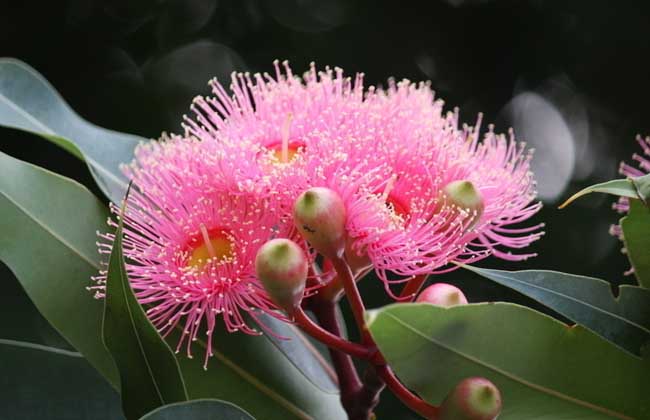
Eucalyptus, also known as bailan oil tree, mangshu, youjiali, large-leaf eucalyptus and so on, is the collective name for plants of the genus Eucalyptus in the family Myrtaceae. Most species originate from the Australian continent, growing on sunny plains, hillsides and roadsides, and are cultivated in southern and southwestern China. Let's take a look below at when eucalyptus blooms!
When does eucalyptus bloom?
Eucalyptus grows very rapidly, generally flowering and fruiting 3 to 4 years after afforestation, but flowering times differ among varieties. Usually, the flowering period of Eucalyptus exserta (small-leaf eucalyptus) is in June, that of Eucalyptus robusta is from April to September, Eucalyptus citriodora blooms from November to January of the following year, fast-growing eucalyptus blooms from mid-September to mid-October, Eucalyptus obliqua blooms from August to September, and the flowering and fruiting period of Eucalyptus maidenii is usually in the two seasons of spring and autumn.
Is eucalyptus actually toxic?
Eucalyptus is not toxic. Research by the Eucalyptus Research Center of the State Forestry Administration shows that eucalyptus is not only non-toxic, but can also be directly used by animals and humans. Eucalyptus contains eucalyptus oil, a type of natural compound extracted from eucalyptus leaves, which can be used in cosmetics. For example, Head & Shoulders also contains eucalyptus essence. Many pharmaceutical raw materials contain eucalyptus oil as an ingredient, and it can also be used as a medicinal raw material for oral use, rhinitis use, expectorant use, cooling oil, throat lozenges, wind-dispelling ointment and so on. Eucalyptus oil contains eucalyptol, which is mainly used in toothpaste, mouthwash, food and medicine and other fields.
Common cultivated varieties of eucalyptus
1. Eucalyptus tereticornis: Eucalyptus tereticornis is a large tree, 25 m tall. The bark is smooth, grayish white, and sheds in long strips. Young branches are round, slender, and drooping. Juvenile leaves are ovate. Transitional leaves are broadly lanceolate. Mature leaves are narrowly lanceolate, slightly curved. Umbels are axillary, with stout peduncles. Flower buds are long ovate. Stamens have longitudinally dehiscing anthers, and capsules are nearly spherical. It is native to the eastern coastal areas of Australia, at elevations up to 1800 m, commonly found in loamy soils with relatively sufficient rainfall. It tolerates light frost in winter, is not suited to acidic soil, and is cultivated in Guangdong, Guangxi, Fujian, Guizhou, Yunnan and other places. The wood is pale and used for construction, vehicles, ships, machinery, sleepers and so on.
2. Eucalyptus camaldulensis: Eucalyptus camaldulensis is the most widely distributed in Australia, found almost everywhere except deserts and semi-deserts. Its more suitable conditions are areas below 250 m elevation, with annual rainfall of 250 to 600 mm, and habitats with only light frost in winter. It is most commonly found along riverbanks. It is also widely planted in China, cultivated from South China to Southwest China. It is a relatively ideal tree species, growing rapidly and with a certain drought resistance and cold tolerance. The wood is red, highly decay-resistant, and suitable for sleepers, wooden stakes and so on.
3. Eucalyptus citriodora: Eucalyptus citriodora is an evergreen large tree, up to 40 m tall, with a diameter at breast height of up to 1.2 m. Its trunk is tall and straight, and its bark is smooth and white, earning it the title of “fairy of the forest”. It is native to Australia and has been introduced to China for nearly a hundred years, and is cultivated in South China as well as Fujian, Zhejiang, Yunnan, Sichuan and other places. It is light-loving, highly adaptable to climate and soil, drought-tolerant, fast-growing and high-yielding, and is an important afforestation tree species in South China. It is suitable for afforestation on the lower parts of low hills in the south and coastal mountains as well as greening around the four sides, and is also an important fast-growing timber tree species and a very good aromatic oil tree species in the south.
4. Eucalyptus exserta: Eucalyptus exserta, also known as small-leaf eucalyptus, wind-blown willow and so on, is native to Australia and distributed from basalt and sandstone areas along the eastern coast to drier inland areas. It is widely planted throughout South China, and relatively large-scale afforestation trials have been carried out on the Leizhou Peninsula in Guangdong, with preliminary results achieved. The stems of seedlings are mostly crooked, but after felling and regeneration, the coppiced stems are mostly straight. It is a commonly used tree species for afforestation in South China at present, though its wind resistance is somewhat poor and it is not tolerant of typhoon strikes. The wood is light red, hard and decay-resistant, and the leaves contain 0.82% oil.
5. Eucalyptus robusta: Eucalyptus robusta is a densely shaded large tree, up to 20 m tall. The bark does not shed, is dark brown, and has irregular oblique fissures. Young branches are angular. Young leaves are opposite, leathery, ovate, and stalked. Mature leaves are alternate, thickly leathery, ovate-lanceolate, unequal on both sides, with glandular dots on both surfaces. Umbels are large, with flattened peduncles; pedicels are short, thick and flat; petals and sepals unite into a cap-like structure. Capsules are ovate-urn-shaped, slightly contracted in the upper half, with the capsule opening slightly enlarged. The flowering period is from April to September. It grows on sunny plains, hillsides and roadsides, is native to Australia north of the southern latitude, and is cultivated in southern and southwestern China.
6. Eucalyptus obliqua: Eucalyptus obliqua is 20 m tall. The bark is persistent, dark brown, and cracked into squares like pine bark. Young branches are angular. Juvenile leaves are opposite, ovate or broadly lanceolate, up to 7 cm wide. Mature leaves are leathery, lanceolate, slightly curved, with fine small black glandular dots on both surfaces. Umbels are axillary, with flat peduncles; flower buds are spindle-shaped with pointed ends; the cap-like structure is the same length as the calyx tube, with an acuminate tip. Capsules are nearly spherical or bell-shaped, with the fruit rim level with the calyx tube opening and protruding outside the calyx tube. The flowering period is from August to September. It is native to moist saline-alkali soils along the eastern coast of Australia, is planted throughout South China, grows rapidly, has strong sprouting ability, and tolerates poor soil.
7. Eucalyptus globulus: Eucalyptus globulus, also known as yangcaoguo, gray willow, jade tree oil tree and so on, has gray-blue bark that sheds in flakes, and young branches are slightly angular. Juvenile leaves are opposite, sessile, and covered with white powder. Flowers are large, 4 mm wide, solitary or in clusters of 2 to 3 in leaf axils. Pedicels are absent or extremely short. The calyx tube is obconical, with 4 raised ridges and small nodular protrusions on the surface, covered with white powder. The cap-like structure is slightly flat and falls early. Stamens are in many rows, filaments are slender, and anthers are elliptical. The style is 7 to 8 mm long and stout. Capsules are hemispherical, with 4 ridges, a flat and wide fruit rim, and non-protruding valves. It is distributed and cultivated in Guangxi, Yunnan, Sichuan and other places, reaching as far north as Chengdu and Hanzhong, and its leaves and fruits are used as medicine.
8. Eucalyptus maidenii: Eucalyptus maidenii has gray-blue bark that sheds year by year, with persistent bark at the base. Young branches are round and angular. Young leaves are mostly opposite, with leaves ovate to round, and mature leaves lanceolate. Umbels have 3 to 7 flowers, peduncles are flattened or angular, flower buds are elliptical, the calyx tube is obconical, and the cap-like structure is triangular-conical, the same length as the calyx crown. Capsules are bell-shaped or obconical, with a relatively wide fruit rim, and the flowering and fruiting period is usually in the two seasons of spring and autumn. It is native to Australia and was introduced for cultivation less than 100 years ago. It is mainly produced in Yunnan, Guangxi, Guangdong, Hainan, Guizhou, Sichuan and other places in China, and prefers to grow on sunny flat land, hillsides and roadsides.