Why do bamboo plants die after flowering? An analysis of the causes
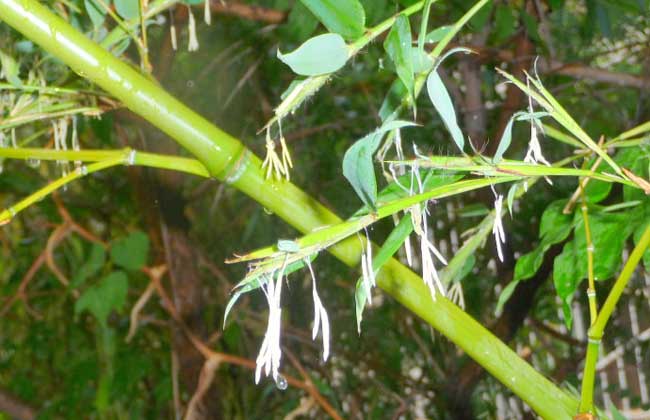
Bamboo is a fairly common plant. Because bamboo reproduces asexually through underground stems, it only flowers when it is about to die or when water, drought, or insect pests run rampant. This easily brings to mind famine years, disasters, and hunger, so some people in China regard it as an omen of fleeing famine and troubled times and avoid it. Now let us take a look at why bamboo plants die after flowering.
Do bamboo plants really flower?
Bamboo does flower. Bamboo does not flower and fruit every year like most flowering plants, so some people mistakenly believe that bamboo does not flower. In fact, bamboo is a flowering plant, and when it reaches a certain age it will also flower and set seed. After flowering, bamboo dies because it does not have enough nutrients to continue growing. When it flowers, white flocculent material generally appears, and the flower spikes contain white filaments and a small grain-sized particle that people call bamboo rice. The impact of bamboo flowering on the ecology is enormous; for example, giant pandas may die because of a lack of food.
The flowering cycle of bamboo
Different types of bamboo have different flowering cycle lengths. This is also affected by heredity and is related to the natural environment. Some bamboos flower only after more than ten or several dozen years. For example, Dendrocalamus strictus and Banna sweet bamboo need about 30 years to flower, Cizhu and Mao bamboo need 32 years to flower, and some species in the genus Bambusa need more than 80 years to flower. Some even take as long as a hundred years to flower, such as moso bamboo, which needs 120 years to flower. Of course, there are a few exceptions, such as Qunrui bamboo and Xianhen Cizhu, which flower about once a year, while Tang bamboo and hedge bamboo flower irregularly.
Why do bamboo plants die after flowering?
Why do bamboo plants wither and die in patches after flowering? This is a question that has puzzled people for a long time, and scientists also hold different views on it. Some scientists believe that when bamboo grows to a certain age, aging inevitably occurs, and in order to reproduce, it flowers and fruits before its life ends. Bamboo flowering exhausts the nutrients stored in the rhizomes and culms. In most species, such as moso bamboo and pear bamboo, both the aboveground and underground parts die completely after flowering. However, in a few bamboo species such as spotted bamboo, moso bamboo, and elegant bamboo, the aboveground parts die after flowering, while the buds in the underground parts can still rejuvenate and regenerate. There are also individual bamboo species such as water bamboo and flower bamboo whose leaves remain green after flowering and whose underground parts do not die. Nevertheless, the flowering branches should be cut off as soon as possible to reduce nutrient consumption and thus ensure the normal growth of the bamboo forest.
Reports of bamboo flowering
Around 1986, beside the primary school in Lilin Village, Futu Town, Yangxin County, Hubei Province, a formerly dense thatch bamboo forest flowered in patches and then withered and died.
On February 23, 2014, a large area of bamboo forest flowered at the entrance of the Yunmao Fa Fragrant Pig Breeding Farm in Shanxing Village, Jiangjiehe Town, Weng'an County, Guizhou Province. Today several plants were seen with yellowed leaves.
Around April 2014, bamboo planted in front of the homes of nearly a thousand farming households on Qianchuan Street, Huangpi District, Wuhan City, Hubei Province, all showed flowering.
At the end of April 2014, bamboo in Cangsheng Park in Shouguang City, Weifang City, Shandong Province, showed flowering.
In early May 2014, bamboo on the campus of Zhangqiu No. 4 Middle School in Zhangqiu City, Shandong Province, showed large-scale flowering.
In mid-May 2014, a large area of bamboo forest flowered on the campus of Changyi No. 1 Middle School in Shandong Province.
On May 21, 2014, a large area of bamboo forest in the courtyard of the Changli Fruit Tree Research Institute of the Hebei Academy of Agriculture and Forestry Sciences showed flowering.
On May 22, 2014, on the east side of the south end of Nanyang Bridge in Qingzhou City, Shandong Province, there was a bamboo forest about 30 m long and about 20 m wide, and most of the bamboo had produced flowers like rice ears, pale yellow, with long filaments protruding, which was very unusual.
On June 1, 2014, in Jinan Quancheng Park in Jinan City, Shandong Province, a large area of bamboo flowered, with shapes like white flower spikes and protruding filaments.
On June 3, 2014, all the bamboo in the Unicom courtyard in Beidaihe District, Qinhuangdao City, Hebei Province, flowered, with flowers like wheat ears, pale green, about 2 cm long
On June 4, 2014, bamboo flowering occurred in Xiaozhuyuan, Zhaxia Town, Shuyang County, Suqian City, Jiangsu Province.
In mid-June 2014, bamboo flowered at the China Institute of Atomic Energy in Beijing.