What does a cherry blossom tree look like? A detailed introduction to its physical characteristics
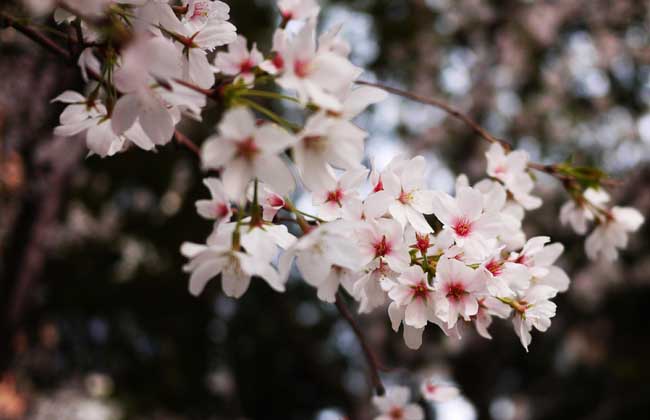
The cherry blossom tree is the collective name for several species in the genus Cerasus of the rose family (Rosaceae). It is a deciduous small tree. In China, varieties such as early cherry, late cherry, weeping cherry, and Yunnan cherry are commonly found, and late cherry is relatively widely used in planting and landscaping in China. It can be planted in groups to form groves, or planted on hillsides, in courtyards, along roadsides, and in front of buildings. According to documentary evidence, more than 2,000 years ago during the Qin and Han dynasties, cherry blossoms were already cultivated in Chinese imperial gardens, and by the Tang dynasty they commonly appeared in private courtyards. At that time, when envoys from many nations came to pay tribute, Japanese visitors brought cherry blossoms back to Japan, where they have a history of more than 1,000 years.
The cherry blossom tree is 4 to 16 m tall, with gray bark. The branchlets are pale purplish brown, hairless; the young twigs are green and sparsely covered with soft hairs. The winter buds are ovoid and hairless. The leaves are elliptic-ovate or obovate, 5 to 12 cm long and 2.5 to 7 cm wide, with a gradually pointed or abruptly caudate tip and a rounded, rarely cuneate, base; the margins have sharp double serrations with gradually pointed tips and small glands; the upper surface is dark green and hairless, the lower surface pale green and sparsely covered with soft hairs along the veins, with 7 to 10 pairs of lateral veins; the petiole is 1.3 to 1.5 cm long, densely covered with soft hairs, with 1 to 2 glands at the apex or sometimes no glands; the stipules are lanceolate, with pinnately lobed glandular teeth, covered with soft hairs, and fall early.
The inflorescence of the cherry blossom tree is an umbellate raceme, with a very short common peduncle, bearing 3 to 4 flowers, blooming before the leaves, with flowers 3 to 3.5 cm in diameter. The involucre is brown, elliptic-ovate, 6 to 7 mm long and 4 to 5 mm wide, sparsely covered with soft hairs on both surfaces. The bracts are brown, spoon-shaped and oblong, about 5 mm long and 2 to 3 mm wide, with glands along the margins. The pedicel is 2 to 2.5 cm long and covered with short soft hairs. The hypanthium is tubular, 7 to 8 mm long and about 3 mm wide, covered with soft hairs. The sepals are triangular-lanceolate, about 5 mm long, with gradually pointed tips and glandular teeth along the margins. The petals are white or pink, elliptic-ovate, with a concave tip and entire, bifid margins. There are about 32 stamens, shorter than the petals. The base of the style is sparsely covered with soft hairs. The drupe is nearly spherical and black, with the stone surface slightly ridged. The flowering period is April, and the fruiting period is May.
The cherry blossom tree is native to the temperate Himalayan region of the Northern Hemisphere, including Japan, northern India, the Yangtze River basin of China, Taiwan, China, and Korea. It is cultivated all over the world, and Japanese cherry blossoms are the most famous. There are about 200 or more cherry blossom varieties worldwide. In China, cherry blossom trees are mainly distributed in Jiangsu, Anhui, Zhejiang, Fujian, Shandong, Jiangxi, Beijing, Tianjin, Hubei, Shanxi, and other places.
The cherry blossom tree is a temperate and subtropical tree species. It likes sunlight and warm, humid climatic conditions, and has a certain degree of cold resistance. It is not demanding about soil and is best grown in loose, fertile, well-drained sandy loam, but it is not tolerant of saline-alkali soil. Its root system is relatively shallow, and it dislikes waterlogged low-lying land. It has a certain degree of cold resistance and drought resistance, but it is weak against smoke and wind, so it is not suitable for planting in coastal areas with typhoons.
The cherry blossom tree is an important flowering tree for early spring and is widely used for garden ornament. It can be planted in groups to form groves, or planted on hillsides, in courtyards, along roadsides, and in front of buildings. When in full bloom, the flowers are abundant and gorgeous, filling the tree with a lavish display, like clouds and rosy clouds, extremely spectacular. It can be planted in large areas to create a “sea of flowers” landscape, or planted in clusters of three to five to dot green spaces and form brocade-like masses, or planted alone to create the pictorial effect of “a single red among myriad green”. It can also be used as a street tree along paths, as a hedge, or made into bonsai.