When Do Cherry Blossoms Bloom? A Detailed Guide to the Blooming Period
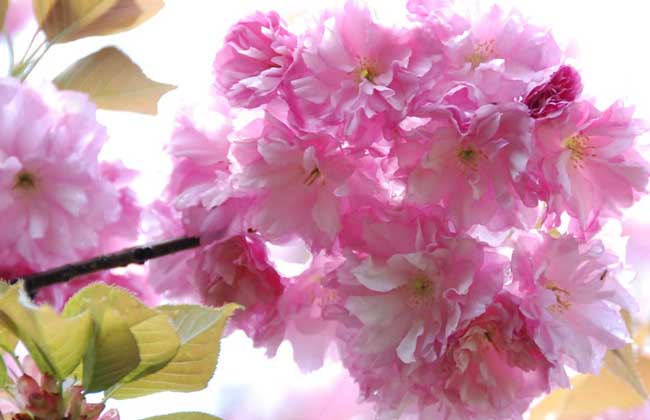
Cherry blossom is the collective name for several plants in the genus Prunus (Cerasus) of the rose family (Rosaceae). It originated in the temperate regions around the Himalayas in the Northern Hemisphere and grows throughout the world, mainly in Japan. Each branch bears 3 to 5 flowers in umbrella-shaped inflorescences, and the petal tips are notched. The flower colors are mostly white and pink. Let's take a look below at when cherry blossoms bloom!
When do cherry blossoms bloom?
Cherry blossoms usually bloom in April, with umbrella-shaped raceme inflorescences, and bear fruit in May. The drupe is nearly spherical. The blooming period is very short, usually four to ten days. Their beauty lies in the fervor of full bloom, and even more in the noble, pure and resolute spectacular scene of petals falling one after another after blooming. Cherry blossom colors include red, pink, vermilion, bright red, white, and pale pink-white. Korean cherry blossoms are mostly white, Japanese cherry blossoms are mostly multi-colored, and Chinese cherry blossoms are mostly pink.
What is the flower language of cherry blossoms?
Cherry blossoms are a symbol of love and hope, representing elegance and simple, pure love. Cherry blossoms are like innocent young girls, quietly blooming in spring. A tree full of white and pink cherry blossoms is the most beautiful language for telling a lover of love. Someone in your heart is like that lonely rain of cherry blossoms, slowly disappearing into the depths of time, leaving eternal memories.
Common varieties of cherry blossoms
1. Tokyo cherry (Prunus × yedoensis): The bark of the Tokyo cherry is purplish-brown, smooth and glossy, with horizontal stripes. Leaves and flowers are alternate; the leaf blade is elliptical or obovate-elliptical, with awn-like teeth along the edge, a pointed tip with glands, dark green and glossy on the surface, and slightly lighter on the underside. Stipules are lanceolate-linear, with finely divided serrated edges, and the split ends have glands. Each branch has three to five flowers in umbrella-shaped inflorescences; sepals spread horizontally, and petal tips are notched, white, red, or pink. The flowers open together with the leaves in March or after the leaves.
2. Somei Yoshino cherry (Prunus × yedoensis 'Somei-yoshino'): Somei Yoshino cherry is a horticultural variety of cherry blossom and a deciduous tree about 5 to 12 m tall. The flowers have five petals. The flower color is pale red when the flowers first open, and gradually turns white when fully open. Because it is artificially bred, it cannot naturally bear fruit and reproduce, and can only be propagated by cuttings. It has the same petal shape and color as Yoshino cherry, and the same blooming period, so they can bloom and fade at the same time. In Japan's Kanto region, the blooming period is about late March to early April.
3. Kanhizakura (Prunus campanulata): Kanhizakura is also called scarlet cherry, bellflower cherry, Fujian mountain cherry, etc. As the name suggests, it is a red cherry blossom that blooms in the cold early spring. Kanhizakura may indeed be considered the earliest cherry blossom to open in mainland China in a year, usually blooming in mid-February. Both its Chinese name and Latin scientific name can explain this: the inflorescences look like strings of long bells.
4. Mountain cherry (Prunus serrulata): Mountain cherry is the cherry blossom variety most widely introduced in China. Because of its diverse varieties and flower colors and its relatively long blooming period, it is favored in Japan and around the world. The original variety of mountain cherry is single-petaled. In mainland China, from Jiangnan to Northeast China, extending to the Korean Peninsula and Japan, it grows wild, but as a garden planting, it is less common than its variety, the Japanese late cherry. The Japanese late cherry has many horticultural varieties, with flower colors from pure white, pink-white, deep pink to pale yellow and light green. The newly grown young leaves also have different appearances, from yellow-green, red-brown to purplish-red. The petals range from single, semi-double to double. The emergence of each late cherry variety is the result of careful breeding.
5. Weeping cherry (Prunus subhirtella var. pendula): Weeping cherry is a variety, also called weeping large-leaved early cherry or large-leaved early cherry. Most cherry blossoms introduced to China have branches that grow upward or spread out. The weeping large-leaved early cherry is the same as most cherry blossoms in the early stage of growth, but after reaching a certain height, the large branches grow horizontally and the small branches are upright or drooping, forming weeping willow-like cherry branches, similar in form to the Japanese pagoda tree (Sophora japonica 'Pendula'). The flowers of the weeping large-leaved early cherry are pale red tending toward white, with a compact flower shape. Together with the quiet and elegant feeling brought by its weeping branches, it is often praised by Japanese people as the most beautiful cherry blossom.
6. Yunnan cherry (Prunus cerasoides): Yunnan early cherry is also called red-flowered tall pot cherry. It blooms before the leaves, with deep red flowers, about 25 petals, a flower diameter of about 2.5 cm, and flowers in a semi-open state, drooping, with red sepals. The young leaves are tea-brown. The blooming period is from late February to early March. This type of cherry blossom originated in Yunnan and is also distributed in Nepal, Bhutan, and Myanmar. It was first widely cultivated in Kunming, Yunnan, and since the 1980s has been promoted to major cherry blossom planting areas across the country. The flowers of the red-flowered tall pot cherry are mostly semi-double, with colors from deep pink to red, dense like clouds. It blooms in early spring at the end of February, almost in the same blooming period as Kanhizakura.
7. Edohigan (Prunus × subhirtella): Edohigan can grow into a large tree about 15-25 m tall. Somei Yoshino is exactly a hybrid of "Edohigan" and "Oshima cherry." Among Japan's representative ancient trees, many are Edohigan. The shape of the calyx tube is very distinctive, with the lower part swelling into a pot shape. Its blooming period is relatively early, and it got this name because it blooms during the spring equinox period. The petals are about 1 cm long, and the flower colors include pure white and red-purple, but pale red is more common. This cherry tree is very robust and long-lived, and many are large trees up to 15-20 m tall. The blooming period is late March (Tokyo), mid-April (Sendai, Kanazawa), and late April to early May (Morioka).