Can Asparagus Fern Be Put in the Sun? Key Points on Light Care
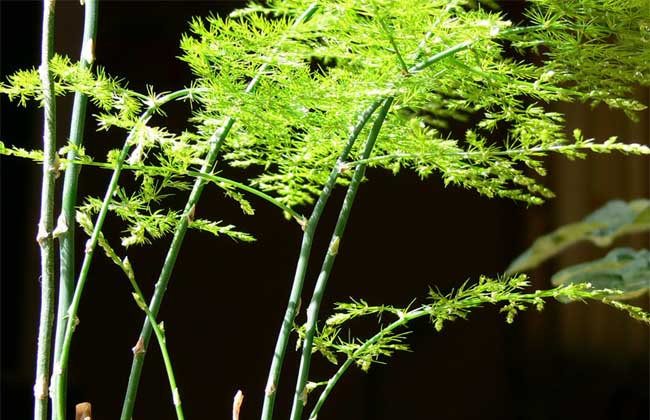
Although asparagus fern is not a true bamboo, its leaves are soft and delicate and stay green all year round, and its stems have nodes and resemble bamboo in shape, yet compared with upright bamboo it shows an elegant and unrestrained posture. It is a highly ornamental plant that can be placed in the living room or study, purifying the air while also adding a scholarly touch. Below, let us take a look at whether asparagus fern can be put in the sun!
Can Asparagus Fern Be Put in the Sun?
Asparagus fern can be given a suitable amount of sun. Asparagus fern likes a semi-shaded environment and is best placed indoors with diffused light. Except in winter, it should not be placed in direct sunlight during the other seasons. In spring, summer and autumn, if it is to be placed in the sun, it should be shaded. Also, watering should be moderate, not too much or too little. At the same time, in spring and autumn it should be fertilized once every half month.
Making a Bonsai with Asparagus Fern
1. Material selection: one asparagus fern about 20 cm tall, two asparagus ferns selected at just over 10 cm tall, an irregular-shaped white marble shallow pot with its matching stand, several pieces of rock about 10 cm tall, an appropriate amount of potting soil and moss.
2. Bonsai shaping: spread a thin layer of potting soil on the surface of the white marble shallow pot, plant the tallest asparagus fern with its curved branches and leaves facing left at the right end of the pot, plant the second-tallest asparagus fern not far to the left of the first asparagus fern and appropriately close to the back rim of the pot, then plant the shortest asparagus fern at the boundary between the 1/3 and 2/3 length of the pot, with its curved branches and leaves also facing left, so as to achieve coordinated and unified orientation of the three asparagus ferns. Then adjust the positions of the asparagus ferns in the pot until they appear natural and beautiful.
3. Placing stones and spreading moss: place several pieces of rock on the pot surface at a position appropriately toward the right rear, and cover the potting soil on the pot surface with moss to achieve a greening artistic effect. Finally, spray clean water onto the asparagus fern and moss to moisten the potting soil.
How to Grow Asparagus Fern
1. Pot soil: the potting soil for cultivating asparagus fern should be fertile sandy loam, requiring warmth and moisture, richness in decayed branches and leaves, and good drainage. Generally, it can be mixed in a ratio of 4 parts garden soil, 2 parts leaf mold, 2 parts compost soil and 1 part sand, and the soil should be changed and fertilized regularly. If over-concentrated fertilizing causes “root burn”, it is necessary to tip out the pot to remove the fertilizer, rinse the soil ball with clean water, and then replace it with new soil for growing.
2. Watering: watering is the key point in cultivating and growing asparagus fern. Too much watering and overly wet potting soil can easily cause root rot, while too little watering can cause the leaf tips to wither, scorch and turn yellow. Therefore, during watering, it should be determined according to the weather, growth condition and the dryness or moisture of the potting soil, following the principle of not watering when dry and watering thoroughly when watering. In hot and dry weather, the leaf surface can be sprayed with water to increase humidity and lower temperature, while in winter less water should be given.
3. Fertilizing: asparagus fern does not like heavy fertilizer, but it cannot lack fertilizer either. Limited by the potting soil of container growing, nutrients must be supplemented in time during cultivation to meet its growth requirements. During fertilizing, it should be frequent but in small amounts, and concentrated fertilizer must not be applied, otherwise it will cause yellow leaves. Generally, applying a thin liquid fertilizer once a month after decomposition is enough. After the plant grows larger and its form is established, fertilizing can be appropriately controlled and reduced. During the growing season, a thin fertilizer containing nitrogen and phosphorus should be applied as a top dressing 1 to 2 times a month to promote lush branches and leaves, and other liquid fertilizers may also be used. Do not fertilize too much during the flowering period; applying liquid fertilizer twice each in May to June and September to October as a top dressing is enough.
4. Light: when growing asparagus fern, it must not be exposed to the scorching sun. In hot seasons, it should be placed in a cool and ventilated place. At the same time, during the flowering period, asparagus fern is afraid of both wind and rain, so attention should be paid to good ventilation, and in good weather it can be appropriately placed outdoors to receive sunlight. In winter, the temperature for potted asparagus fern should be kept above 5°C to avoid freezing.
5. Placement: asparagus fern loves a clean environment with circulating air. If it is irritated by harmful gases such as smoke, dust, coal gas and pesticides, the leaves will turn yellow, curl and even die. Therefore, asparagus fern should be placed in a clean, tidy and well-ventilated environment, away from decorative materials such as marble that release mercury gas.