What meanings and symbolic significance does the asparagus fern have?
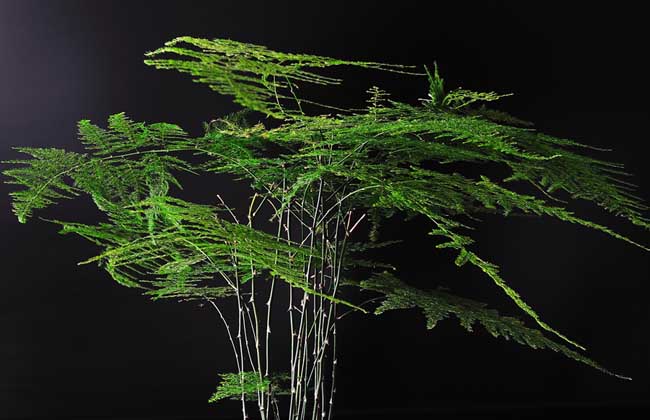
The asparagus fern, also known as cloud-pine, spiny asparagus, cloud bamboo and so on, originated in South Africa and is distributed across central China, the northwest, the Yangtze River basin and various places in the south. It likes warm, humid and semi-shaded, well-ventilated environments, is a highly ornamental plant, and can be placed in the living room or study, purifying the air while also adding a scholarly atmosphere. Now let us take a look at what meanings the asparagus fern has!
What meanings does the asparagus fern have?
The asparagus fern means "the bamboo of elegance". Although it is not bamboo, its leaves are soft and delicate, it stays green all year round, and its stems have nodes and resemble bamboo in appearance, yet compared with upright bamboo, it further highlights an elegant and unrestrained posture, hence it is called asparagus fern. It symbolizes eternity, and the pure heart of friends that never changes. In wedding flowers it is a symbol of a happy and sweet marriage and everlasting love.
The feng shui role of the asparagus fern
1. Placing the asparagus fern beside the television is good for health. The asparagus fern has medicinal value, and keeping a plant that can serve as a medicinal herb at home represents a yearning for health.
2. Placing the asparagus fern at the door is good for the owner's popularity. The asparagus fern symbolizes eternity, the pure heart of friends, and never changing; planting an asparagus fern at the door benefits the owner's popularity.
3. Placing the asparagus fern in the study is good for reading and work. The four treasures of the study - brush, ink, paper and inkstone - together with the "bamboo of elegance" make the study even more full of a refined and scholarly atmosphere, and people who are fond of feng shui all like such a layout.
4. Planting bamboo trees at home or in shops and factories carries the meaning of "bamboo reporting peace". However, since planting bamboo is for the sake of an auspicious omen, one may choose to plant the asparagus fern, preferably in a vase, and besides planting the bamboo, one can also place a large vase nearby, thus achieving a veritable "bamboo reporting peace".
How to grow the asparagus fern
1. Potting soil: The potting soil for cultivating the asparagus fern should be fertile sandy loam, requiring warmth and moisture, rich in leaf mold, and with good drainage. Generally, a ratio of 4 parts garden soil, 2 parts leaf mold, 2 parts compost soil and 1 part sand can be used, and the soil should be changed and fertilized regularly. If over-fertilizing causes "root burn", the pot needs to be turned out to remove the fertilizer, and the soil ball rinsed with clean water, then replaced with new soil for growing.
2. Watering: Watering is the key point in cultivating and growing the asparagus fern. Too much watering and overly wet potting soil easily cause root rot, while too little watering leads to withered, scorched and yellowing leaf tips. Therefore, in the process of watering, it should be determined according to the weather, the growth condition and the dryness or moisture of the potting soil, so as to not water when not dry, and water thoroughly when watering. In hot and dry weather, the leaves can be sprayed with water to increase humidity and lower temperature, while in winter less water should be given.
3. Fertilizing: The asparagus fern is not fond of fertilizer, but it should not lack fertilizer either. Limited by the potting soil of container growing, nutrients must be supplemented in time to meet its growth requirements. In the process of fertilizing, apply frequently but in small amounts, and do not apply concentrated fertilizer, otherwise it will cause yellowing of the leaves. Generally, applying a thin, well-rotted liquid fertilizer once a month is enough; after the plant has grown and taken shape, fertilizing can be appropriately controlled and reduced. During the growing season, apply a thin fertilizer containing nitrogen and phosphorus 1 to 2 times a month to encourage lush branches and leaves; other liquid fertilizers may also be used. Do not fertilize too much during the flowering period; just apply liquid fertilizer twice each in May to June and September to October.
4. Light: The asparagus fern must not be put out in the blazing sun to bake. In the hot season, it should be placed in a cool, ventilated place. At the same time, the asparagus fern during its flowering period is afraid of both wind and rain, so attention should be paid to good ventilation, and in good weather it may be appropriately placed outdoors to receive sunlight. In winter, the temperature for potted asparagus fern should be kept above 5°C to avoid freezing.
5. Placement: The asparagus fern loves a clean and well-ventilated environment. If stimulated by harmful gases such as smoke and dust, coal gas and pesticides, its leaves will turn yellow, curl up and even wither and die. Therefore, the asparagus fern should be placed in a clean and well-ventilated environment, away from decorative materials such as marble that release mercury vapor.
6. Pruning:
① Gap-filling pruning: When the growth position of the small leaf-like branches on the main branch is not ideal or is missing for some reason, short pruning can be carried out at an appropriate position on the main branch to force the dormant buds there to sprout. Generally, the height of the cut is the height at which the leaf-like branches sprout, and the position of the thorns on the branch is the position at which the leaf-like branches sprout, and the greater the thickness of the branch, the higher the sprouting rate of the dormant buds.
② Renewal pruning: If the branches and leaves of the whole plant grow poorly due to severe sunscald or overly dry potting soil, lack of fertilizer, or some unknown reason, renewal of the whole plant can be carried out. During renewal pruning, all the leaf-like branches can be cut off, but attention should be paid to the positions of the backward-facing thorns on the branches, because they determine whether the distribution of the retained branches is even. Pruning in the growing season generally makes it easy for new branches to sprout; after pruning, the amount of watering should also be appropriately reduced, and the potting soil must absolutely not be kept too wet, otherwise the pruning will fail.