Detailed Explanation of Key Pomegranate Bonsai Cultivation Techniques
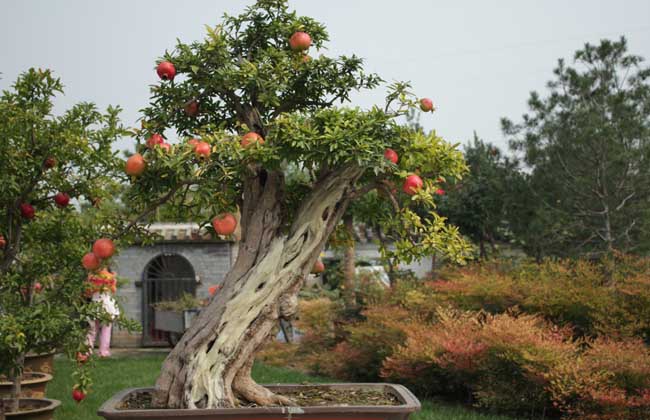
Pomegranate is also known as Shanliye, Danruo, Ruoliumu, Jinying, Jinpang, Tulin, Tianjiang, etc. It is a deciduous tree or shrub of the genus Punica in the family Lythraceae. In traditional Chinese culture, the pomegranate is regarded as an auspicious symbol and a representation of many children and abundant blessings. It has extremely high cultivation value, offering both ornamental flowers and edible fruit, and is therefore deeply loved by people. Let us now take a look at pomegranate bonsai cultivation techniques!
Growth Habits of Pomegranate Bonsai
The pomegranate is native to the Balkan Peninsula through Iran and adjacent regions, and is cultivated in temperate and tropical zones worldwide. It grows on mountains at elevations of 300-1000 m. It prefers warm, sunny environments, is drought-tolerant, cold-tolerant, and tolerant of poor soil, but is not tolerant of waterlogging or shade. It is not demanding regarding soil, but cultivation in well-drained sandy loam is preferable.
Stock Cultivation Management for Pomegranate Bonsai
For making pomegranate bonsai, small pomegranate species with dwarf stature, small leaves, and small flowers and fruits are mostly chosen, such as Huo Pomegranate (fire pomegranate), Siji Pomegranate (four-season pomegranate), and Manao Pomegranate (agate pomegranate). Propagation can be done by sowing or cuttings. Seedlings obtained by sowing or cuttings must be field-planted for more than 3 years before the trunk can be cut back and branches cultivated to produce small to medium bonsai. To make large bonsai, one can dig up tree stumps in the wild or purchase potted old pomegranate stumps from markets.
Branch Cultivation Management for Pomegranate Bonsai
For pomegranate, according to the tree's form, the trunk should be cut off at an appropriate height and the main branches shortened, allowing the creation of various styles such as straight-trunk, slanting-trunk, and curved-trunk. Some ancient-stump pomegranate bonsai have trunks composed of two pieces of bark with xylem, with fruit borne on the branches at the top of each bark section, giving a richer aesthetic through the contrast of withering and flourishing. Pomegranate trees have a certain cold tolerance; slight protection in a wind-sheltered, sunny location is sufficient. For faster tree growth, field planting is preferable. Pomegranate trees are heavy feeders; besides applying good base fertilizer at planting time, during the vigorous spring and summer growth period, apply decomposed dilute organic fertilizer once every half month. Growth is relatively fast; when branch thickness reaches about 70% of the ideal thickness, the branch should be cut short to promote the development of lateral branches.
Formation Management for Pomegranate Bonsai
After several years of branch cultivation, pruning, and training, when the pomegranate basically meets the designed composition requirements, in early spring the pomegranate stump is planted into an ornamental pot of suitable size and style. Straight-trunk and slanting-trunk styles can be planted in oval pots of medium depth or slightly shallower; curved-trunk style can be planted in square pots of medium depth. During this stage of cultivation, still apply somewhat more fertilizer to promote tree growth and better perfect the shape, while also taking into account the needs of appreciation.
Maintenance Techniques for Pomegranate Bonsai
1. Shaping: Pomegranate trees have strong sprouting ability, producing new branches several times within a year. Generally, robust new branches grown in spring can form fruit-bearing mother branches; the following spring, the terminal or axillary buds on these branches produce short new shoots that often flower, and the terminal bud flowers are the most likely to set fruit. Buds grown in summer and autumn should be removed promptly. Bonsai shaping is usually carried out before spring budding, cutting out water sprouts, overly dense branches, and thin weak branches, while taking care to retain those robust fruit-bearing mother branches.
2. Fertilizing: Pomegranate trees are heavier feeders than ordinary flowering plants. When repotting, place a suitable amount of fermented hoof pieces or cake fertilizer at the bottom of the pot. During the vigorous spring and summer growth period, fertilizers containing more phosphorus should be applied.
3. Environment: The period from late April to early June is the pomegranate's flower bud differentiation stage. Sufficient light should be provided and watering appropriately reduced to keep the potting soil on the dry side. When the new leaves at the branch tips are slightly wilted, place the pomegranate tree in a shaded area for 30 minutes, then water thoroughly. Repeat this several times, and flower buds will appear in about 20 days.
4. Fruit thinning: After the pomegranate fruits have set firmly, excess fruits not needed for the design should be cut off. A medium-sized pomegranate bonsai should retain 3-5 fruits. Fruit distribution should be staggered at different heights, with varying density, not evenly spaced. If there are too many fruits, besides appearing cluttered, it will also affect fruiting the following year.
Daily Management of Pomegranate Bonsai
1. Sunlight: Pomegranate loves sunlight; year-round full sun without shading is fine. Place in a ventilated, sunny location and it need not be moved frequently.
2. Watering: Pomegranate prefers dry conditions; water should not be excessive. During the flowering period, take care not to water onto the flowers. If water seeps into the ovary, it will cause the flower base to rot, leading to flower and fruit drop. Therefore, during the pollination period, guard against rainwater seepage when it rains and when watering.
3. Fertilizing: Pomegranate is a heavy feeder. When repotting, apply fully decomposed base fertilizer and phosphate fertilizer, preferably bone meal, which is high in phosphorus and has a long fertilizer effect period. Generally apply once every 10 days or half a month; do not apply raw fertilizer. Do not fertilize during the flowering period or when fruit is about to set; this is the key to pomegranate fruiting. If fertility is too abundant at this time, flowers tend to drop and fruit is difficult to set.
4. Cold protection: Pomegranate is not cold-tolerant. If the pomegranate is frozen, it will affect flowering and fruiting the following year. Therefore, good insulation management for the pomegranate should be done in winter.
5. Branch thinning: Pomegranate has strong sprouting ability; vigorous sprouted branches should be removed promptly, and branches and leaves should be regularly pruned to maintain tree shape and enhance ventilation and light penetration. If there is too much fruit, it should also be thinned promptly to ensure nutrient supply and flowering and fruiting the following year.
Pest and Disease Control for Pomegranate Bonsai
1. Pomegranate Dry Rot
[Symptoms]It damages fruits and also infects branches and trunks. Diseased young fruits generally develop bean-sized light brown spots around the calyx tube, which gradually expand until the entire fruit rots. From July to September, spots are prone to occur on the underside of fruits in contact with leaves. After mature fruits are affected, they lose water and become brown mummified fruits. During storage, it can cause fruit rot, with dense small black dots appearing on the fruit surface. When branches and trunks are affected, the bark color turns dark brown and dries up, with dense small black dots on it. The junction between diseased and healthy tissue often cracks, and the diseased bark lifts and peels off. Diseased branches weaken, leaves turn yellow, and the upper part dies quickly.
[Control]①Strengthen cultivation management to improve tree disease resistance. ②Clean the orchard; in winter, remove diseased branches, rotten fruits, etc. thoroughly along with pruning. In summer, promptly remove diseased fallen fruits and bury them deeply or burn them. ③Take care to protect the tree from freezing or injury. ④Bag the fruits. ⑤Scrape off diseased spots on branches and trunks and bury them deeply, then apply a protective treatment such as asomate. ⑥Spray lime sulfur mixture in early spring; from May to August, alternate Bordeaux mixture and carbendazim, etc., spraying once every 15-20 days for better results.
2. Pomegranate Brown Spot Disease
[Symptoms]After leaves are infected, small dark brown spots first appear, which expand to nearly circular. The lesion margins are black to dark brown, slightly raised, with a grayish-brown center. The symptoms on the underside of leaves are the same as on the upper side. Lesions on fruits are nearly circular or irregular, black and slightly sunken, also with gray fuzzy small granules. After the fruit colors, the outer edge of the lesion appears pale yellowish-white.
[Control]①Strengthen cultivation management, prune reasonably, and enhance tree vigor. ②Clean the orchard; after leaf fall, gather fallen leaves and fruits in the orchard and burn or deeply bury them. ③For chemical control, use 140-fold equal-strength Bordeaux mixture or 80% ultra-micro carbendazim 0.125-0.17% solution. Spray once at the early stage of disease onset; control efficacy can reach over 80%. If sprayed 3 consecutive times, the effect is even better.
3. Peach Fruit Borer
[Symptoms]Eggs are mainly laid in the pomegranate calyx tube. Newly hatched larvae mostly feed within the calyx tube or in double fruits or where fruits touch leaves, or bore into the fruit. Larvae have the habit of transferring to other hosts. After larvae mature, they mostly cocoon within damaged fruits or between fruits and in bark crevices, and pupate inside the cocoon.
[Control]①Scrape bark in early spring and plug tree holes. ②Plug the calyx tube with pesticide mud: mix 10 g of 90% trichlorfon with 100 times soil and 10 kg water into medicinal mud, form into mud balls and plug the calyx tube, which can effectively control larval damage for 70-80 days. ③Take advantage of the peach fruit borer's strong tendency to lay eggs on sunflower heads. Plant some sunflowers around the orchard; after blooming they attract adults to lay eggs, and spray pesticides regularly for control. ④During the adult occurrence period, spray 50% fenitrothion emulsion at 0.1% solution; after field application, the kill rate is over 90% within 5 days. During the first generation egg and larval hatching period, spray 50% phoxim or 90% trichlorfon at 0.1% solution 1-2 times for better results.
4. Pomegranate Noctuid Moth
[Symptoms]Larvae feed on buds and leaves. Larval body color resembles bark color, making them hard to find. They rest quietly during the day and feed at night. Mature larvae pupate and emerge at trunk forks. At the end of September, mature larvae descend from the tree and pupate in the soil near the trunk to overwinter. Generations overlap. Adults feed on fruit juice.
[Control]①After leaf fall and before budding, dig for overwintering pupae around the trunk. ②During the larval occurrence period, spray 90% trichlorfon at 0.15% solution or 50% phoxim emulsion at 0.2% solution for effective control.
5. Yellow Slug Moth
[Symptoms]It has 2 generations per year, overwintering as mature larvae in cocoons. Pupation begins in late May the following year. The first generation adult occurrence period is from mid-July to late August. Second generation larvae begin causing damage in late July, with the most severe damage in early to mid-August. Newly hatched larvae concentrate to cause damage, mostly gnawing leaf flesh on the underside of leaves. As they grow, they gradually disperse and their feeding increases, able to consume entire leaves, leaving only the petiole.
[Control]①In winter, along with winter pruning, cut off cocoons. ②During the period of concentrated larval damage, inspect the orchard and pick off leaves to destroy larvae. ③During the larval occurrence period, spray 90% trichlorfon or 50% dichlorvos at 0.15% solution, both giving good control results.
6. Ceroplastes japonicus (Japanese Wax Scale)
[Symptoms]One generation per year, overwintering as fertilized female adults on twigs. Damage begins in March and April the following year. The peak egg-laying period is during the wheat harvest. Larvae begin feeding and causing damage in late June and secrete wax to form a scale cover. Newly hatched crawlers are quite active and can spread long distances by wind. The insects begin to differentiate in late July; male and female adults appear in September. After mating, males die, while females continue to cause damage. They enter the overwintering state in November.
[Control]①During the overwintering period, manually scrape bark and cut off infested branch tips, and spray 5% diesel emulsion. ②In early spring, spray 1 time with 5° lime sulfur mixture. ③During the summer egg hatching period, spray 1 time with 50% wettable carbaryl at 0.17% solution.
7. Scale Insects
[Symptoms]It has 3-4 generations per year, overwintering as last-instar nymphs in bark crevices, old bark, and on fruit stalks of 2-3 year old branches. Damage begins in April the following year. As nymphs grow, they gradually form a waxy covering and differentiate into male and female. In early May, female adults have a raised back and lay eggs in felt-like sacs. Nymph hatching periods are from late May to early June, mid-to-late July, and late August to early September. In early October, nymphs begin to overwinter. It mainly spreads through nursery stock and cuttings.
[Control]①For severely affected orchards, use a stiff brush dipped in systemic insecticide to brush the branches and trunks from top to bottom once; the effect is good. ②In early spring when overwintering nymphs emerge from dormancy, this is the key period for chemical control. The best treatment is 3-5° lime sulfur mixture plus 0.3% laundry detergent, with control efficacy reaching over 95%.