Detailed Explanation of Pomegranate Bonsai Making Methods and Steps
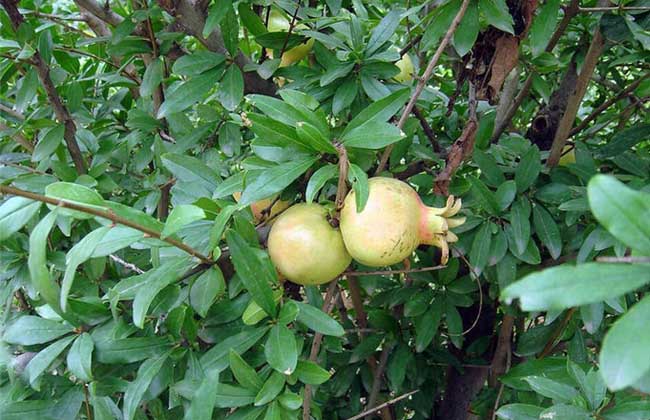
In traditional Chinese culture, the pomegranate is regarded as an auspicious symbol, representing many children and abundant blessings. Its flowers are large and brightly colored, with a long blooming period that lasts from around the wheat harvest all the way to October. Its fruit is also vividly colored. Because it can both be enjoyed for its flowers and eaten for its fruit, it is deeply loved by people, and bonsai made from pomegranate are especially favored. Now let us take a look at how to make a pomegranate tree bonsai!
How do you cultivate the trunk stock for a pomegranate bonsai?
For making pomegranate bonsai, small pomegranate species with dwarf stature, small leaves, and small flowers and fruits are mostly chosen, such as the fire pomegranate, four-season pomegranate, and agate pomegranate varieties. Propagation can be done by sowing or cuttings. Saplings obtained by sowing or cuttings must be grown in the ground for more than 3 years before the trunk can be cut back and branches cultivated to produce small to medium bonsai. If you want to make a large bonsai, you can dig up tree stumps in the wild or buy old potted pomegranate stumps at a farmers' market.
How do you build up branches on a pomegranate bonsai?
For pomegranate, according to the shape of the tree, the trunk should be cut off at an appropriate height and the main branches shortened, so that various styles such as straight-trunk, slanting-trunk, and curved-trunk can be created. In some old-stump pomegranate bonsai, the trunk is composed of two pieces of bark with woody tissue, and the branches at the top of each piece of bark bear fruit, making the contrast between withering and flourishing even richer in flavor. Pomegranate trees have a certain cold resistance, and slight protection in a wind-sheltered, sunny spot is enough. To make the tree grow faster, ground planting is preferable. Pomegranate trees like fertilizer. In addition to applying good base fertilizer when planting, during the vigorous growth period in spring and summer, apply a thin, decomposed organic fertilizer once every half month. Growth is relatively fast, and when the thickness of a branch reaches about 70% of the ideal thickness, cut the branch short to encourage the side branches to grow and develop.
How do you shape a pomegranate bonsai?
After several years of branch cultivation, pruning, and shaping, when a pomegranate basically meets the requirements of the designed composition, plant the pomegranate stump in early spring into an ornamental pot of suitable size and style. Straight-trunk and slanting-trunk styles can be planted in oval pots of medium depth or slightly shallower, while curved-trunk styles can be planted in square pots of medium depth. During this stage of cultivation, you should still apply a somewhat generous amount of fertilizer to promote tree growth and better perfect the shape, while also taking into account the need for appreciation.
How do you care for a pomegranate bonsai?
1. Shaping: Pomegranate trees have strong sprouting ability and grow new branches several times within a year. Generally, the robust new branches that grow in spring can form fruiting mother branches. The following spring, the terminal buds or axillary buds on these branches produce short new shoots that often flower, and among them the flowers on the terminal buds are the easiest to set fruit. Buds that grow in summer and autumn should be removed in time. Bonsai shaping is usually carried out before budding in spring, cutting out water sprouts, overly dense branches, and thin, weak branches, while taking care to retain those robust fruiting mother branches.
2. Fertilizing: Pomegranate trees like fertilizer more than ordinary flowering plants. When repotting, place a suitable amount of fermented hoof pieces or cake fertilizer at the bottom of the pot. When fertilizing during the vigorous growth period in spring and summer, apply fertilizer with a relatively high phosphorus content.
3. Environment: The period from late April to early June is the bud differentiation stage of the pomegranate. There should be sufficient light and watering should be appropriately reduced to keep the potting soil on the dry side. When the new leaves at the branch tips are slightly wilted, place the pomegranate tree in a shaded spot for 30 minutes, then water the pot thoroughly. Repeat this several times, and flower buds will appear in about 20 days.
4. Fruit thinning: After the pomegranate fruits have set firmly, cut off the excess fruits that are not needed for the shape. A medium-sized pomegranate bonsai only needs to keep 3 to 5 fruits. The fruits should be distributed at varying heights, with some sparse and some dense, and must not be evenly spaced. If there are too many fruits, besides looking messy and disorderly, it will also affect fruiting the next year.