When do poplar flowers bloom? A detailed guide to the poplar flowering period
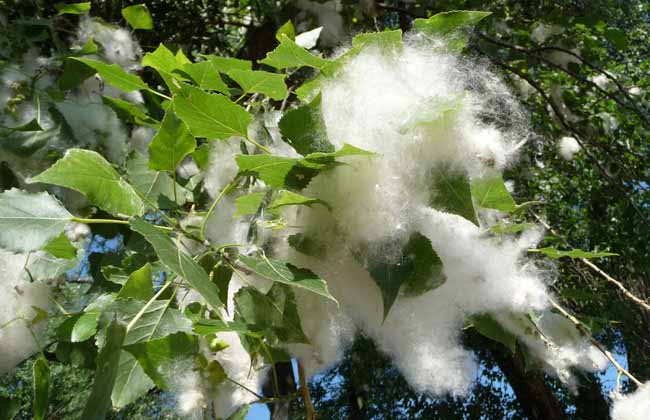
Poplar (Populus) includes the Euphrates poplar, white poplar, cottonwood and others. It is a major tree species for timber forests, shelterbelts and roadside greening. Its wood is mostly used for civil construction timber, furniture, matchsticks and sawn timber, and is also used for artificial boards and fiber. The leaves are good fodder. Like willow (Salix) plants, poplar roots are quite invasive. Let's take a look below at when poplar flowers bloom!
When do poplar flowers bloom?
Under normal conditions, poplars bloom at the end of March, but because temperatures vary from region to region, the blooming time also differs. Poplars have catkins, with male and female flowers on separate trees. They have no petals, but have a ring-shaped disc and bracts. The bract tips are split, and the stamens are numerous. Male catkins are 10-14 cm long; the male bracts have about 10 pointed tips and are densely covered with long hairs; there are 6-12 stamens, and the anthers are red. Female catkins are 4-7 cm long; the bracts are sharply split and have long hairs along the edges; the ovary is long-elliptic, and the stigma is 2-lobed and pink.
Medicinal value of poplar flowers
[Properties and flavor] Bitter in flavor, cold in nature, non-toxic.
[Meridian tropism] Large intestine meridian.
[Functions] Clears heat and detoxifies, resolves dampness and stops diarrhea; mainly used for bacillary dysentery and enteritis.
[Usage] Internal use: decoct in water, 9-15 grams. External use: appropriate amount, hot compress.
[Caution] Use with caution in those with spleen-stomach deficiency-cold.
Classification of common poplar varieties
1. Black poplar: Black poplar is a tree 30 m tall with a broad elliptic crown. The bark is dark gray and grooved and fissured when old. The branchlets are round, pale yellow and hairless. The buds are long-ovate, rich in sticky substance, reddish brown, and the tips of the flower buds bend outward. The flowering period is April to May, and the fruiting period is June. It grows naturally on riverbanks and river bends, rarely on coastal sand dunes, and often forms belts or patches of forest. It is cold-resistant, light-loving, not tolerant of saline-alkali soil, and not tolerant of drought. It grows well on alluvial sandy soil and is distributed in northern China, North Asia and other places.
2. Large-leaved poplar: Large-leaved poplar is a deciduous tree over 20 m tall with a diameter at breast height of 0.5 m. Its suitable growing area is the middle and lower reaches of the Yellow River, and it mostly grows in low mountain plains with deep soil and abundant rainfall, usually existing in shrub form. The bark splits in flakes and is rough. The buds are conical, slightly gelatinous and hairless. It prefers abundant rainfall and a rainy hot season. The leaf shape of this species is the largest in the genus Populus, usually with a gradually pointed tip, making it easy to identify.
3. White poplar: White poplar is the general name for plants in the genus Populus of the willow family. It is native to the Northern Hemisphere, while other Populus plants are distributed in more northern and higher areas. It is famous for its leaves swaying in the breeze and its very straight trunk. Because it suckers quickly, it often grows into forests, with single specimens being rare, and it is very beneficial to natural landscapes. The bark is gray-green and smooth, the branches are natural, and the green leaves are dense and turn bright yellow. Male and female flowers are on separate trees, and in spring the catkins open before the leaves.
4. Cathay poplar: Cathay poplar is a commonly seen tree species in northern China. It is a deciduous tree in the genus Populus of the willow family and can reach 30 m tall. The crown is broadly ovate. The bark is gray-green and smooth when young, and gray-white with shallow vertical fissures when old. The petiole is cylindrical and hairless. The capsule is ovate. It flowers from March to May and fruits from May to July. It is produced in Liaoning, North China, Northwest China, Sichuan and other provinces in China, and grows in valleys, on riverbanks and on shady mountain slopes.
5. Euphrates poplar: Euphrates poplar is a medium-sized natural deciduous tree with a diameter of up to 1.5 m. Its wood is fine and soft, and its leaves are broad and fragrant. It is drought-tolerant and flood-tolerant, with tenacious vitality, and is one of the rare tree species in nature. Euphrates poplar can live up to 200 years. Its trunk is straight, 10-15 m tall, and it is rarely shrub-like. Its leaves are peculiar: because it grows in extremely arid desert areas, to adapt to the dry environment, the leaves on young trees and tender branches are narrow and long like willow leaves, while the leaves on the old branches of large trees are round and full like poplar leaves.