What information is there about the white poplar? This article takes you through the white poplar
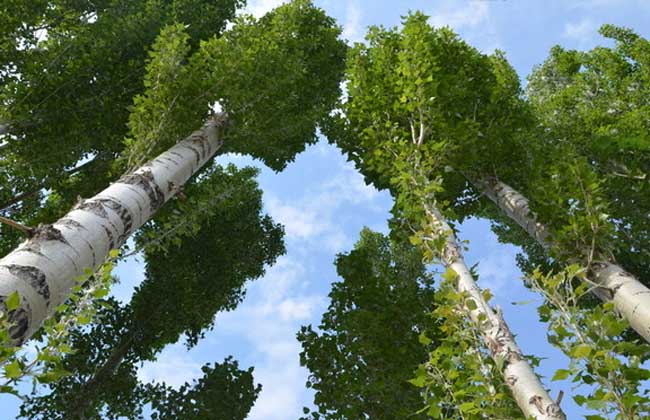
The white poplar is also known as white poplar, silver poplar, etc. It is a deciduous tree of the genus Populus in the willow family (Salicaceae). Its characteristics are strong vitality, tall and straight growth, and steadfastness. It embodies a spirit of close unity, striving upward, standing firm and unbending, and it has diverse uses: it can be used as firewood, made into furniture, used as roof purlins and ridgepoles, and made into farm tools. Let us take a look below at what information there is about the white poplar!
Morphological characteristics of the white poplar
The white poplar is generally 5-15 m tall, with a broad crown and a white trunk. The bark is white to grayish-white and often rough at the base. The twigs are covered with white down, and the sprouting branches and long branches are broad. The leaf margins have irregular tooth buds, and the petiole is equal to or shorter than the leaf blade and is covered with white down. The male inflorescence is 3-6 cm long, the bracts are about 3 mm long, the stamens are 8-10 mm, and the anthers are purplish-red. The female inflorescence is 5-10 cm long, the pistil has a short stalk, and the stigma is 2-lobed. The capsule is conical, about 5 mm long, hairless, and splits into 2 valves. The flowering period is April-May, and the fruiting period is May-June.
The living environment of the white poplar
The white poplar is an ordinary tree in the northwest region. Wherever there is grass, there is a trace of the white poplar. It is not very particular about living conditions. By the roadside or beside field ridges, wherever there is yellow earth, that is where it lives. It does not crave rainwater or cling to sunlight. Even on hard ground, as long as it is given a little moisture, a cut branch of the white poplar will take root and sprout. It only needs to displace a little space from weeds to adorn the yellow earth and hold up a patch of green. It does not need people to fertilize it, nor does it need to be irrigated like delicate lawn grass. As long as no one swings a knife or axe to cut it down and it is given a little loose environment so it can absorb free air, it will stand tall and grow upward.
Geographical distribution of the white poplar
The white poplar is distributed in Europe, North Africa, and western Asia. In China, it is mainly distributed in **, Inner Mongolia, Hebei, Shanxi, Shaanxi, Liaoning, Shandong, Henan, Ningxia, Gansu, Qinghai, Jiangsu, Anhui, Shanghai, Zhejiang, Jiangxi, Jilin, Heilongjiang, Beijing, Tianjin and other places. There is also a small amount distributed in the southwestern region, such as Sichuan, Chongqing, Guangxi, Yunnan, etc.
Growth habits of the white poplar
The white poplar likes light and is not shade-tolerant. It is resistant to severe cold, with no frost damage at minus 40 degrees. It tolerates arid climates, but not humid heat; cultivation in the south makes it prone to pests and diseases, and the trunk often bends and becomes shrub-like. It tolerates poor, mildly alkaline soil and soil with a salt content below 0.4%, but grows poorly in heavy clay soil. It is deep-rooted, with a well-developed root system, strong soil-binding ability, and strong root suckering. It has strong resistance to wind, pests, and diseases. Its lifespan reaches more than 90 years.
Cultivation value of the white poplar
The white poplar has strong adaptability, a tall tree form, and silvery-white leaves that sway in the breeze and have a special shimmering effect under sunlight. Its appearance is upright and clean, and it has a certain ornamental value. It can be used as a shade tree, a street tree, planted in clumps on lawns, and can also be used as a tree species for sand fixation, soil conservation, rock and embankment protection, and afforestation of barren sand. In addition, it also has medicinal value. The sap extracted from the white poplar (containing salicylic acid) can relieve pain and fever. The bark of the white poplar has the effects of dispelling wind, promoting blood circulation, and reducing phlegm, and treats wind arthralgia, beriberi, blood stasis from trauma, dysentery during pregnancy, toothache, mouth sores, and other conditions.