Detailed Explanation of Poplar Planting Techniques and Management Methods
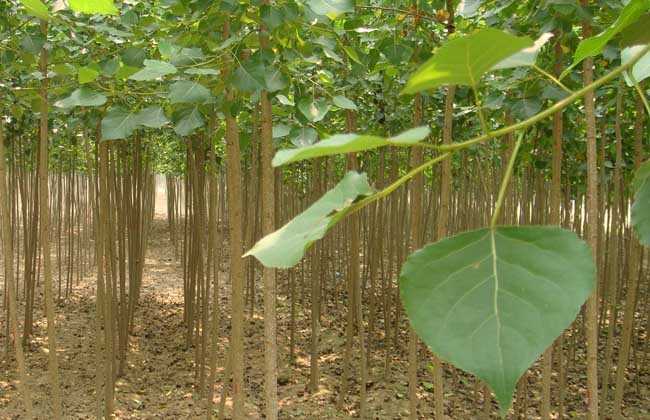
Poplar, also known as white poplar, silver poplar, etc., is a deciduous tree of the genus Populus in the Salicaceae family. It has extremely strong survival ability. Wherever there is loess along roadsides and field ridges, it can be found. Its trunk is slender and upright, reaching a height of 20 m. It can be used as firewood, for making furniture, as roof purlins and beams, and for making farm tools. It has extremely high cultivation value. Let us take a look at poplar planting techniques together below!
Cultivation Value of Poplar
Poplar has strong adaptability, a tall tree form, and silver-white leaves that sway in the breeze and have a special shimmering effect under sunlight. Its appearance is upright and clean, and it has a certain ornamental value. It can be used as a shade tree, street tree, or planted in clumps on lawns, and can also be used as a tree species for sand fixation, soil conservation, rock and embankment protection, and afforestation of barren sand. In addition, it also has medicinal value. The extract from poplar (containing salicylic acid) can relieve pain and fever. Poplar bark has the effects of dispelling wind, promoting blood circulation, and resolving phlegm, and treats wind arthralgia, beriberi, traumatic blood stasis, dysentery during pregnancy, toothache, mouth sores, and other conditions.
Growth Habits of Poplar
Poplar is light-demanding, not shade-tolerant, and extremely cold-tolerant, with no frost damage at minus 40 degrees. It tolerates arid climates but not damp heat. Cultivation in the south makes it prone to pests and diseases, and the trunk often bends and becomes shrub-like. It tolerates poor light alkaline soil and soil with a salt content below 0.4%, but grows poorly in heavy clay soil. It is deep-rooted, with a well-developed root system, strong soil-binding ability, and strong root sprouting. It has strong wind resistance and resistance to pests and diseases, and its lifespan reaches more than 90 years.
Site Selection for Poplar
Selecting afforestation land suitable for poplar growth is the basic condition for achieving rapid growth and high yield of poplar. Poplar is a fast-growing tree species among deciduous broadleaf trees. It grows best on alluvial soil that is deep, loose, fertile, moist, and well-drained, with flat terrain or a slope below 15°, an effective soil layer thickness greater than 0.7 m, and irrigation conditions. For soil texture, light loam and sandy loam are best, medium loam is second, and white poplar can grow on relatively light or heavy soil. The suitable groundwater level for growth should be around 1.5 m, and during the growing season the groundwater level should be below 1 m. Soil nutrient content should be relatively high, with a minimum requirement of organic matter content greater than 0.4%. Soil pH 6-8, soil salt content below 0.1%, and gravel content below 20%.
Land Preparation and Afforestation of Poplar
Land preparation is carried out before the soil freezes. Level the land according to the terrain, carry out full reclamation by machine ploughing with a reclamation depth of more than 30 cm, or local land preparation in strips and reverse-slope terraces, then dig planting holes 80 cm square. When digging holes, keep topsoil and subsoil separate. On afforestation land with good site conditions, for varieties with fast growth and larger crowns, and for cultivating large-diameter timber, the density should be lower. Where site conditions are poor, choose varieties with straight stems and narrower crowns, and when cultivating short-rotation stands, the density can be higher. For pure stands, a spacing of 2×4 m, 3×4 m, 4×5 m, 4×8 m is suitable. On plains using agroforestry compound management, a spacing of 1×2×12 m, 1.5×2×8-10 m is suitable.
Planting Techniques for Poplar
1. Seedling treatment: At every stage of lifting, transporting, and planting seedlings, prevent the seedlings from losing water. In the seedling field, follow the principle of irrigating first and then lifting seedlings. During seedling lifting and transport, protect the root system so that it remains complete, fresh, and moist, and try to lift, transport, and plant in succession. Seedlings that cannot be planted in time should be properly heeled in. For some clones of Populus deltoides, soak in clean water for 1-2 days before planting. Before afforestation, the long roots should be cut off, and the lateral roots should generally be kept at a length of 30 cm (if too long, root balling is likely to occur during planting). For seedlings whose terminal buds or even shoot tips are damaged during transport, when trimming the roots, cut off the terminal shoot back to 1 cm above the uppermost strong bud.
2. Tree seedling planting: The planting time is spring and late autumn to early winter (late October to mid-November). After poplar leaves fall in winter and before the soil freezes, and before sprouting in spring, both are suitable for poplar afforestation. Planting depth depends on soil conditions. On relatively dry and loose soil, a planting depth of about 60 cm is suitable. This depth can increase the amount of rooting in the seedlings and improve drought and wind resistance, while on relatively heavy clay soil and low-lying land, deep planting is not suitable. During afforestation, large-hole planting is required, with the seedling held upright and planted straight, soil filled in layers, and trampled firm in layers, so that the seedling root system spreads out and is in close contact with the soil. Water immediately after planting. After the water seeps in, straighten the seedling and earth up to close the hole.
Tending Management of Poplar
1. Timely irrigation: In addition to immediately watering newly established young forests, during the dry season from April to June, the stand should be irrigated in a timely manner to ensure vigorous growth of the trees. Irrigation should also be carried out during autumn droughts. Winter irrigation of varieties such as Populus deltoides can improve the drought and cold resistance of the trees. The number of irrigations and the amount of water depend on the weather and soil conditions. Generally, before and after trees sprout in spring, during the growing season, and before the soil freezes, water timely when the soil lacks moisture according to soil moisture and rainfall conditions, and after watering, earth up promptly to preserve soil moisture.
2. Rational fertilization: Before afforestation, apply 1500 kg of farmyard manure and about 50 kg of superphosphate per mu, mix them, and apply them into the dug tree holes within the range of root planting depth. From May to June each year, during the peak growth period of poplar, topdress twice, with each application of 3-7 kg of urea or 12-15 kg of ammonium bicarbonate. In the year of afforestation, it can be applied later and less; as the stand age increases, it can be applied appropriately more, and attention should be paid to the combination of nitrogen, phosphorus, and potassium. Topdressing should be carried out in combination with watering.
3. Loosening soil and weeding: Before the stand canopy closes, weed no fewer than two times per year. When agroforestry intercropping is practiced, it can be combined with crop management. After the stand canopy closes, the number of weedings can be appropriately reduced. During agroforestry intercropping, do not specially loosen the soil for the forest land. After intercropping stops, loosen the soil at least 1-2 times per year to loosen the soil and prevent soil compaction.
4. Rational pruning: Timely pruning can improve trunk quality and is conducive to cultivating high-quality timber with a full stem form. At afforestation, prune off all lateral branches of the seedling. For young trees 1-3 years after afforestation, remove competing branches, retain auxiliary branches, and cut off sprouts at the base of the trunk to cultivate an upright and strong main trunk. Pruning intensity should maintain the ratio of crown length to tree height above 3/4. Plywood timber should have no knots. When the trunk at the base of the first whorl of lateral branches reaches 10-12 cm, carry out pruning, remove the first whorl of lateral branches, and cultivate knot-free quality timber. Pruning should be carried out after trees shed leaves in autumn. The cut should be smooth and should not tear the branches. For trees after four years, gradually prune out the weak branches in the lower part of the crown.
5. Agroforestry intercropping: Using cultivation instead of tending, practicing agroforestry intercropping before the stand canopy closes not only improves land utilization, but also, through the management of crops, such as loosening soil, weeding, watering, and implementation, plays a role in tending young forests, promoting tree growth, and increasing income. Intercropped crops should be short, shade-tolerant, and low in water and fertilizer consumption, such as soybean, peanut, and other legume crops, or melons, vegetables, medicinal herbs, wheat, etc. Intercropped crops and trees should maintain a distance of more than 50 m to avoid damaging tree roots during cultivation or competition between crops and trees for water and land.
Pest and Disease Control of Poplar
1. Silvicultural measures: First, advocate matching trees to sites and establishing mixed forests. Paulownia, black locust, tree of heaven, Chinese toon, silk tree, catalpa, and jujube, apple, pear, etc. can be selected for block mixing or strip isolation with poplar. For afforestation seedlings, use improved varieties and strong seedlings with strong insect resistance. Second, strengthen tending management, timely carry out intertillage, soil loosening, weeding, and fertilization, and prune and tend in suitable seasons to enhance tree vigor and improve the stand's own ability to resist pests and diseases.
2. Biological control: When the area of pest occurrence is relatively large, release Chouio's small wasp or Notodontidae trichogramma wasps in the early stage of pest egg laying for control. Or hang bird nests in the forest and actively attract beneficial birds to increase the number of birds. Or use knapsack motorized mist sprayers and duster sprayers, or stretcher-type motorized sprayers to spray 25% diflubenzuron 2000-fold liquid and other ground spray control. For roadside forests, forest networks, and patch forests with a certain canopy density, knapsack motorized duster sprayers can be used to spray Sendebao powder for control. For large-area concentrated contiguous occurrence, ultra-low-volume aerial control can be used with 25% diflubenzuron 600 g/hectare.
3. Physical control: During the overwintering (oversummering) period of pests, manually collect fallen leaves on the ground or plough the soil, and remove egg masses, insect bags, or cocoons, which can reduce the overwintering (oversummering) pest base and reduce the number of pests. During the peak emergence period of adults, insect-killing lamps (black light lamps) can be hung in the forest, or fires can be lit at the forest edge to trap and kill adults.
4. Chemical control: For young and middle-aged forests with tree height below 12 m, ground smoke spraying or smoke release control can be used. It is suitable before the 3rd instar larval stage to use stretcher-type, knapsack motorized sprayers or vehicle-mounted machines to spray 80% trichlorfon 800-fold liquid and other high-efficiency, low-toxicity, environmentally friendly chemical agents for control. For roadside forests, forest networks, and patch forests with a certain canopy density, 6hy and or series smoke machines can be used to spray emulsifiable concentrates or oil formulations with contact, stomach toxicity, or fumigant action for smoke control. The mixing ratio of pesticide to diesel is 1:10, or lindane smoke agent and dimethoate smoke agent can be used for smoke release control, with a smoke agent dosage of 1 kg/mu. When local occurrence and tall trees are damaged, methods with strong permeability and long persistence, such as 10% imidacloprid and other agents, can be used by cutting wounds around the trunk at breast height or scraping off old bark and then applying a poison ring. Trunk base drilling and injection can also be used. Use a drilling and injection machine or hand drill and other tools to drill 3-4 holes in different directions at the base of the trunk, and inject strongly systemic and translaminar 10% imidacloprid emulsifiable concentrate, 40% omethoate emulsifiable concentrate, etc. The dosage is 2-4 ml/10 cm breast diameter, as the original liquid or a 1-3 fold dilution. After injection, be careful to seal the injection ports well.