Can Christmas cactus be grown in the bedroom?
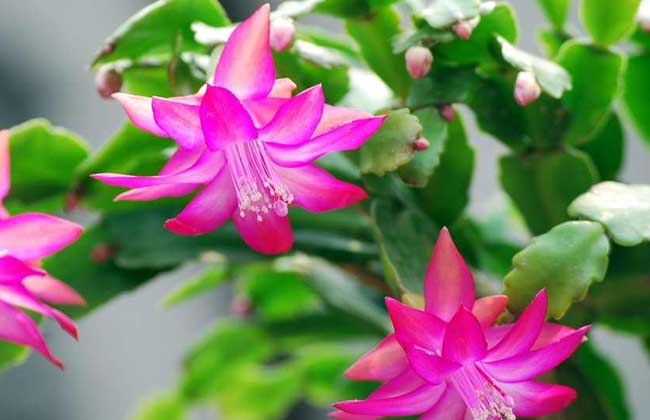
Christmas cactus flowers grow at the tips of the stems, with the perianth opening and curling backward. The flower colors include light purple, yellow, red, pure white, pink, orange, and bicolor, among others. The flowers are delicate and graceful, radiant and charming, bright and captivating, and are especially loved and praised by people, with very high ornamental value. Let us take a look below at whether Christmas cactus can be placed in the bedroom!
Can Christmas cactus be placed in the bedroom?
Christmas cactus can be placed in the bedroom. Christmas cactus is an excellent indoor decorative plant. Whether grown in pots or hanging baskets, it is suitable for decorating windowsills, entranceways, and exhibition halls, instantly bringing brilliance to the room and surpassing even brocade curtains in beauty. Moreover, Christmas cactus can release oxygen at night and absorb carbon dioxide, which is extremely beneficial to human health. Its flower language is "fortune arriving" and "turning one's luck around," and placing it by the bedroom window will bring good fortune to its owner.
How is Christmas cactus best grown?
1. Pot selection: Christmas cactus can use clay pots, plastic pots, porcelain pots, or ceramic pots, but clay pots are preferable. To coordinate with home decor, plastic pots in varied colors can be used for cultivation. It is best to choose a pot whose diameter is 2/3 of the plant's crown diameter.
2. Soil mix: Christmas cactus prefers fertile, loose soil. At home, you can use 3 parts garden soil, 4 parts leaf mold, and 3 parts sand, or 4 parts peat soil, 2 parts leaf mold, 2 parts sand, and 2 parts perlite (or volcanic rock). After mixing the soil, it is best to sterilize it at high temperature before use, or you can sun-dry it to kill bacteria.
3. Proper watering: Christmas cactus is an epiphytic cactus, often growing on trees or in moist valleys in its natural environment, so the growing environment requires semi-shade and moisture, but the potting soil must not be overly wet. Follow the principle of "water thoroughly when dry." In hot seasons, water once every 2 to 3 days, and avoid watering at noon. In winter when temperatures are lower, water once a week, and avoid watering in the evening.
4. Timely fertilizing: Christmas cactus loves fertilizer. When fertilizer is sufficient, it has more branches and more flowers. Begin topdressing after leaf buds sprout. During the growing season, apply once every 15 to 20 days a mix of fermented 10x liquid fertilizer with an equal amount of 1000x potassium dihydrogen phosphate solution or 1000x "Huaduoduo" general-purpose fertilizer. In late autumn, reduce the frequency of fertilizing, and stop fertilizing when the temperature falls below 10°C. Do not fertilize when summer temperatures are high or winter temperatures are low.
5. Light control: Christmas cactus fears hot, high temperatures and should be protected from direct sun and rain, so in summer it should be placed in a ventilated indoor spot or on a balcony facing away from the sun. After the Start of Autumn, Christmas cactus gradually resumes growth and should be placed in a location with 50% light, such as a shade shed or a sunny window, to receive light and promote flower bud differentiation. As the weather turns cooler, gradually increase light, and from late autumn to winter, provide ample light.
6. Flowering regulation: Christmas cactus is a short-day plant, and the flowering period can be controlled by regulating light duration. To force blooming, begin short-day treatment 60 to 70 days before the desired flowering time, with 8 hours of natural light per day and light-blocking treatment for the rest of the time. Keep blocking light continuously without interruption, and flower buds can generally be seen after 20 days.
Plants suitable for the bedroom
1. Dragon tree: As long as you give it a little care, dragon tree can grow for a long time and bring high-quality air. In suppressing harmful substances, few other plants can compare with dragon tree. Its leaves and roots can absorb xylene, toluene, trichloroethylene, benzene, and formaldehyde and break them down into non-toxic substances.
2. English ivy: English ivy can effectively resist the carcinogens in nicotine. Through the tiny stomata on its leaves, it can absorb harmful substances and convert them into harmless sugars and amino acids. It is suitable for planting in semi-shade. Just keep the potting soil moist and fertilize regularly.
3. Umbrella tree: Umbrella tree brings fresh air to smoking households. Its pretty umbrella-shaped leaves can absorb nicotine and other harmful substances from smoke-filled air and convert them into harmless substances of the plant's own through photosynthesis. It has low requirements for its growing environment and is very suitable for inexperienced growers.
4. Weeping fig: Plants in the weeping fig group show many excellent characteristics. They can increase room humidity, which benefits our skin and breathing, and can also absorb formaldehyde, xylene, and ammonia and purify murky air. They are suitable for planting in semi-shade.
5. Golden pothos: Golden pothos can "work" in environments where other indoor plants cannot adapt. Through a process similar to photosynthesis, it breaks down toxic substances released from fabrics, walls, and smoke into substances of the plant's own. This type of plant is easy to care for and can grow well even in dim environments, making it the best choice for beginner growers.
6. Silver queen: Silver queen is known for its unique air-purifying ability. The higher the concentration of pollutants in the air, the more it can exert its purifying ability, so it is very suitable for dark rooms with poor ventilation. This plant with gray-white leaves likes to live in a constant-temperature environment, and watering it with warm water can help it survive for a longer time.
7. Peace lily: Peace lily is an "expert" at suppressing waste gases exhaled by humans, such as ammonia and acetone. It can also filter benzene, trichloroethylene, and formaldehyde from the air. Its high evaporation rate can prevent nasal mucosa from drying out, greatly reducing the possibility of illness.
8. Devil's ivy: Placing or hanging a pot of vine plants such as devil's ivy in an indoor doorway corner can effectively absorb chemicals in the air and dissolve odors left after renovation. However, devil's ivy cannot tolerate strong direct sunlight. It needs to be watered daily to keep the soil moist, but water must not accumulate and breed mosquitoes. Fertilizing once every one to two months can make the leaf color more glossy and beautiful.