Is the Christmas cactus really a succulent plant?
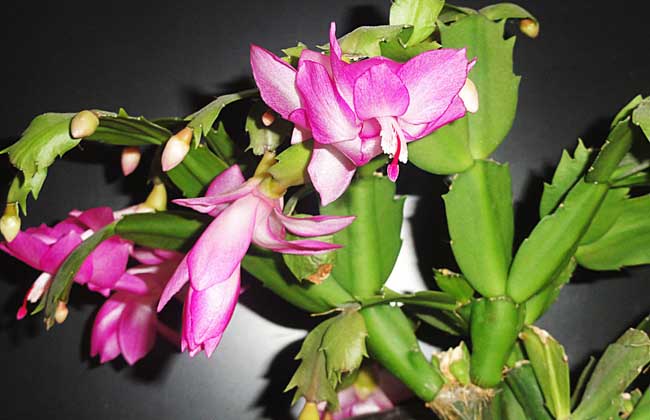
The Christmas cactus is also known as crab claw lotus, immortal finger flower, Christmas cactus, and so on. It originated in Brazil, South America, and is now commonly cultivated in tropical and subtropical regions around the world. In China, it is cultivated as an ornamental plant in parks and flower nurseries everywhere, and is often grafted onto dragon fruit cactus (Hylocereus undatus) or other rootstocks to obtain vigorous plants. Let us take a look below at whether the Christmas cactus is a succulent plant!
Is the Christmas cactus a succulent plant?
The Christmas cactus is a succulent plant. The Christmas cactus (Schlumbergera truncata) is an epiphytic succulent plant of the genus Schlumbergera in the cactus family, shrub-like, with hanging stems, many branches and no spines, old stems woody, young stems flat. Bright green or slightly purple, with a truncate apex, flowers borne singly at the tips of the branches, bilaterally symmetrical. The calyx apex is separate, the corolla has several whorls, the stamens are numerous, and the berry is pear-shaped. The flowering period is from October to February of the following year, and indoor cultivation can regulate the flowering period by controlling light.
How to grow the Christmas cactus
1. Flower pot selection: For the Christmas cactus, clay pots, plastic pots, porcelain pots, or ceramic pots can be used, but clay pots are best. To coordinate with home decor, plastic flower pots with color variations can be used for cultivation. It is best to choose a pot with a diameter 2/3 of the plant's crown diameter.
2. Soil preparation: The Christmas cactus likes fertile, loose soil. At home, you can use 3 parts garden soil, 4 parts leaf mold, and 3 parts sand, or 4 parts peat soil, 2 parts leaf mold, 2 parts sand, and 2 parts perlite (or volcanic rock). After mixing the soil, it is best to sterilize it at high temperature before use, or you can expose it to the sun to sterilize it.
3. Reasonable watering: The Christmas cactus is an epiphytic cactus and in its natural environment often grows attached to trees or in moist valleys, so the cultivation environment requires semi-shade and humidity, but the potting soil must not be too wet, following the principle of "water thoroughly when dry." In hot seasons, water once every 2 to 3 days, and avoid watering at noon. In winter, when the temperature is lower, water once a week, and avoid watering in the evening.
4. Timely fertilizing: The Christmas cactus likes fertilizer. When fertilizer is sufficient, there are many branches and many flowers. Start topdressing after the leaf buds emerge. During the growing season, apply once every 15 to 20 days a topdressing of fermented 10 times diluted liquid fertilizer mixed with an equal amount of 1000 times monopotassium phosphate solution or 1000 times "Huaduoduo" general-purpose fertilizer. In late autumn, the number of fertilizations should be reduced, and fertilizing should stop when the temperature is below 10°C. Do not fertilize when the summer temperature is high or the winter temperature is low.
5. Light control: The Christmas cactus fears hot high temperatures and should avoid exposure to the sun and rain, so in summer it should be placed in a ventilated indoor area or on a balcony facing away from the sun. After the Start of Autumn, the Christmas cactus gradually recovers its growth, and it should be placed in a location with 50% light, such as a shade shed or a sunny window, to receive light and promote flower bud differentiation. As the weather turns cooler, gradually increase the light, and from late autumn to winter it should be given sufficient light.
6. Flowering regulation: The Christmas cactus is a short-day plant, and the purpose of controlling the flowering period can be achieved by regulating the light duration. To force flowering, start short-day treatment 60 to 70 days in advance according to the desired flowering time, with 8 hours of natural light per day and shading treatment for the rest of the time. Keep shading continuously without interruption, and flower buds can generally be seen after 20 days.
What are the common succulent plants?
1. Lotus leaf lotus: As the name suggests, lotus leaf lotus is named because it looks like a lotus. The color of the leaves changes in all four seasons. When there is plenty of sunlight, a red edge appears along the edges of the leaf petals.
2. White beauty: White beauty is also called star beauty. It changes throughout the year; both its color and its appearance change. If you like it, you can use a camera to record its changes through the four seasons.
3. Purple peony: Purple peony is a large pot with many leaf petals, layer upon layer, very beautiful. Strangely, the color of the fleshy leaves changes with seasonal temperature and light intensity, either bright or plain.
4. Ruby: Ruby is like a red gemstone and needs light. The color of the fleshy leaves changes with seasonal temperature and light intensity, turning red or green.
5. Graptopetalum paraguayense 'Bronze': The red fleshy leaves of Graptopetalum paraguayense 'Bronze' are very ornamental. The color of the fleshy leaves also changes with seasonal temperature and light intensity. It is a very interesting succulent plant.
6. Yachiyo: Yachiyo is more like clusters and clumps of red and green gemstones. It is also very easy to keep alive and very easy to propagate. Just insert the leaves into the soil to grow it. The color of the leaves likewise changes with the four seasons, beautiful and lovely.
7. Haworthia cooperi: The fleshy leaves of Haworthia cooperi are arranged in a compact rosette. The leaves are thick and plump, with the upper half transparent or semi-transparent, burying most of the body under the soil and exposing only the windowed part above the ground.
8. Black prince: As the name suggests, Black prince's black leaf petals are its appearance. It likes places with plenty of sunlight. Without sunlight, it will turn green and not look good.
9. Blue stone lotus: Blue stone lotus looks very noble, beautiful, and elegant. When there is plenty of sunlight, the edges of the leaves also turn pink. It does not like low temperatures or cold.