How to repot a Christmas cactus? The correct repotting method and steps
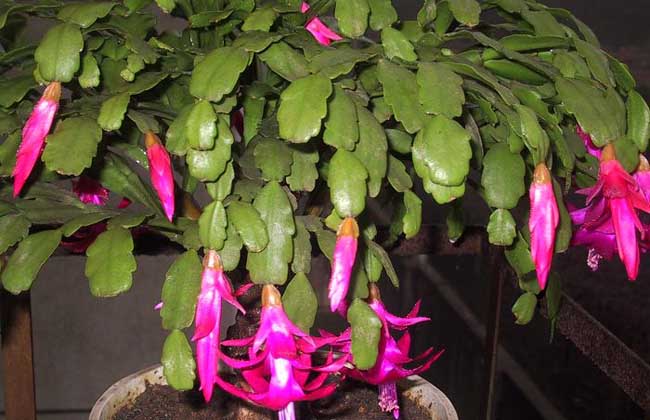
The Christmas cactus (Schlumbergera) is a sun-loving, drought-tolerant potted plant, an epiphytic succulent of the genus Schlumbergera in the cactus family. It is not as delicate as other flowers and plants and is fairly easy to grow, but during the cultivation of the Christmas cactus, if the original pot is too small to meet its growth needs and the potting soil has become poor, it is time to consider repotting. Let's take a look together at how to repot a Christmas cactus!
When to repot a Christmas cactus
According to how early or late they bloom, Christmas cacti are divided into early-blooming, mid-blooming and late-blooming types, with the flowering period running from September to April of the following year. Repotting should be chosen after the flowering period of the Christmas cactus, because during flowering it is especially sensitive and does not like being moved, watered or fertilized. It is best to do it from April to October after flowering, when repotting will not affect the flowering period.
How to repot a Christmas cactus?
1. Pot selection: Before repotting a Christmas cactus, first observe the plant's growth condition to determine the right pot. Clay pots, plastic pots, porcelain pots or ceramic pots can be used, but clay pots are best, and a pot with a diameter about 2/3 of the plant's crown diameter is suitable.
2. Apply sufficient base fertilizer: When repotting a Christmas cactus, first add sandy loam soil to the new pot and apply base fertilizer well. Fermented organic fertilizer, bone meal or superphosphate can be used as base fertilizer, and mixing in a small amount of plant ash can make the pH neutral.
3. Repotting method: Use a loosening tool to move the Christmas cactus from the original pot into the new pot. After repotting, water only a little; once it grows new leaves, gradually increase the amount of watering, and at the same time move it to a spot with light and good ventilation.
How to grow a Christmas cactus?
1. Soil mix: The Christmas cactus likes fertile, loose soil. At home you can use 3 parts garden soil, 4 parts leaf mold, 3 parts sand, or 4 parts peat soil, 2 parts leaf mold, 2 parts sand, 2 parts perlite (or volcanic rock). After mixing the soil, it is best to sterilize it at high temperature before use, or you can expose it to the sun to sterilize it.
2. Reasonable watering: The Christmas cactus is an epiphytic cactus that in its natural environment often grows attached to trees or in moist valleys, so the growing environment should be semi-shaded and moist, but the potting soil must not be too wet; follow the principle of “water thoroughly only when completely dry”. In hot seasons, water once every 2 to 3 days, and avoid watering at noon. In winter, when the temperature is lower, water once a week, and avoid watering in the evening.
3. Timely fertilizing: The Christmas cactus likes fertilizer; when fertilizer is sufficient, it has more branches and more flowers. Start top-dressing after the leaf buds sprout. During the growing season, apply once every 15 to 20 days a mixture of well-rotted 10-times liquid fertilizer and an equal amount of 1000-times potassium dihydrogen phosphate solution, or 1000-times “Huaduoduo” general-purpose fertilizer. In late autumn, reduce the frequency of fertilizing, and stop fertilizing when the temperature is below 10°C. Do not fertilize when the summer temperature is high or the winter temperature is low.
4. Light control: The Christmas cactus fears hot, high temperatures and dislikes exposure to the sun and rain, so in summer it should be placed in a ventilated indoor spot or on a balcony on the shady side. After the Start of Autumn, the Christmas cactus gradually recovers its growth, and it should be placed in a spot with 50% light, such as a shade shed or a sunny window, to receive light and promote flower bud differentiation. As the weather turns cooler, gradually increase the light, and from late autumn to winter it should be given sufficient light.
5. Flowering regulation: The Christmas cactus is a short-day plant, and the flowering period can be controlled by regulating the light duration. To force flowering, begin short-day treatment 60 to 70 days before the desired flowering time, with 8 hours of natural light per day and light-shielding treatment for the rest of the time. The light shielding must be continuous and cannot be interrupted; generally flower buds can be seen after 20 days.