When Does the Christmas Cactus Bloom? A Detailed Introduction to Its Blooming Period
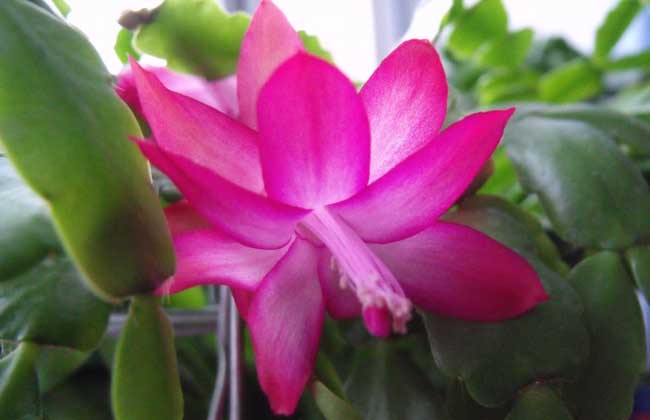
The Christmas cactus (Schlumbergera) is an epiphytic succulent plant of the genus Schlumbergera in the cactus family, native to the tropical rainforests of Brazil. Because it often grows as an epiphyte on large tree trunks or in dark, moist rock crevices in its place of origin, it requires shaded, humid environmental conditions for growth and development. It is a short-day plant, needing 8 to 10 hours of sunlight per day. Let's take a look below at when the Christmas cactus blooms!
When does the Christmas cactus bloom?
According to how early or late they bloom, Christmas cacti are divided into early-blooming, mid-blooming and late-blooming varieties. The blooming period runs from September to April of the following year. The flowers are borne singly at the tips of the branches and are rose red. The blooming period also varies depending on the region, but because of cultivation methods, some Christmas cacti are regulated to bloom in October. In countries such as Japan, Germany and the United States, the Christmas cactus has already been produced on a large scale and has become one of the main indoor potted flowers in winter.
How do you regulate the blooming period of a Christmas cactus?
To make a Christmas cactus bloom earlier, it must receive 8 to 10 hours of sunlight per day, be in complete darkness the rest of the time, and be given appropriate water control. After taking the above measures, it will generally bloom in 60 to 70 days. If you want it to bloom for National Day, you can start in mid-to-late July using a light-blocking black cloth cover or black plastic cover to shade the Christmas cactus, exposing it to light for only 8 hours a day and covering it with the black cloth cover the rest of the time; in this way it will bloom by late September. During the shading treatment, water once a day to keep the potting soil slightly moist, and pay attention to ventilation. To extend the blooming period of the Christmas cactus, place it in an environment of around 15degC after it blooms. If you want to delay blooming, you can keep the potted plant under low-temperature conditions of 5 to 8degC or extend the daily light exposure to more than 14 hours.
Why does the Christmas cactus fail to bloom?
1. Too much light: The Christmas cactus is a short-day plant, and when daily light exposure exceeds 10 to 12 hours, it is difficult for flower buds to form. If there is ample light during the day and strong electric light at night, this will also affect bud formation and blooming.
2. Unsuitable room temperature: When the room temperature is too low, a Christmas cactus that has already formed buds will have difficulty blooming. At this time, you can move the flowerpot into a greenhouse and keep the temperature above 15degC, then move it back to its original room for viewing after it blooms.
3. Excessive temperature difference: When the temperature difference between day and night is too great, flower buds that have already formed will be damaged or dropped. For this reason, from mid-October to mid-November, before bringing it indoors, it should be moved indoors in time to avoid sudden temperature changes. Normally, let it bask in more sunlight outdoors during the day to encourage more bud formation, and bring it indoors at night to prevent an excessive temperature difference.
What should you do if the Christmas cactus does not bloom?
1. Apply less nitrogen fertilizer: If the Christmas cactus does not bloom, apply less nitrogen fertilizer. Fertilizers containing a relatively large amount of nitrogen, such as horseshoe chips and ammonium sulfate, are indispensable for the normal growth of the Christmas cactus, but if too much is applied and the supply of phosphorus and potassium fertilizer is insufficient, vegetative growth will become overly vigorous and reproductive growth will be inhibited, resulting in a reluctance to bloom. Therefore, apply less nitrogen fertilizer.
2. Correct lighting: The Christmas cactus is a typical short-day plant and can only bloom smoothly under light conditions of short days and long nights. Some growers like to place it near lights at night in winter. Because the light period is extended, flower bud differentiation is affected, so it is reluctant to bloom. The correct management method is to place them where the light is in sync with nature, that is, a place with light during the day and darkness at night.
3. Suitable temperature: In a low-temperature environment of around 15degC, flower bud development in the Christmas cactus is slow, and at this time it is prone to the "blind bud" phenomenon in which flower buds die. In addition, if the ambient temperature drops to around 0degC, the flower buds will freeze to death. Maintain an ambient temperature of 15 to 20degC to ensure normal flower bud development.
4. Prune old plants: The flower buds of the Christmas cactus are borne at the tips of the leaf-like stems, so encouraging the growth of a large number of new leaf-like stems is the key to ensuring normal blooming of the plant. Every spring, it is best to combine repotting with cutting away some of the older fleshy stems of the Christmas cactus, and carefully knock the plant out of the flowerpot, then use a sharp knife to slice away a layer of old roots from the surface of the root ball to stimulate new root growth. In this way, the plant's ability to absorb fertilizer increases, its growth vigor becomes stronger, and it naturally produces more flowers.