How to graft Christmas cactus? A detailed guide to practical grafting techniques
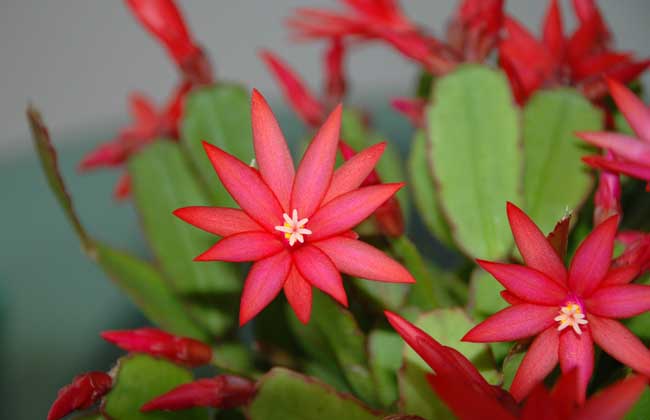
Christmas cactus (Schlumbergera) is an epiphytic succulent plant of the genus Schlumbergera in the cactus family Cactaceae, commonly cultivated in tropical and subtropical regions worldwide. It can be propagated by cuttings or by grafting, but grafting is the best method, as the resulting plants look better and produce excellent results whether viewed on their own or used to decorate and beautify a room. Let's take a look at the grafting techniques for Christmas cactus!
Grafting time for Christmas cactus
Grafting can be done in late spring and early summer, or in late summer and early autumn, but late spring and early summer is best. In southern regions, mid-May is most suitable, as this is the peak growing season for both Christmas cactus and cactus, allowing ideal scions and rootstocks to be selected. In addition, the temperature is suitable at this time, the scion and rootstock have strong compatibility, rot is unlikely, and the survival rate is relatively high. For the scion, choose vigorous young branches, ideally the part with the growing tip, about 8-10 cm long. Use cactus as the rootstock, selecting a one-year-old single pad of cactus kept specifically as a rootstock, about 15 cm long, with flesh of moderate thickness.
Grafting techniques for Christmas cactus
1. Rootstock selection: For grafting Christmas cactus, select a one-year-old, elongated, not-too-thick but vigorously growing, pest- and disease-free cactus branch as the rootstock, 8-12 cm in length. Remove it from the parent plant, cut the lower end flat, insert it into sandy loam, and cultivate for 2-3 months. Once it has taken root, it can be used as a grafting rootstock.
2. Scion selection: For grafting Christmas cactus, select a healthy mother Christmas cactus plant, and from it choose a relatively tender top branch of the current year with nodes as the scion, 3-4 cm long (an overly long scion will grow weakly after sprouting). Use an alcohol-sterilized blade to cut both sides of the lower part of the scion into a wedge shape, with a cut length of about 0.8-1.2 cm.
3. Grafting method: First, slant-cut both sides of the basal node of the scion into a duck-bill shape. The cut surface should be 1.5-2.5 cm long, and it is best to make the cut in one stroke to aid survival. Then make a vertical cut in the top of the rootstock, with the width and depth of the cut slightly larger than the cut surface of the scion, and quickly insert the prepared scion into the rootstock cut and secure it. Finally, place the grafted pot in a wind- and rain-sheltered, cool, ventilated place; survival can be expected in about 20-30 days.
Grafting management for Christmas cactus
1. Shade and light protection: After grafting Christmas cactus, do a good job of shading and protecting it from light. A freshly grafted Christmas cactus, having just been separated from the plant, is very prone to wilting from excessive water loss, so at this time it must be moved to a shaded place to reduce water evaporation.
2. Moderate watering: After grafting Christmas cactus, water it moderately, keeping the potting soil slightly moist. Generally, water once every three or four days, and be very careful when watering to avoid water entering the cut.
3. Timely fertilization: Moderate watering. If the grafted plant still has not wilted after half a month, it indicates that it has survived, and after one month it can be fertilized moderately to promptly supply the nutrients needed for plant growth.
4. Timely staking: After the grafted Christmas cactus has survived, because its stem segments are relatively soft, stakes should be set up promptly during its growth to secure it and tie it appropriately, so as to maintain a complete and attractive plant shape.
5. Disease and pest control: Christmas cactus is prone to rot disease, which can be scraped off with a sterilized small knife and disinfected by applying sulfur powder. The main pests are scale insects and aphids; if they occur, when the number is small they can be brushed off with a brush. When the number is large, a 1000-fold dilution of 40% omethoate emulsifiable concentrate or 50% fenitrothion emulsifiable concentrate can be sprayed to kill them, and sprayed again after 20 days.