What plant is the Christmas cactus? It turns out to be a succulent in the cactus family
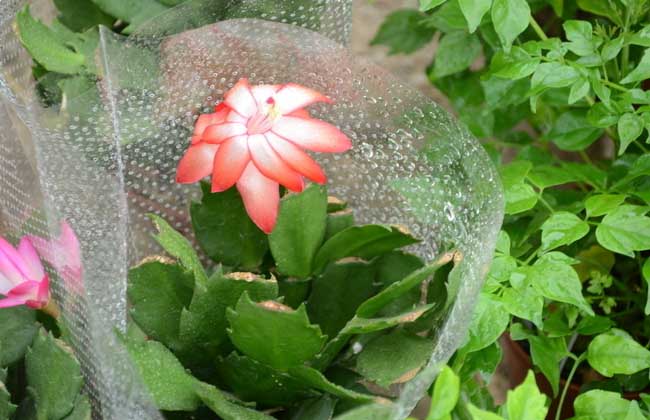
The Christmas cactus (Schlumbergera) is an epiphytic succulent plant in the cactus family, genus Schlumbergera, also known as Christmas cactus, crab-claw lotus, fairy-finger flower, and "icing on the cake," among other names. The Christmas cactus is so named because the shape of the joints where its segments connect resembles a crab's pincers. It originates from Brazil. It is commonly cultivated in parks and flower nurseries across China, and is often used as an ornamental plant grafted onto Hylocereus undatus or other rootstocks to obtain vigorously growing plants. Its jointed stems often become pendulous because they grow too long, so it is also often made into a hanging plant for decoration, suitable for decorating windowsills, entranceways, and exhibition halls.
The Christmas cactus is usually shrubby, without leaves. Its stems are spineless, much branched, and often pendulous; the old stems become woody and are slightly cylindrical, while the young stems and branches are flattened. Each joint is oblong to obovate, 3-6 cm long and 1.5-2.5 cm wide, bright green, sometimes slightly purplish, with a truncate apex, each side bearing 2-4 coarse teeth, and a thick midrib in the center of both surfaces. The areoles sometimes bear a few short bristles.
The flowers of the Christmas cactus are solitary at the tips of the branches, rose-red, 6-9 cm long, and bilaterally symmetrical. The calyx is in one whorl, short-tubular at the base, with the apex free. The corolla is in several whorls, tubular below and free above, with the tube becoming longer toward the inside. The stamens are numerous, in 2 whorls, exserted, arching upward. The style is longer than the stamens, dark red, with a 7-lobed stigma. The berry is pear-shaped, red, about 1 cm in diameter.
The Christmas cactus prefers a cool, warm environment, is relatively drought-tolerant, fears the high heat of summer, and is relatively shade-tolerant. The optimum growing temperature is 20-25°C, and the temperature during the dormant period is around 15°C. It likes a loose substrate rich in organic matter with good drainage and aeration. It is a short-day plant; under conditions of 8-10 hours of sunlight per day, it can bloom in 2-3 months, and the flowering period can be regulated by controlling light.
Common hybrids of the Christmas cactus include the white varieties Christmas White, Doset, Gina, and Snowflake; the yellow varieties Gold Charm, Christmas Flame, Gold Fantasy, and Cambridge; the orange varieties Ante and Friedo; the purple variety Madoga; and the pink varieties Camilla, Disto, and Eva, among others, most of which were introduced from countries such as the United States, Japan, and Denmark. Conventional varieties include Schlumbergera truncata, with light purple stems and red flowers; Schlumbergera bella, with white flower buds that turn pink when open; Schlumbergera coccinea, with red flower buds; and Russell, Buckley, Blunt Angle, and Christmas cactus, among others.