Does the Rubber Plant Bloom? A Detailed Guide to Rubber Plant Flowering
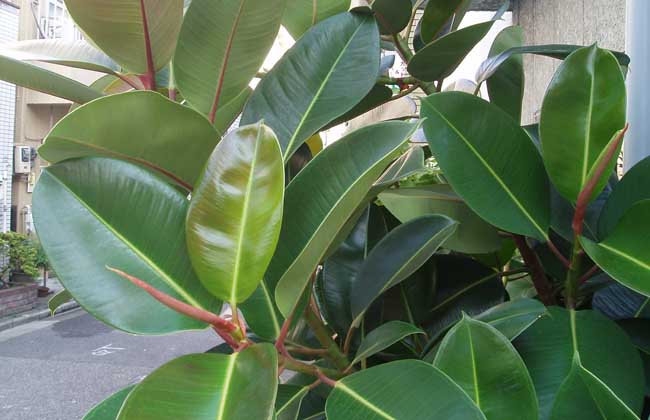
The rubber plant (Ficus elastica) is native to Brazil and is now widely cultivated in the tropical regions of Asia. It loves high temperatures and humidity and a sunny environment. Its suitable growing temperature is 20-25°C. It should be protected from direct sunlight. It tolerates shade but not cold, and its safe overwintering temperature is 5°C. It tolerates dry air, dislikes clayey soil, and cannot stand barren conditions or drought. Let's take a look below at whether the rubber plant blooms!
Does the Rubber Plant Bloom?
The rubber plant does bloom. Its flowers are very small and have no petals. Many tiny flowers are hidden inside a small jar-like receptacle, just like those of its close relative the banyan tree. In its native environment it usually blooms from May to July, and the flowering period lasts several months. The rubber plant has a syconium (hidden-flower inflorescence), with no ordinary flowers; the very small flowers are hidden on the inner wall of the invisible receptacle. At the top of the receptacle there is a small opening that connects to the outside, and tiny insects can enter and exit through the opening to pollinate the small flowers inside.
Rubber Plant Pruning Methods
1. Pruning season: When pruning the rubber plant, pay attention to "prune branches in winter, control side branches in summer." That is, in winter, heavily prune vigorous trees and lightly prune weak trees, focusing on removing upright, strong competing branches from the base. For rubber plant pruning in summer, heavily control strong vigorous branches, control the strong and keep the weak, adjust the tree's vigor to a balanced state, and grasp the principles of tipping the strong side branches, heavily pruning sturdy branches, lightly pruning weak branches, and keeping more small branches, so as to achieve the pruning goal of highlighting the main trunk and promoting faster tree growth.
2. Pruning height: The pruning cut on the rubber plant should be smooth, and splitting of the bark must be strictly prevented. A stubble height of 1-2 cm is appropriate. Too high or too low will affect wound healing and tree growth. The best pruning seasons for the rubber plant are early spring, late autumn, and winter. Early spring is best before the sap begins to flow. If you prune when the tree is sprouting, the tree body transpires water quickly, loses water, and consumes more nutrients, which is not conducive to tree growth. If you prune the rubber plant in summer, be careful not to prune branches on cloudy and rainy days, so as to avoid the wound being soaked in water and becoming infected with disease.
3. Pruning techniques: In the shaping and pruning of the rubber plant, it is sometimes also necessary to highlight the growth of the main trunk or main branches and thin out overly dense branches or branches that affect the shape. The commonly used shaping and pruning methods to highlight the main trunk and main branches include bud removal and branch thinning. That is, remove buds that are just beginning to sprout, so as to inhibit the growth of side branches. The principle is to eliminate the growth of side branches at the budding stage, so that nutrients are concentrated to supply the growth of the main branches. That is, use pruning shears to cut off branches from the base of the branch. This is often used to thin out overly dense branches. Branch thinning is a remedial measure for bud removal; that is, because bud removal was not timely, side branches have already formed, and in order to strengthen the growth of the main trunk or meet shaping needs, some excess side branches are thinned out.
4. Pruning and care: After pruning the rubber plant, in order to prevent excessive loss of latex from the cut and affect survival, the wound should be promptly coated with plant ash. Insert the prepared cuttings into a cutting bed with river sand or vermiculite as the substrate. After insertion, keep the cutting bed fairly humid, and frequently sprinkle water on the ground (but do not let water accumulate), so as to increase air humidity. At a temperature of 18-25°C and under semi-shaded conditions, roots can form in about 2-3 weeks.
Four-Season Care for the Rubber Plant
1. Spring care: Each spring, when the temperature stabilizes at around 15°C, repot the plant, and prune it appropriately before repotting. In spring, place it in a spot with light, keep the potting soil moist, and frequently sprinkle and mist water around it to increase air humidity. Young plants can begin to be fertilized after new leaves emerge. When the temperature is higher in late spring, move it to a semi-lit location or an indoor spot with scattered light for placement and cultivation.
2. Summer care: The rubber plant tolerates high temperatures and strong sun, but when the light is too strong, the leaves easily lose their luster, which is not good for ornamental value. The rubber plant can be placed in a bright indoor spot. An indoor spot with weaker light is not good for its growth. Because the rubber plant has many large leaves and consumes a lot of water, it should be watered in time to keep the potting soil moist, and at the same time mist its leaves and surroundings frequently to meet its air humidity requirements.
3. Autumn care: In autumn, move the potted plant to a sunny windowsill or balcony for cultivation, keep the potting soil moist, and when the temperature is higher at noon, sprinkle and mist water around it and on the leaves to increase air humidity. In autumn, to enhance its cold resistance, you can let it be exercised outdoors at low temperatures for a period of time, but do not let it be hit by frost. Before frost falls, promptly move it indoors to a spot with light.
4. Winter care: The rubber plant is not cold-resistant and can tolerate short-term low temperatures of 0°C. However, the indoor temperature should be kept at around 5°C. At this time, the rubber plant's growth is in a stagnant state, so sufficient light should be ensured and the potting soil should be kept moist but on the dry side. Potting soil that is too wet easily causes root rot. When the temperature is higher at noon, sprinkle and mist water around it and on the leaves several times. When the indoor temperature is kept above 15°C, the rubber plant can grow normally, and care can refer to spring.