What kind of tree is the rubber plant? Let us get to know the rubber plant
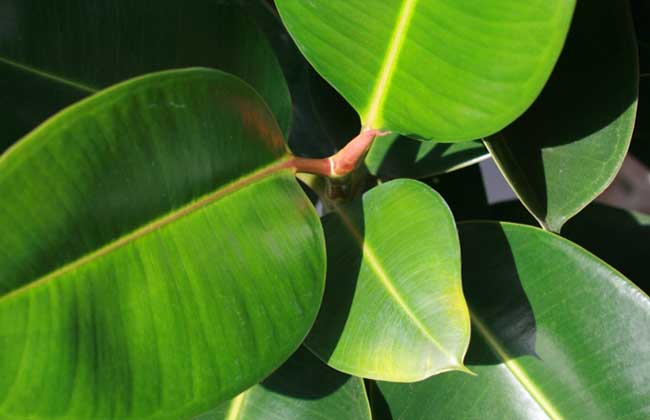
The rubber plant is a well-known potted foliage plant, also known as the Indian rubber tree, Indian banyan large-leaf green, red Burmese tree, red-mouth rubber tree, and so on. It is a large tree of the genus Ficus in the family Moraceae, with high ornamental value, and is extremely suitable for indoor beautification arrangements. Small and medium-sized plants are often used to beautify living rooms and studies, while medium and large plants are suitable for placement on both sides of the entrance halls of large buildings and in the center of lobbies, appearing majestic and spectacular and able to reflect a tropical scenery.
The rubber plant can reach 30 m in height and has abundant latex. The digitate compound leaves have 3 leaflets, the petiole is up to 15 cm long, the leaflets are elliptical, with 10-16 pairs of lateral veins, and the leaflet petiole is 1-2 cm long. The inflorescence is axillary, paniculate, covered with grayish-white short pubescence. The male flower calyx lobes are ovate-lanceolate; the female flower calyx is the same as the male but larger. The capsule is elliptical, with a pointed beak at the apex and slightly concave at the base; the exocarp is thin and shows reticulate vein patterns when dry, while the endocarp is thick and woody. The seeds are elliptical, light grayish-brown, and patterned. The flowering period is May to June.
The rubber plant is native to Brazil and is now widely cultivated in tropical regions of Asia. In China, it is cultivated in Taiwan, China, southern Fujian, Guangdong, Guangxi, Hainan, and southern Yunnan, with more planting in Hainan and Yunnan. It likes a high-temperature, humid, and sunny environment, with a suitable growth temperature of 20-25°C, and avoids direct sunlight. It can also tolerate shade but not cold, with a safe overwintering temperature of 5°C. It tolerates dry air. It avoids clayey soil and does not tolerate barrenness or drought; it likes loose, fertile, well-drained, slightly acidic soil.
The rubber plant has a unique function of purifying dust and can also purify formaldehyde among volatile organic compounds. The rubber plant can also absorb carbon monoxide, carbon dioxide, and hydrogen fluoride from the air, purifying the air. The rubber plant likes places with sufficient sunlight, which can ensure vigorous photosynthesis and transpiration. For offices with more dust, it is most suitable to place it by the window. The rubber plant is not cold-tolerant, so do not place it in a low-temperature place in winter, and repot it once every 2-3 years.
The leaves of the rubber plant are thick and beautiful, broad, attractive, and glossy. The red terminal bud resembles a crouching cloud, and when the stipules split open they look just like red tassels hanging down, full of charm. As a potted plant, it is a good material for decorating hotel halls and family rooms. In the south, it is often arranged in front of buildings, in the center of flower beds, and on both sides of roads.
In home feng shui, the rubber plant is related to family harmony and the cultivation of interpersonal connections. The placement of the rubber plant affects the family's fortune and prospects. Placing the rubber plant in an appropriate indoor position has the effect of promoting good luck and prosperity and resolving indoor yin energy and sha qi. If the living room at home has relatively sufficient light, it is the auspicious position for regulating qi in the house. Try not to place too many green plants on the balcony to avoid blocking light, and placing the rubber plant in the living room can promote good fortune.