Detailed Explanation of Key Techniques for Growing Large-Flowered Roses
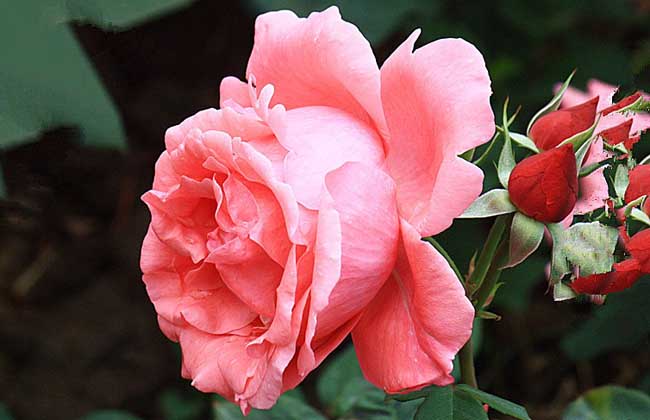
The large-flowered rose, also known as the perfume rose, the floribunda rose, the ornamental rose, and so on, is a plant of the genus Rosa in the family Rosaceae. It has a robust and attractive growth habit, with large, full blooms, elegant flower posture, beautiful flower form, and a rich fragrance. It is suitable for growing in environments with ample sunlight and good air circulation, and has low requirements for soil. Let us take a look below at the growing techniques for large-flowered roses!
Propagation of Large-Flowered Roses by Cuttings
Propagation of large-flowered roses by cuttings is generally done in early spring or late autumn, when the large-flowered rose is dormant, by cutting mature branches bearing 3 to 4 buds for rooting. If softwood cuttings are used, appropriate shading is needed, and the seedbed should be kept moist. After cutting, roots generally form in 30 days, with a survival rate of 70% to 80%. If rooting powder is used to dip the branches during cutting, the survival rate is even higher.
Cutting Management for Large-Flowered Roses
1. Erecting a shed for shade: The optimum temperature for large-flowered rose rooting is 20°C to 25°C. During the cutting period, a shed needs to be erected for shade. A plastic shed can regulate the temperature and humidity of the soil and air, and a shade net can prevent direct sunlight and lower the temperature. If the temperature is too high, in addition to covering with a shade net, watering to cool down and ventilation to cool down can also be used,
2. Timely watering: In the early stage of large-flowered rose cuttings, the cuttings have not yet sprouted leaves, so water should not be supplied too much; generally watering once every 7 to 10 days is sufficient. After one month, the cuttings begin to take root and send out shoots, and water consumption gradually increases, so watering should be done once every 3 to 5 days. The amount of watering should be determined according to soil moisture and air humidity, so as to keep the soil at a moderate degree of moisture.
3. Reasonable fertilizing: Large-flowered rose cuttings do not need much fertilizer. Since base fertilizer was already applied when preparing the land, there is no need to fertilize the soil again before the seedlings are transplanted, but foliar fertilizing should be carried out. That is, one month after cutting, every half month alternately apply 0.3% urea liquid fertilizer and 0.2% monopotassium phosphate liquid fertilizer as a foliar feed to promote rooting.
Cultivation Management of Large-Flowered Roses
1. Cultivation site: The large-flowered rose is a light-loving plant. During cultivation, a sunny site should be chosen, avoiding planting beside tall buildings, under tree shade, or on the shady side of a hillside. The ideal soil for cultivating large-flowered roses should have a good granular structure and be rich in organic matter.
2. Planting spacing: The plant and row spacing for large-flowered rose cultivation varies according to the purpose of cultivation. For variety plots used for breeding or scientific research, the commonly used plant and row spacing is 150 cm × 80 cm.
3. Reasonable pruning: Before planting large-flowered roses, the seedlings need to be pruned once, cutting off damaged branches, diseased branches, and weak branches; damaged or overly long roots should also be cut off. After pruning, apply a callus and anti-corrosion membrane to the wounds so that they heal quickly.
4. Water and fertilizer management: Large-flowered roses like fertilizer, especially organic fertilizer such as barnyard manure and compost. The flowering period is long, so during their growth, attention should be paid to topdressing with chemical fertilizer to achieve quick results. In addition to maintaining sufficient water and fertilizer, spraying flower-strengthening agent on the buds during the bud stage can promote strong buds, plump petals, vivid flower color, rich fragrance, and a longer flowering period.