Complete Guide to Cactus Information and Characteristics
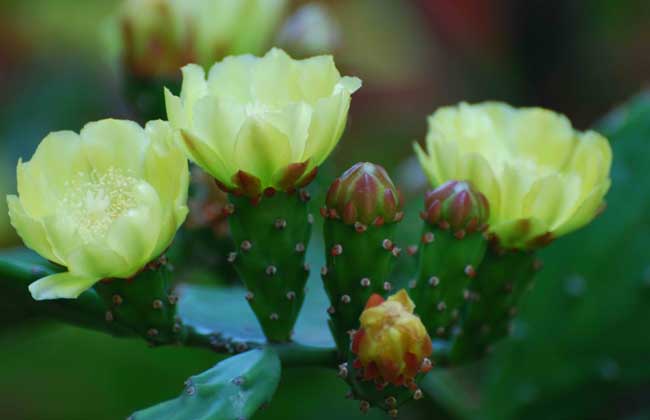
Cactus is also known as xianbazhang, bawangshu, huoyan, huozhang, niu shetou, and so on. It is a clumping succulent shrub of the genus Opuntia in the family Cactaceae (cactus family). It has a great many species: worldwide there are 70 to 110 genera and more than 2,000 species, which can be specifically divided into the pad cactus group, the segmental cactus group, crab claw cactus, leaf-type forest cactus group, globular cactus group, and so on. It often grows in dry environments such as deserts and is called the "hero flower of the desert." It is one of the succulent plants.
Cactus grows 1.5 to 3 m tall. The upper branches are broadly obovate, obovate-elliptic, or nearly circular, with margins usually irregularly wavy, the base cuneate or gradually narrowed, green to blue-green, hairless. The areoles are sparsely borne and distinctly prominent; as they mature the spines often thicken and increase in number, each areole bearing 3 to 10 spines, densely covered with short woolly hairs and barbed bristles. The spines are yellow, with light brown transverse bands, stoutly subulate, flattened at the base, hard. The barbed bristles are dark brown, upright, more or less persistent. The short woolly hairs are gray, shorter than the barbed bristles, persistent. The leaves are subulate, green, early deciduous.
The cactus flower is radiate; the receptacle is obovate, sparsely bearing prominent areoles, and the areoles have short woolly hairs, barbed bristles, and subulate spines. The sepal-like tepals are broadly obovate to narrowly obovate, with the apex acute or rounded and bearing a small mucro. The petal-like tepals are obovate or spoon-shaped obovate, with the apex rounded, truncate, or slightly concave. The filaments are pale yellow. The berry is obovoid, with a concave apex, the base more or less narrowed into a stalk-like form, the surface smooth and hairless, purple-red, and the areoles bearing short woolly hairs, barbed bristles, and subulate spines. The seeds are numerous, flat and round, light yellowish brown. The flowering period is June to October.
Cactus likes strong light, tolerates heat, drought, and poor soil, has tenacious vitality, and is extensively managed, making it very suitable for cultivation on family balconies. The optimum growth temperature is 20 to 30°C, and during the growing period there should be a day-night temperature difference, preferably 30 to 40°C during the day and 15 to 25°C at night. In spring and autumn, watering should follow the principle of "do not water until dry, and do not let it become too wet."
Cactus originated on the east coast of Mexico, the southern and southeastern coastal areas of the United States, the West Indies, Bermuda, and northern South America. It has become naturalized in the Canary Islands, India, and eastern Australia. It was introduced into China in the late Ming Dynasty, is commonly cultivated in the southern coastal areas, and has escaped into the wild in Guangdong, southern Guangxi, and the coastal areas of Hainan.
In China, cactus was first recorded as a medicinal plant in the Qing Dynasty work Supplement to the Compendium of Materia Medica by Zhao Xuemin. According to that book, cactus is bland in taste and cold in nature, and its functions are to move qi and invigorate blood, clear heat and detoxify, reduce swelling and relieve pain, moisten the intestines and stop bleeding, strengthen the spleen and stop diarrhea, and calm the spirit and promote urination; it can be taken internally or used externally to treat many diseases. In the Qing Dynasty work Caomu Bianfang by Liu Shanshu, it is recorded that cactus is bitter and astringent and cold in nature, that it is not difficult to treat the bleeding of five types of hemorrhoids, that white ringworm in children is rubbed with sesame oil, and that insect sores and scabies are washed with it safely.
Cactus is high in potassium, low in sodium, and low in sugar; its sugar content is even lower than that of lettuce and cucumber. It has long been a traditional food in the Americas and is an indispensable specialty vegetable and fruit in people's daily lives. People wash and chop cactus and cook it in soup, or roast it over a stove, or make it into pie filling, or directly pickle fresh cactus, and some also use cactus to brew wine.