What kind of tree is the camphor tree? An article to help you get to know the camphor tree
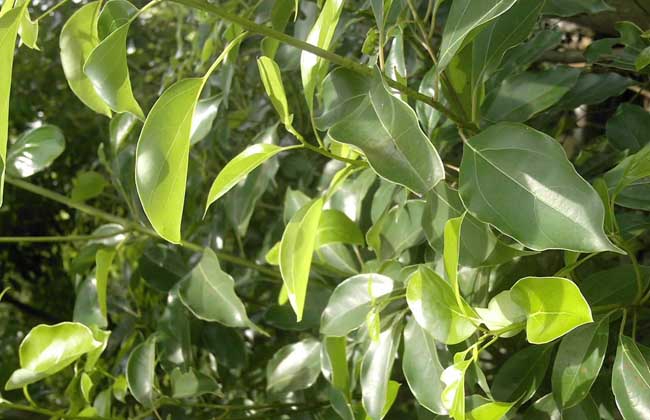
The camphor tree is an evergreen large tree of the genus Cinnamomum in the family Lauraceae, order Laurales, also known as camphor, camphor tree, camphor wood, stinking camphor, and black camphor. It is an excellent landscaping tree, street tree, and shade tree. The entire plant has a camphor aroma and can be used to produce camphor and extract camphor oil. Its wood is hard and attractive, suitable for making furniture and boxes. It is resistant to harmful gases such as chlorine, sulfur dioxide, ozone, and fluorine gas, can repel mosquitoes and flies, and can withstand short-term flooding.
The camphor tree can reach a height of 30 m, with a diameter of up to 3 m. Its crown is broadly ovate. The branches, leaves, and wood all have a camphor odor. The bark is yellowish brown with irregular vertical fissures. The terminal buds are broadly ovate or spherical, and the scales are broadly ovate or nearly round, slightly covered with silky hairs on the outside. The branchlets are cylindrical, light brown, and hairless. The leaves are alternate, ovate-elliptic, with an acute apex and a broadly cuneate to nearly rounded base, with entire, cartilaginous margins. The petiole is slender, 2-3 cm long, concave above and convex below, and hairless. When young, the bark is green and smooth, gradually becoming yellowish brown or grayish brown and longitudinally fissured with age.
The camphor tree's panicles are axillary, stalked, and hairless on the peduncle and axes at all levels, or covered with grayish white to yellowish brown puberulent hairs, with the hairs often especially obvious at the nodes. The flowers are greenish white or tinged with yellow, and hairless. The outside of the perianth is hairless or puberulent, while the inside is densely covered with short soft hairs. The perianth tube is obconical, and the perianth lobes are elliptical. The ovary is spherical and hairless. The fruit is ovoid or nearly spherical, purple-black. The fruit cup is cup-shaped, truncate at the apex, with longitudinal grooves. The flowering period is April to May, and the fruiting period is August to November.
The camphor tree is mostly sun-loving, slightly shade-tolerant, and prefers a warm and humid climate. It is not very cold-hardy and is suitable for growing in sandy loam. It is relatively tolerant of wet conditions, but when transplanting, care should be taken to maintain soil moisture, as waterlogging can easily cause root rot and death from lack of oxygen. However, it is not tolerant of drought, barren soil, or saline-alkali soil. The main root is well developed and deep-rooted, so it can resist wind. It has strong sprouting ability and is tolerant of pruning. Its growth rate is moderate, and its tree form is huge and umbrella-like, able to provide shade and coolness.
The roots, wood, branches, and leaves of the camphor tree can all be used to extract camphor and camphor oil. Camphor is used in medicine, plastics, explosives, preservation, and insecticide, while camphor oil can be used as a raw material for pesticides, ore dressing, soap making, varnish, and flavorings. According to scientists' research, chemical substances released by the camphor tree, such as pinene, camphene, limonene, and eugenol, have the ability to purify toxic air, have anti-cancer effects, and have insect-repellent effects, filtering out fresh and clean air that is refreshing to the heart and mind. The wood is of high quality, resistant to insect damage and tolerant of wet conditions, and is used for construction, shipbuilding, furniture, boxes and cabinets, boards, and carving.
The camphor tree has dense branches and leaves, a broad crown with deep shade, and a majestic tree form. It can absorb smoke and dust, conserve water, fix soil and prevent sand, and beautify the environment. It is an excellent tree species for urban greening and is widely used as a shade tree, street tree, shelterbelt, and scenic forest, and is often used for garden ornamental purposes. When planted in clumps, groups, or singly in lawns, or used as a background tree, it is majestic and spectacular. Because of its strong resistance to various toxic gases, strong ability to absorb and retain dust, and ability to absorb harmful gases, it is often used in cities and industrial and mining areas.