What are the planting methods for cycad seeds?
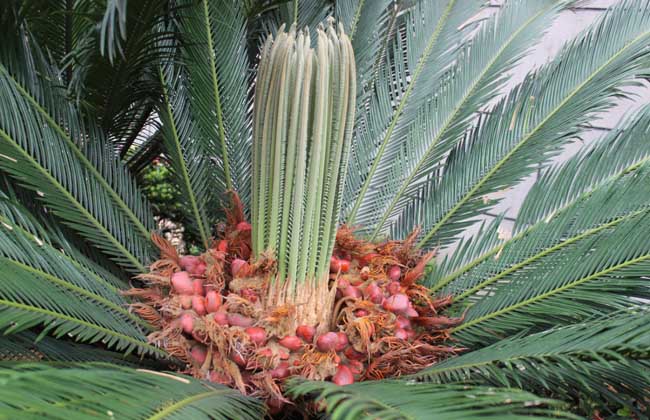
The cycad is an evergreen palm-like woody plant of the genus Cycas in the family Cycadaceae. It is an excellent foliage plant for green spaces, courtyards and indoors. It generally blooms from late spring to early summer, and the seeds are harvested after they mature in autumn. Seeds sown in the same year can reach a germination rate of over 95%, while seeds sown the following year have a germination rate of only about 20%. Let's take a look below at how to plant cycad seeds!
Sow seeds immediately after harvesting
1. Seed treatment: Before sowing, soak cycad seeds in warm water at about 50°C in a thermos for 12 hours, pour them out and spread them for 1 hour, then replace with water of the same temperature with 0.1% ferrous sulfate and potassium dihydrogen phosphate added, put them back into the thermos and soak for another 12 hours, after which they are ready for sowing.
2. Sowing method: Cycad sowing uses spot sowing in pots, covering with 2 cm of soil. At a high temperature of 30-33°C, they can germinate in two weeks, and the seedlings can only be transplanted after 2-4 years of cultivation.
Sowing seeds the following year
1. Seed treatment: Choose plump seeds no more than two years old, soak them in warm water at about 50°C for 24 hours, then soak them in dilute hydrochloric acid or dilute sulfuric acid for 10-15 minutes, then rinse them clean with water. During soaking, change the clean water every other day. After the seed coat has fully absorbed water, swelled and softened, manually peel off the outer seed coat, wash away the fruit pulp, dry the seeds, and then store them properly.
2. Sowing method: Around December, carry out sand storage treatment of the seeds. First sow the prepared seeds into the bed, about 3 cm deep, then immediately cover with river sand 3 cm thick. Sand storage generally takes 4-6 months. During this period, maintain a suitable temperature of 18-25°C and a relative humidity of 80-90%, and do a good job of keeping them warm in winter, not below 12°C. In May-June of the following year, the seeds sprout and break out of their shells, and in July-August they germinate and grow one true leaf, at which point they can be transplanted.
Cycad cultivation methods
1. Growing environment: Cycads are best planted in a place with ample sunlight, that is moist and warm, and has good ventilation. If the winter is relatively cold, the plant should be wrapped with plastic bags or straw bundles. For potted plants, most of the branches and leaves can be cut off, and the plant placed in a sunny, wind-sheltered spot.
2. Timely watering: Cycads like moist soil, so loose, fertile, slightly acidic sandy soil is most conducive to their growth. When watering, grasp the principle of "water after the soil dries, water when dry and let dry when wet", that is, water after the soil dries and do not allow water to accumulate in the surrounding soil, otherwise it is easy to cause root rot in cycads.
3. Reasonable fertilizing: During the vigorous growth and reproduction stage, cycads need regular fertilizing to ensure their nutritional needs. Fertilizing is mainly with nitrogen fertilizer and potassium fertilizer, and it is best to apply thin fertilizer frequently. To make the cycad leaves dark green and glossy, an appropriate amount of ferrous sulfate solution can be added during fertilizing.
4. Shaping and pruning: To keep the cycad's shape beautiful and well-proportioned, you can prune off the old yellow leaves from the previous year when new leaves grow each year.
5. Pest and disease control: The cycad's branches and trunk are relatively hard, so pests are rare. If scale insect damage is found, in mild cases wash and kill the insects manually, and in severe cases spray the leaf surfaces with 1% ferrous sulfate.