Does the sago palm actually bloom? Explained clearly in one article
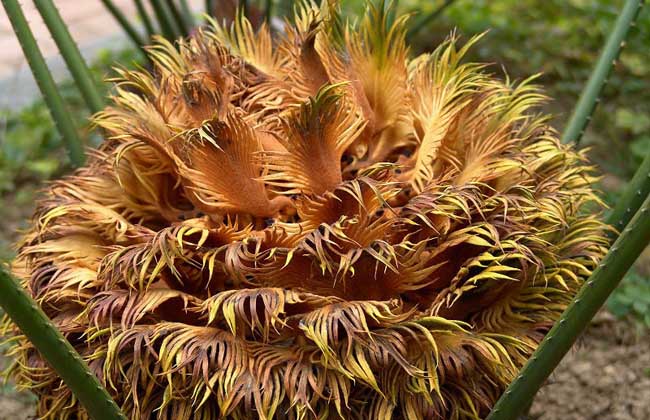
The sago palm is also known as cycad, phoenix-tail banana, fire-avoiding banana, phoenix-tail pine, etc. It is an evergreen palm-like woody plant of the genus Cycas in the family Cycadaceae. Because its trunk is as hard as wrought iron and it likes iron-containing fertilizer, it is named sago palm. Its tree form is elegant, vigorous and simple, and its large and beautiful leaves are dark green and borne at the top all year round, with a unique ornamental effect. Let us take a look below at whether the sago palm blooms!
Does the sago palm bloom?
The sago palm does bloom. The sago palm blooms relatively rarely. Generally, old trees of 15-20 years of age can bloom. If cultivated properly, it can also bloom once every few years. In the south, when the growing environment is good, blooming can be seen every year, and the flowering period can last as long as 1 month. Generally, the male flowers bloom from June to August, and the female flowers bloom from October to November. In fact, as long as conditions such as temperature are suitable, the sago palm can bloom every year.
The symbolism of the sago palm blooming
The sago palm blooming is a symbol of beauty and happiness. A flower that blooms only after a long time, if it fortunately blooms in this place at this season, fully shows that the environment where it grows is pleasant, rich in noble air, and filled with humanity and love everywhere. The sago palm blooming is a symbol of happiness, auspiciousness and wealth, foretelling a happy life, smooth fortune, great wealth and high honor, just as timely snow promises a good year.
How to grow the sago palm
1. Environment: The sago palm should be planted in a place with sufficient sunlight, moisture and warmth, and good ventilation. If it encounters colder winter weather, the plant should be wrapped with plastic bags or straw bundles. If it is potted, most of the branches and leaves can be cut off, and it should be placed in a sunny and wind-sheltered place.
2. Watering: The sago palm likes moist soil, so loose, fertile, slightly acidic sandy soil is most favorable for its growth. When watering, the principle of “water after the soil dries, see dry and see wet” should be grasped, that is, water after the soil dries, and the surrounding soil must not have standing water, otherwise it is easy to cause root rot of the sago palm.
3. Fertilizing: During the vigorous stage of growth and reproduction, the sago palm needs regular fertilizing to ensure its nutritional needs. Fertilizing is mainly based on nitrogen fertilizer and potassium fertilizer, and it is best to apply thin fertilizer frequently. In order to make the sago palm leaves dark green and glossy, an appropriate amount of ferrous sulfate solution can be added during fertilizing.
4. Pruning: In order to maintain a beautiful and symmetrical tree shape, the old yellow leaves from the previous year can be pruned when new leaves grow each year.
5. Pest prevention: The branches and trunk of the sago palm are relatively hard, so pests rarely occur. If scale insect damage is found, in mild cases manual washing can be used to kill the insects, and in severe cases a 1% concentration of ferrous sulfate can be sprayed on its leaf surface.