What plant is the sago palm? An introduction to the sago palm's family, genus, and growth habits
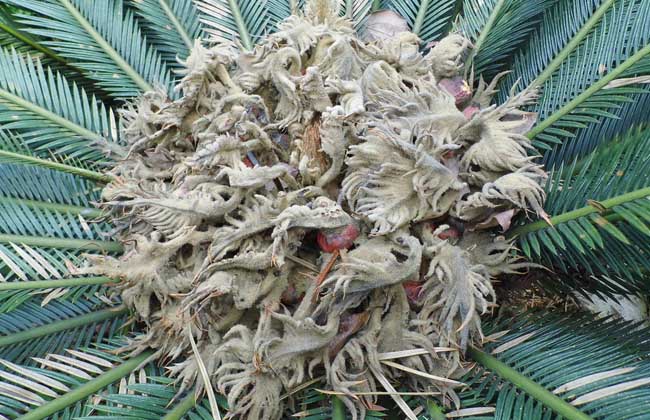
The sago palm is also known by the names phoenix-tail banana, fire-avoiding banana, phoenix-tail pine, and others. It is an evergreen palm-like woody plant in the family Cycadaceae, genus Cycas. Because its trunk is as hard as iron and it likes fertilizer containing iron, it got the name "iron tree" (sago palm). In addition, because its branches and leaves resemble a phoenix tail, and its trunk resembles the trunk of a banana or pine, it is also called phoenix tail. It grows slowly and can live for more than 200 years, and each year it can send out a new whorl of leaves from the top of the stem.
The sago palm stem is 1 to 8 m tall. The stem is cylindrical and unbranched. After the growing point is damaged, clustered buds can sprout below the wound, forming a multi-headed shape. The persistent leaf bases and leaf scars on the stem are scale-like. The leaves emerge from the top of the stem, are once-pinnate compound leaves, 0.5 to 2.0 m long, thickly leathery and hard, with linear pinnae. The leaflets are linear, rolled inward when young, later spreading obliquely upward and slightly forming a “V” shape, with margins revolute downward and acute tips; the leaf underside is densely covered with rusty-colored hairs, and the basal leaflets become spine-like.
The sago palm is dioecious and flowers from June to August. The male cone is cylindrical, and the microsporophylls are woody, densely covered with yellowish-brown hairs, with many pollen sacs borne on the back. The female cone is flatly spherical, and the megasporophylls are broadly ovate, with the upper part pinnately divided and 2 to 4 naked orthotropous ovules borne on both sides below. The seeds mature in December; the seeds are large, ovate and slightly flattened, reddish-brown or orange-red when ripe.
Flowering in the sago palm is often irregular and not easy to see, hence the saying “a thousand-year sago palm blooms,” meaning it flowers relatively rarely. Generally, old trees aged 15 to 20 years can flower, and if cultivated well, they may also flower once every few years. In the south, when the growing environment is good, flowering can be seen every year, and the flowering period can last as long as 1 month. Generally, those flowering from June to August are male flowers, and those flowering from October to November are female flowers. It is dioecious, and the flowering periods are not synchronized, so it is not easy to obtain seeds in the north.
The sago palm likes light and is somewhat tolerant of partial shade; it likes warmth and is not very cold-tolerant; it likes fertile, moist, and slightly acidic soil, but it can also tolerate drought. It grows slowly, and plants more than 10 years old can flower. There are 17 species worldwide, distributed in tropical and subtropical regions such as eastern Asia, southeastern Asia, Oceania, and Madagascar. China has 8 species, produced in Taiwan, China, Guangdong, Hainan, Fujian, Guangxi, Yunnan, Sichuan, and other provinces and regions.
Plants of the genus Cycas have a beautiful tree form, vigorous and simple, with large and beautiful leaves that are deep green and borne at the top all year round, giving a unique ornamental effect. For example, when arranged in courtyards and large venues, they can achieve a solemn and dignified effect; when placed at the center of a flower bed, they give a sense of tranquility; when used as a foil for ancient buildings, they show age and vigor; when planted with modern architecture, their year-round deep green is pleasing and refreshing; and when planted beside temples, they have the wonderful use of warding off evil.