Does the cedar have fruit? Let us walk you through the cedar's fruiting situation
The cedar is an evergreen tree of the genus Cedrus in the pine family (Pinaceae). Together with the golden larch, the Norfolk Island pine, the giant sequoia and the Japanese umbrella pine, it is known as one of the "five great garden trees of the world." China began introducing it in 1920, and it is now widely cultivated in the major cities of the Yangtze River basin. Among these, Nanjing is China's largest cedar-producing area, with output accounting for about 60% of the national total. Let us take a look below at whether the cedar has fruit!
Does the cedar have fruit?
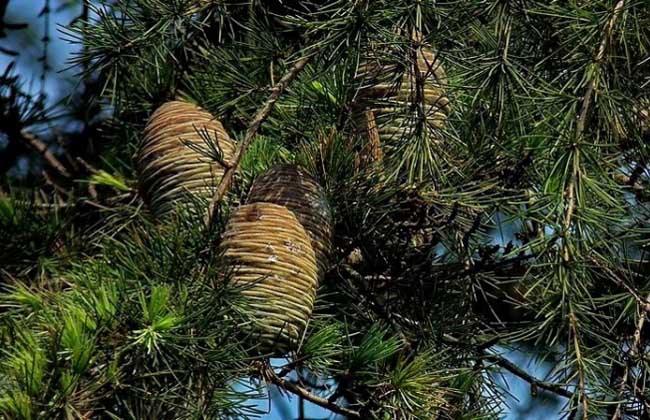
The cedar does have fruit. Before the cedar cone ripens it is pale green with a slight white bloom; when ripe it is reddish-brown, ovate or broadly elliptical, 7 to 12 cm long and 5 to 9 cm in diameter, with a rounded blunt apex and a short stalk. The middle seed scales are fan-shaped and inversely triangular, 2.5 to 4 cm long and 4 to 6 cm wide, broadly rounded above, with the margin curved inward, wedge-shaped in the middle and ear-shaped below, claw-like at the base; the back of the scale is densely covered with short down, and the bract scales are small and short. The seeds are nearly triangular, and the seed wing is broad and large, longer than the seed, measuring 2.2 to 3.7 cm together with the seed.
Conditions for the cedar to bear fruit
For a cedar to bear fruit there are generally 3 conditions: first, the tree age is over 30 years; second, male and female plants grow side by side; third, certain climatic conditions such as temperature and humidity must be present. However, meeting these 3 conditions does not necessarily mean a cedar will produce cones, because the vast majority of cedars are dioecious, with male flowers opening about ten days earlier than female flowers, so the two flowers "never meet," making the probability of natural pollination extremely low. In the areas north of the Yangtze River in China, flowering and fruiting are extremely rare.
The cedar's growing environment
The cedar grows vigorously in a mild, cool and moist climate on deep, well-drained acidic soil. It requires a mild, cool and moist climate and deep, well-drained soil, and it likes ample sunlight, though it is also quietly tolerant of shade; it grows in acidic and slightly alkaline soils at elevations of 1300 to 3300 m. It occurs in the northern warm temperate deciduous broad-leaved forest region, the southern warm-temperate deciduous broad-leaved forest region, the mid-subtropical evergreen and deciduous broad-leaved forest region, and the evergreen broad-leaved mixed forest region. It prefers a warm temperate to mid-subtropical climate with an annual precipitation of 600 to 1000 ml, and grows best in the middle and lower reaches of the Yangtze River in China.