What information is there about cedar? A comprehensive guide to cedar in one article
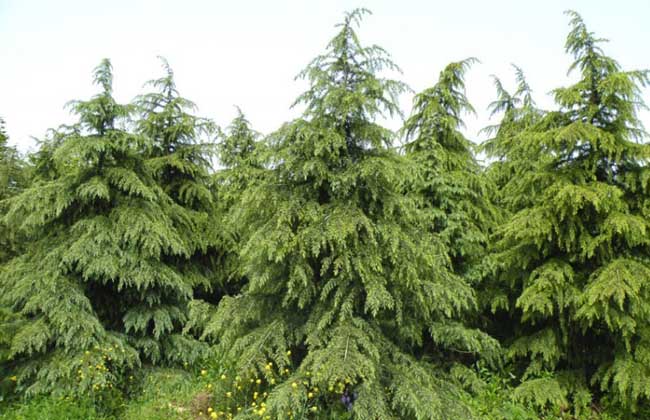
Cedar is an evergreen tree of the genus Cedrus in the pine family (Pinaceae), also known as fragrant cypress, pagoda pine, foreign cypress, Himalayan cedar, etc. It originates from western Asia, the western Himalayas and Africa, and the Mediterranean coast. In China there is only one species, the Himalayan cedar (Cedrus deodara), distributed in southern Tibet and in India and Afghanistan, and it has been widely cultivated as a garden tree in Beijing, Lushun, Dalian, Qingdao, Xuzhou, Shanghai, Nanjing, Hangzhou, Nanping, Lushan, Wuhan, Changsha, Kunming and other places.
Cedar grows to about 30 m tall, with a diameter at breast height of up to 3 m. The bark is dark gray, splitting into irregular scaly plates. The branches spread out flat, slightly slanting or slightly drooping, and the small branchlets often droop; first-year long shoots are pale grayish yellow, while second- and third-year branches are gray, pale brownish gray or dark gray. The leaves spread out radially on long shoots, while the leaves on short shoots are clustered; the leaves are needle-shaped, hard, and pale green or dark green. The male cones are long ovoid or elliptic-ovoid, and the female cones are ovoid. The cones are pale green with a slight white bloom before maturity, and reddish brown when ripe, ovoid or broadly elliptic. The seeds are nearly triangular, and the seed wing is broad and large, longer than the seed.
Cedar grows vigorously in mild, cool and moist climates on acidic soil that is deep and well drained; it requires a mild, cool and moist climate and deep, well-drained soil, prefers ample sunlight, and also tolerates shade. It grows in acidic and slightly alkaline soils at elevations of 1300-3300 m, in the northern warm temperate deciduous broad-leaved forest region, the southern warm zone deciduous broad-leaved forest region, the mid-subtropical evergreen and deciduous broad-leaved forest region, and the evergreen broad-leaved mixed forest region. It prefers a warm temperate to mid-subtropical climate with an annual precipitation of 600-1000 ml, and grows best in the middle and lower reaches of the Yangtze River in China.
Cedar is one of the world's famous ornamental garden tree species, with a strong ability to resist dust, reduce noise and kill bacteria, and it is also suitable as a greening tree species for industrial and mining enterprises. The tree body is tall and the tree shape is graceful, making it most suitable for solitary planting in the center of a lawn, in the center of a building's front courtyard, in the center of a square, or on both sides of major buildings and at garden gate entrances. The large branches on the lower part of the trunk spread out flat from near the ground and do not wither for many years, forming a luxuriant and majestic crown. In addition, planting it in rows on both sides of a garden path to form a walkway is also very spectacular.
The medicinal use of cedar has a very long history, dating back as far as biblical times. The ancient Egyptians added cedar oil to cosmetics for beauty purposes and also used it as an insect repellent. Native Americans also regarded cedar as a sacred item used in medicinal and purification rituals. Aromatic oil can also be obtained by distillation, and the various benefits of cedar essential oil make it an excellent choice for treating dandruff and rashes, with medical effects such as anti-seborrheic, antiseptic, bactericidal, tonic, astringent, diuretic, emmenagogue, expectorant, insecticidal and sedative properties.