A Detailed Guide to Cedar Planting Techniques and Management Methods
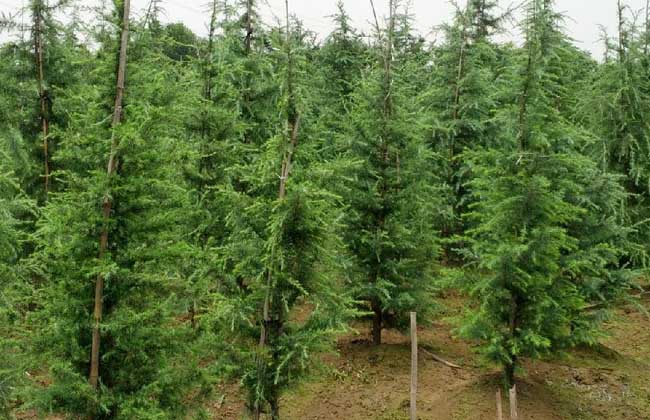
Cedar is an evergreen tree of the genus Cedrus in the pine family (Pinaceae), also known as incense cedar, pagoda pine, and foreign cypress. It is one of the world's famous ornamental garden trees, highly favored for its graceful tree form, majestic bearing, and upright trunk. It has strong dust-blocking, noise-reducing, and sterilizing abilities, and is widely used in landscaping. Let's take a look at cedar planting techniques below!
Cedar Growing Environment
Cedar grows vigorously in a mild, cool, and moist climate on deep, well-drained acidic soil. It requires a mild, cool, and moist climate and deep, well-drained soil. It likes abundant sunlight and is also quietly tolerant of shade, growing in acidic to slightly alkaline soil at altitudes of 1300-3300 m. It is found in the northern warm temperate deciduous broad-leaved forest region, the southern warm zone deciduous broad-leaved forest region, the mid-subtropical evergreen and deciduous broad-leaved forest region, and the evergreen broad-leaved mixed forest region. It prefers a warm temperate to mid-subtropical climate with annual rainfall of 600-1000 ml, and grows best in the middle and lower reaches of the Yangtze River in China.
Cedar Propagation Techniques
1. Sowing: Cedar sowing can be carried out in mid-to-late March, with a sowing rate of 75 kg/hectare. Sowing can also be done earlier to increase seedling disease resistance. Choose sandy loam with good drainage and aeration as the seedbed. Before sowing, soak the seeds in cold water for 1-2 days, then dry them and sow. They begin to germinate after 3-5 days, lasting about 1 month, with a germination rate of 90%. During the seedling stage, attention must be paid to shading and to preventing and controlling damping-off disease and cutworms. One-year-old seedlings can reach 30-40 cm in height and can be transplanted the following spring.
2. Cuttage: Cedar cuttage propagation can be carried out in both spring and summer. In spring, it is best before March 20; in summer, late July is preferable. In spring, cut one-year-old robust branches from young mother trees and treat them with rooting powder or 500 mg/L naphthaleneacetic acid to promote rooting. Then insert them into well-aerated sandy loam, water thoroughly, and set up a double-layer shade for shading. In summer, it is best to select semi-lignified branches of the current year as cuttings.
3. Transplanting: Propagated cedar seedlings can be transplanted after remaining in the bed for 1-2 years. Transplanting is done in February-March, and the plants need to be balled and supported with stakes. The initial transplanting spacing is about 50 cm, and the second transplanting spacing should be expanded to 1-2 m. During the growing period, 2-3 topdressings should be applied. Seedlings are susceptible to pests and diseases, especially damping-off disease and cutworms, which are the most severe. Other pests include white grubs, bagworms, pine tussock moths, pine shoot borers, red wax scales, and termites, which must be controlled promptly.
Cedar Planting Techniques
1. Pot selection: For cedar, purple clay pottery pots are preferred, but glazed pottery pots can also be used. For large bonsai, deep round pots can be used, as well as various carved stone pots, but the roots must be secured with wire. For medium bonsai, crabapple-shaped or manger-shaped pots are suitable. For small seedlings planted together in a forest style, shallow carved stone pots such as white alum stone or marble can be used.
2. Soil: For cedar, loose, well-drained, slightly acidic sandy loam can be used. For potting, aged garden soil or leaf mold mixed with sand is commonly used.
3. Planting: For cedar, March-April in spring is preferable, and it can also be done after autumn. Cedar seedlings dug from the ground must retain native soil to aid survival. Also prune dead roots sparsely, spread out the fibrous roots, cover with fine soil, gently shake the pot, and firm with a bamboo stick so that the potting soil and root system are in close contact. The planting position should preferably have the main trunk leaning to one side.
4. Shaping: The shaping and styling of cedar bonsai is mainly by wiring and bending, supplemented by pruning. Wiring and bending is best in winter and spring, mostly using palm fiber. Cedar has an upright trunk and horizontally spreading side branches, so the side branches are often bent into an S shape, while the main trunk is generally not bent, naturally growing upward into a large tree form, with an extremely simple and beautiful posture. Alternatively, 5-7 seedlings of the current year can be taken, arranged at varying heights, and planted together in a forest style, with graceful foliage and a distinctive charm.
5. Tree form: The cedar tree body is tall and upright, with side branches spreading horizontally and drooping. When making bonsai, its natural form must be used, and tree forms such as straight trunk, double trunk, slanting trunk, and forest style are good. Through wiring and pruning, the branches and leaves can be made into layered or cloud-like forms. After years of care, it can become an excellent bonsai combining strength and softness with an elegant posture.
Cedar Planting Precautions
1. Cedar is a shallow-rooted plant. When planting, the soil pit must not be dug too deep. Deep planting violates the normal growth pattern of cedar. The root system grows best and has the highest activity only near the surface layer of the soil.
2. After transplanting, if cedar leaves turn yellow and do not grow vigorously, it is generally due to iron deficiency. Foliar fertilization is generally used. In areas where pine needles are severely yellowed due to iron deficiency, iron fertilizer must be applied in combination with soil application. Commonly used iron fertilizers include ferrous sulfate, ferrous ammonium sulfate, ferrous ammonium sulfate, and synthetic chelated iron such as ferric citrate, EDTA-Fe, and EDDHA-Fe. In most cases, soil application is not very effective. Iron fertilizer can be mixed with organic fertilizer and applied in furrows or holes.
3. Cedar is afraid of water but not drought. Even a single instance of waterlogging can cause lifelong damage to cedar, after which the growth rate is greatly reduced, the color becomes yellowish, and in severe cases the pine needles partially fall off and the cedar may even die quickly. For nursery planting, deep ditches must be dug in the field to ensure that no water accumulates or ponds in the field during the rainy season. For engineering planting of cedar, the cedar must be planted in a position relatively higher than the road surface and the green island surface, and the surrounding area must be guaranteed to be free of water accumulation.
4. In early spring, the aboveground temperature is high while the underground temperature is low. The aboveground part begins to grow first, while the underground part, affected by temperature, delays absorbing water and nutrients from the soil, resulting in nutrient deficiency. The plant, through its own signal transduction, regulates the internal environment and decomposes chlorophyll in the leaves to supply nutrients to the growth center. In other words, at this time the nutrients for plant growth come from the leaves rather than the roots. The leaves lose chlorophyll but retain xanthophyll and carotene, thus appearing yellow. If the external environment does not improve, shoot dieback may occur.